



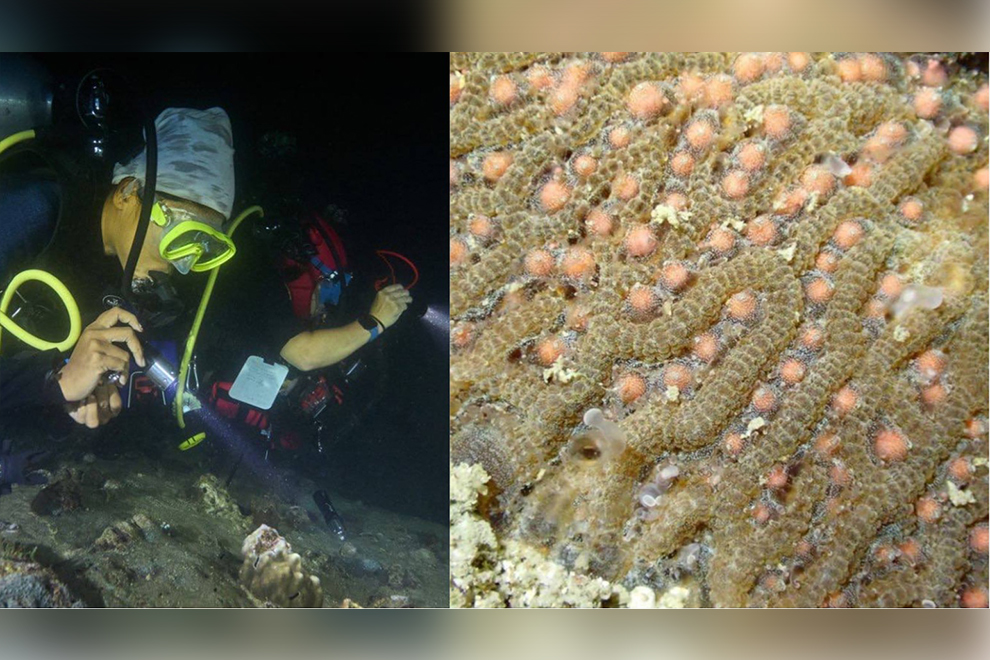
Government researchers and their NGO partners have discovered a coral spawning event for the first time on Song Saa Island and for the third time in the Koh Rong Archipelago, providing hope for long-term coral conservation and confirming healthy Cambodian seas.
According to a joint press release from the Ministry of Agriculture, Forestry and Fisheries, the Ministry of Environment, Fauna & Flora, the Marine Resource Protection Organization and the Song Saa Foundation, the event was discovered during a March 7-9 survey. The work was carried out in cooperation with the Bubbles Up Dive Centre and Khmer Dive Group.
“Over the course of the survey, the team conducted night dives and detailed reef monitoring to record spawning activities, assess coral health and document environmental conditions. These observations provide vital scientific data that help researchers understand coral reproduction cycles, track reef recovery and identify factors that contribute to effective coral reef management,” explained a March 16 release.
It said the information gathered also supports evidence-based strategies for long-term coral reef conservation, benefiting both biodiversity and coastal communities that rely on healthy reefs for food and livelihoods.
“The successful observation of coral spawning highlights the effectiveness of ongoing conservation and management efforts in Cambodia’s marine protected areas. Continued collaboration between government institutions, conservation organizations, and local communities is essential to conserve biodiversity and to sustain these ecosystem services for all generations,” said environment minister Eang Sophalleth.
Agriculture minister Dith Tina stated that the results shown over three consecutive years bear witness to the recovering health of Cambodia’s seas and stand as proof of success in implementing fishery protection measures.
“We have moved beyond policies on paper to achieve tangible results in the water. However, we must not rest on today’s achievements; we remain steadfast in our commitment to sustain and build upon this progress for the years to come,” he added.
The research team will use the data for further study to contribute to strengthening marine resource management and ensuring that marine biodiversity in Cambodia continues to increase.
Jun Cheng, senior marine programme manager at the Fauna & Flora-Cambodia Programme, stated that witnessing coral spawning for the third consecutive year is an encouraging sign that Cambodia’s coral reefs still hold remarkable resilience.
“These findings reinforce the importance of continued scientific monitoring and strong collaboration amongst the government, NGOs and local partners to ensure the long-term protection of these critical marine ecosystems,” she said.
