



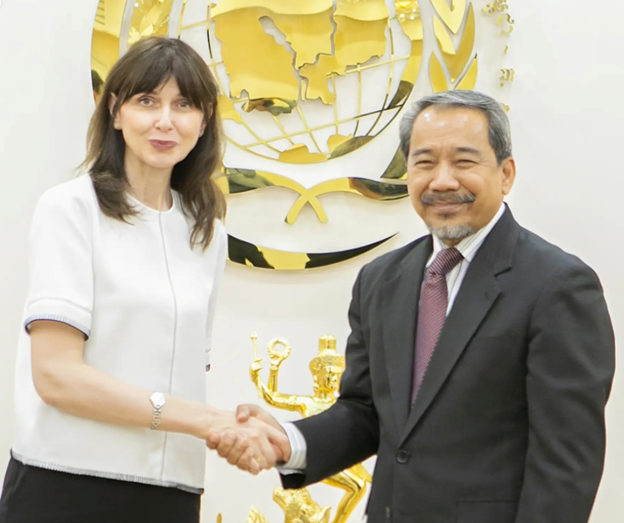
The Cambodian Human Rights Committee (CHRC) has continued to raise the issue of Thai soldiers stealing Cambodian citizens’ property and committing other abuses with the UN representative to Cambodia, even as the Cambodia-Thailand border issue remains deadlocked.
During a March 12 meeting with Vladanka Andreeva, UN Resident Coordinator in Cambodia, CHRC president Keo Remy explained the situation along the border, which has seen severe impacts and violations of international law, particularly human rights and international humanitarian laws.
He stated that since the clashes erupted last year, Thai troops have stolen property from Cambodian citizens, discriminated against them and used violence against Cambodian migrant workers. They have also committed sexual violence against women, he added.
He recalled human rights violations involving the use of high-decibel noises and other disturbances that have caused psychological trauma to people living along the border.
“Thailand launched indiscriminate attacks using heavy weaponry, cluster munitions, toxic gas and fighter jets such as the F-16, Gripen and T-50, causing damage to both private and public property, including the Preah Vihear Temple, a World Heritage site,” he said.
“Thailand is attempting to create a new reality or ‘fait accompli’ on the ground, by deploying razor wire barricades, placing shipping containers, bulldozing people’s homes and building new infrastructure in the encroached areas, leaving approximately 40,000 citizens unable to safely return to their homes,” he added.
Remy emphasised that Cambodia maintains a stance of maximum restraint and seeks to resolve the conflict peacefully in accordance with international law and existing legal mechanisms, while continuing to strive to protect the rights, safety and dignity of the affected citizens.
Andreeva expressed concern over the border situation, which has negatively impacted migrant workers and border residents. She noted that conflicts inevitably cause severe consequences for people’s lives and social development, stressing that peace must be maintained and international law must be respected, according to the CHRC.
The Cambodia-Thailand border issue has seen no recent positive developments, at least for the Cambodian side. The Thai side has continued to delay key meetings, notably the Joint Boundary Commission (JBC) for land boundaries, while their soldiers continue to occupy several locations within Cambodian territory and construct permanent structures, explained the CHRC.
Government spokesperson Pen Bona reiterated today, March 13, that Cambodia does not recognise any alteration of borders through the use of force.
Aside from the border issue, the two sides also discussed the Kingdom’s domestic human rights situation.
Andreeva highlighted the importance of civic space and the role of civil society organisations in promoting human rights and social development.
Remy claimed that Cambodia consistently pays close attention to and believes in the importance of sincere cooperation with civil society organisations, and has opened up civic space to allow for broad participation in the promotion of human rights.
