



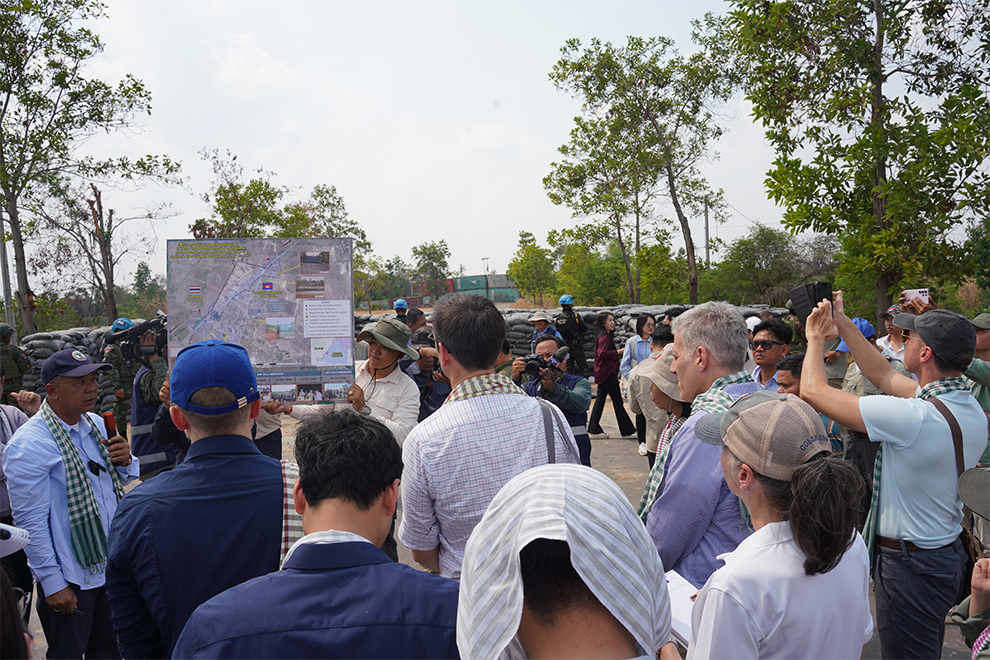
The Philippines, as current ASEAN chair, has begun consultations aimed at safeguarding the fragile ceasefire along the Cambodia–Thailand border. On February 23, foreign diplomats visited several illegally occupied parts of Banteay Meanchey province, where they witnessed the scale of displacement and destruction affecting thousands of Cambodian families.
Philippines ambassador to Cambodia Flerida Ann Camille P. Mayo said Manila has initiated talks with both countries to strengthen the role of the ASEAN Observer Team (AOT) in maintaining the ceasefire and creating space for bilateral mechanisms to secure what she described as “durable peace”.
“We hope for a peaceful resolution of the issues,” she told more than 20 diplomats and international NGOs during a field visit to O’Chrov and Thmar Puok districts.
“The chair will make good offices available upon request from either side,” she added.
Her remarks came after a delegation led by acting Minister of Foreign Affairs and International Cooperation Eat Sophea toured in Chouk Chey, Prey Chan and Boeung Trakoun villages, where the Thai military has occupied Cambodian territory since the December 7-27 clashes of last year.
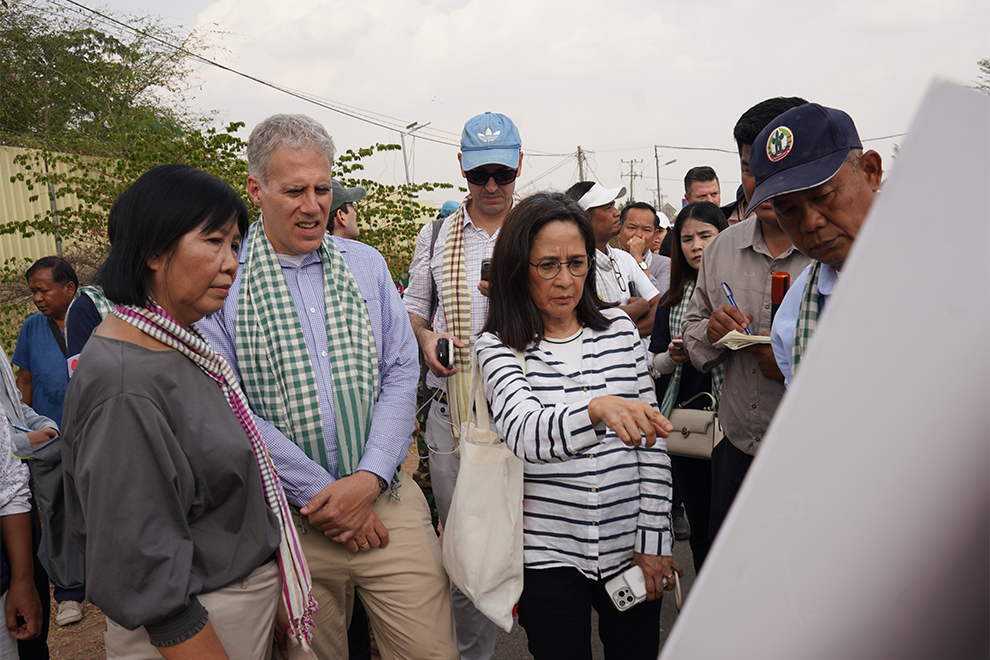
As she stood near a row of shipping containers, placed by the Thais to block Road 58 in Chouk Chey village, Sophea pointed to maps showing what she described as encroachment beyond agreed boundary lines.
“Before the fighting, people were able to live in their villages. Now, Thailand has occupied land, even beyond the borderline,” she said, adding that Cambodia bases its claims on the 1904 and 1907 conventions.
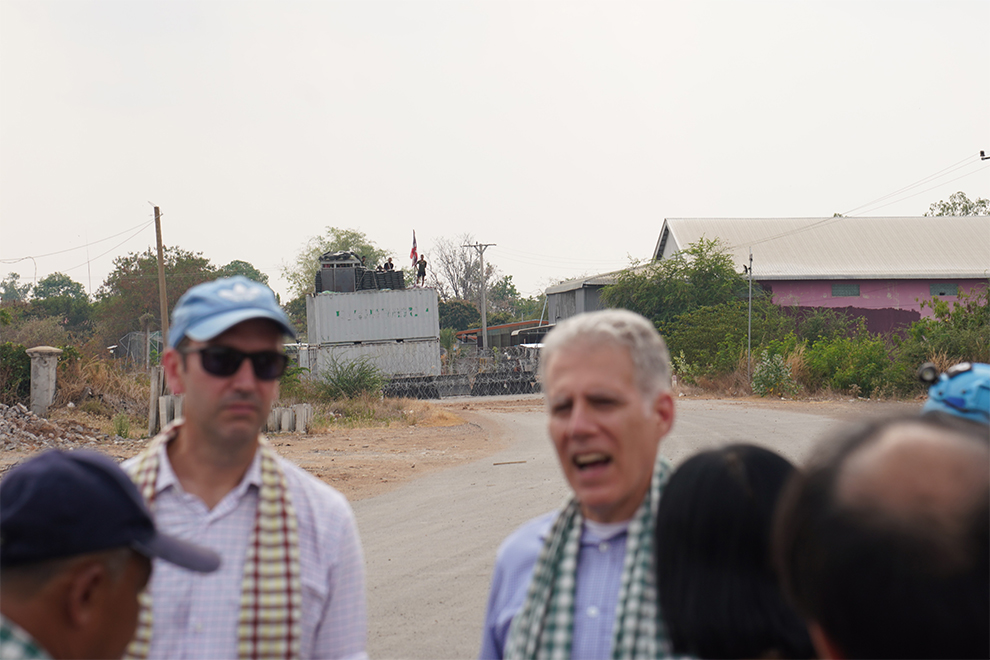
According to provincial governor Oum Reatrey, the Thai military currently controls about 763 hectares in the affected areas.
He reported that 16 containers in four locations block 137 hectares in Chouk Chey village, while 63 containers in three locations have cut off access to 42 hectares in Prey Chan village.
“In the Boeung Trakoun area, 26 containers have been placed across 13 locations, affecting four villages and covering 584 hectares,” he told the diplomats.
More than 3,000 families have been displaced as a result of the blockade, Reatrey said.
“In Boeung Trakoun alone, 1,557 families from four villages have been forced to relocate. Many are now sheltering at Kandoul pagoda after so many homes and infrastructure were destroyed,” he explained.
Reatrey stated the situation in Boeung Trakoun is particularly sensitive, alleging that booby-trapped hand grenades were laid near the containers.
“The Philippine Armed Forces Chief of Staff, General Romeo Brawner Jr., who recently visited the area, also witnessed evidence of booby traps, according to provincial authorities,” he told the diplomats, who were standing very close to the Thai soldiers stationed atop the shipping container barricades.
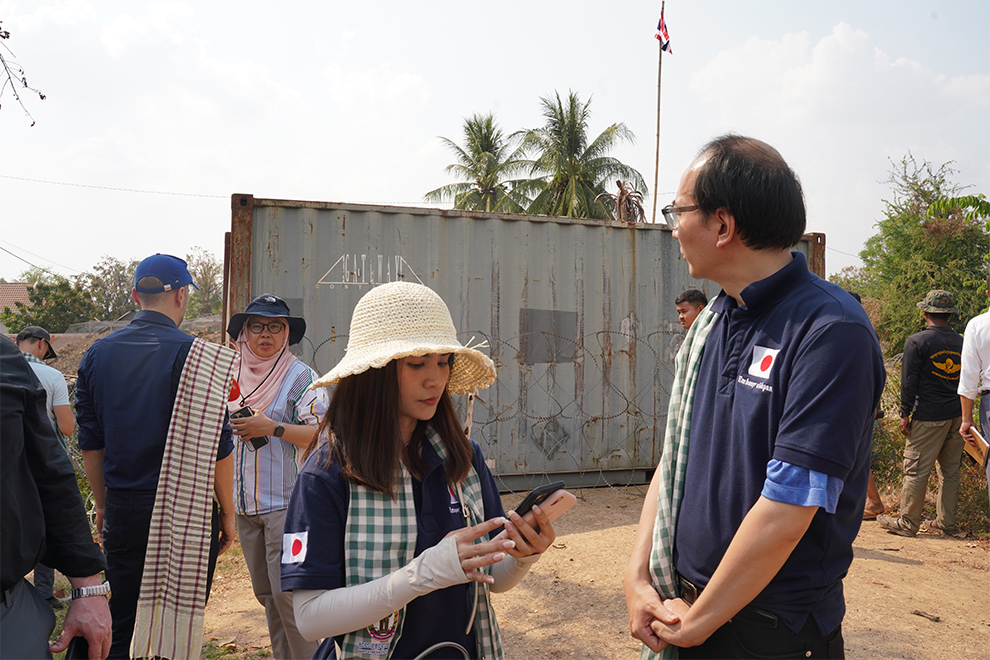
Japanese embassy councillor Matsuda Junsaku, who joined the visit, said the field inspection revealed continuing hardship among residents.
“I discovered that people are still suffering,” he said.
“The government of Cambodia is making a lot of efforts for people in this place, arranging food and sanitary systems,” he noted.
Japan has already provided humanitarian assistance and is supporting the AOT, Matsuda added, noting that Tokyo would continue discussions with ASEAN members, including the Philippines, on how best to strengthen the observer mechanism.
“We believe that the AOT has a crucial role for the resolution of the situation,” he said, noting that Japan would continue speaking with both Cambodia and Thailand to help de-escalate tensions.
British ambassador Dominic Williams also joined the tour. He described the visit as “sobering”.
“We visited a sanctuary for refugees and their homes in Prey Chan, Chouk Chey and Boeung Trakoun villages. I feel sympathy for the ordinary people who were affected,” he said, via social media.
“The UK will continue to call for a peaceful resolution of the border. This is the only sustainable way for communities in both countries to rebuild their homes and livelihoods,” he added.
The Cambodian foreign ministry has formally protested Thai military activities in Banteay Meanchey province, citing the demolition of civilian infrastructure and administrative buildings in Boeung Trakoun, located between boundary markers 33 and 36.
In Chouk Chey village, between markers 46 and 47, the ministry said, a new ditch has been dug, a road constructed and a pond filled in, actions it argues have altered the geographical terrain in violation of previous agreements.
“These actions constitute a clear attempt to legitimise the unlawful occupation of Cambodian territory,” the ministry said in a statement, referencing the UN Charter, the ASEAN Charter and agreements reached during special border meetings in October and December 2025.
The December 27 ceasefire was intended to halt hostilities and initiate de-escalation measures.
However, Cambodian officials maintain that the alleged land seizure and fortification took place after the truce came into effect.
As ASEAN Chair, the Philippines’ decision to activate consultations and enhance the AOT’s mandate signals a regional effort to prevent renewed confrontation.
For families displaced from Chouk Chey, Prey Chan and Boeung Trakoun, however, the immediate priority remains simple: the chance to return home in safety.
