



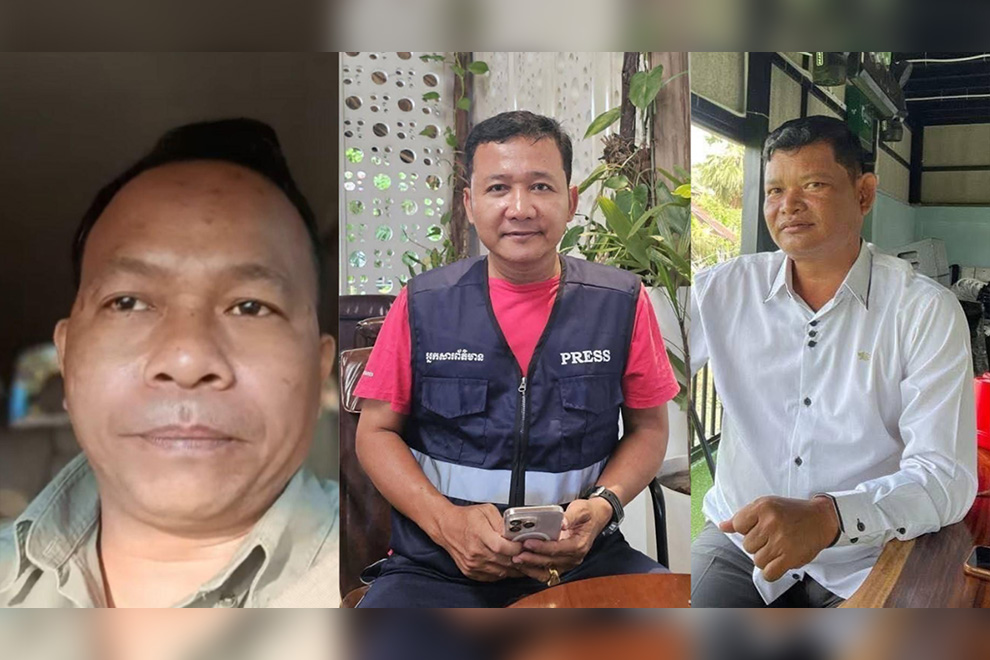
Three journalists were recently detained in connection with their reporting on online scams. The Ministry of Information has announced it is prepared to provide them with legal aid, while calling for cooperation between authorities and the media, and urging all journalists to adhere to professional ethics.
The three were detained in February — one in Banteay Meanchey and two in Takeo province — for their reporting on online scam operations, after authorities reportedly suggested they had levelled false accusations and incited unrest.
Banteay Meanchey
Hem Vanna, publisher of HVNN TV Online, was charged by the Banteay Meanchey Provincial Court on February 4. He faces charges of “incitement to cause serious social unrest” under Article 495 and “listening to or recording private conversations” under Article 301 of the Criminal Code and was sent to pre-trial detention at the provincial prison.
According to rights group ADHOC, his arrest occurred one day after he reported on reported violence against foreigners inside a locked building suspected of being a forced labour site for online scams.
Takeo
In Takeo, two journalists — Prum Sophai, Deputy Editor-in-Chief of Koh Santepheap, and Seang Bunsong, publisher of Sunday News — were reportedly detained by police on February 12. Their arrest followed reports they published alleging that online scam operations still exist in Takeo province. They also accused the Bati district governor and the district police chief of taking a $5,000 bribe from the scam group. Authorities have dismissed these claims as false.
As of today February 13, there have been no further updates on the status of their cases.
Vei Samnang, governor of Takeo Province, told The Post that the two journalists falsely claimed scam groups were still operating in the province, even though such groups were cleared out since last year.
He clarified that more than a dozen buildings belonging to the Sopheakmit Residence Co., Ltd. in Bati district, which previously housed scam operations, are currently being transformed into temporary holding centres for individuals involved in scam offenses who are awaiting legal procedures or deportation.
“They broadcast that there are online scam locations in Takeo being hidden by authorities, specifically accusing the Bati district police chief and governor of taking a $5,000 bribe,” Samnang said.
“As soon as crimes were discovered in that area, the government issued instructions, and we shut down the site on July 22, 2025. The Head of the Royal Government decided to keep the buildings as a facility to house offenders slated for deportation,” he added.
The governor explained that cracking down on online crimes involves many foreign nationals, some with documentation and others without. Consequently, authorities must work with the respective embassies, which can be time-consuming. Due to these delays and the large number of people involved, the government is creating transit housing for those transferred from other provinces awaiting trial or deportation.
He added that the buildings are not being used to run scam operations as alleged; authorities are currently installing security bars to prevent those held there from committing further offenses or harming themselves.
Ministry of Information Response
Tep Asnarith, information ministry spokesperson, stated today, February 13, that the ministry is closely monitoring both cases and is cooperating with authorities to gather more information. He noted that the cases require a thorough review of the facts and the legal principles involved.
“The ministry stands ready to provide legal support. We can review requests for legal assistance regarding these cases, including support during court proceedings,” he said.
He explained that upon receiving such a request, the ministry will evaluate whether the journalists operated within the framework of the law and adhered to the Code of Ethics and the Charter of Journalism Professionalism.
Regarding the crackdown on online scams, Asnarith noted that the Royal Government, ministries and provincial administrations have been active in their efforts, which have been recognised by international partners. He emphasised the importance of media participation through reporting based on accurate, clear and reliable sources.
“I urge the relevant authorities to prioritise transparency and justice in accordance with the law, ensuring that all facts, legal points and research are included in the case files for a comprehensive review,” Asnarith added.
He also reminded journalists to strengthen their professional ethics and cooperate with law enforcement by sharing information they receive so that authorities can take appropriate action.
“This is to ensure the safety of journalists in the exercise of their profession and to contribute to the Royal Government’s fight against technological scams,” he concluded.
