



As part of its ongoing efforts to reduce Cambodia’s reliance on imported goods, Mong Reththy Group has completed construction of what it hopes will become a multi-million-dollar egg-production facility, aimed at supplying the Kingom’s domestic market.
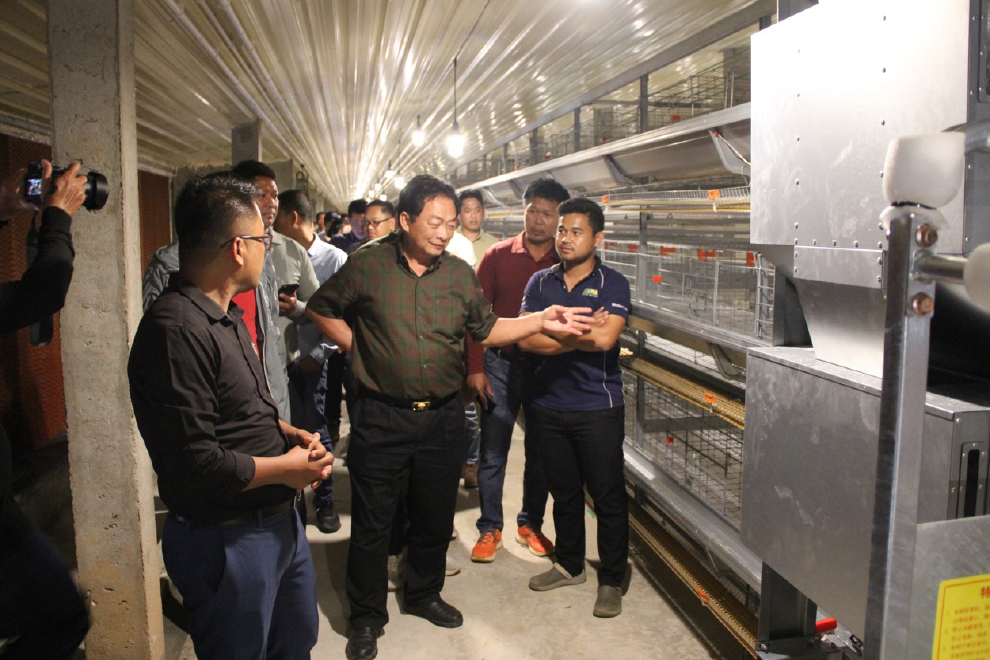
The newly built chicken farm, located within the company’s agricultural and agro-industrial zone, is equipped with the latest technology. The facility is ready to begin operations, pending the introduction of laying hens.
Mong Reththy, chairman and CEO of Mong Reththy Group, led a delegation of around 55 entrepreneurs on a visit to the company’s development zone on February 6, during which they toured the newly constructed farm.
According to Reththy, construction of the first farm alone required an investment of more than $300,000, excluding other associated costs. He explained that if the pilot phase proves successful, the company plans to expand investment by several million dollars, eventually producing millions of eggs per annum for the local market and competing with imported eggs.
“If this trial phase is successful, we will increase investment by about five times to reach profitability,” he said.
“This project is initially focused on meeting domestic demand,” he added.
During the visit, Ly Lavill, chairman of the Cambodian Livestock Association and managing director of M’s PIG ACMC Cambodia, a Mong Reththy Group subsidiary, noted that the project would begin on a small scale, with 20,000 hens, before expanding to 240,000.
At full capacity, he said the operation could produce around 240,000 eggs per day, equivalent to more than 71 million eggs per year, with projected annual revenue of $7–8 million over a five-year plan.
Lavill added that infrastructure investment for the expansion phase is estimated at $4.7–5 million. Once the farm reaches full capacity, it is expected to supply approximately 15% of Cambodia’s domestic egg market.
Reththy explained that the company’s priority during the initial five-year phase is to stabilise domestic supply at reasonable prices, noting strong competition from imported eggs, particularly from Vietnam.
“Our goal is to supply the local market and prevent prices from rising too high,” he said.
“The egg market in Cambodia is already highly competitive, as Vietnamese producers have lower production costs and account for nearly 90% of imports,” he continued.
When asked whether the project could eventually replace egg imports, Mong Reththy said the company would focus on domestic supply while accepting the realities of market competition.
“We are doing this to supply the local market,” he said.
“Competition is unavoidable, but there’s no need to be afraid. If you’re too afraid, you won’t dare do anything,” he added.
Lavill said the company is confident it can compete with imports due to its existing resources, including feed mills and production capacity, which help keep costs competitive with neighbouring countries.
In addition to egg production, Mong Reththy Group is planning a second project, focused on broiler chicken farming to meet rising domestic demand for poultry meat.
Lavill said the company aims to produce more than 20,000 broiler chickens per day, equivalent to over 7 million chickens per year, or approximately 16,400 tonnes of chicken meat, for distribution in the Cambodian market.
“This reflects our long-term vision for expanding our livestock business,” he said.
