



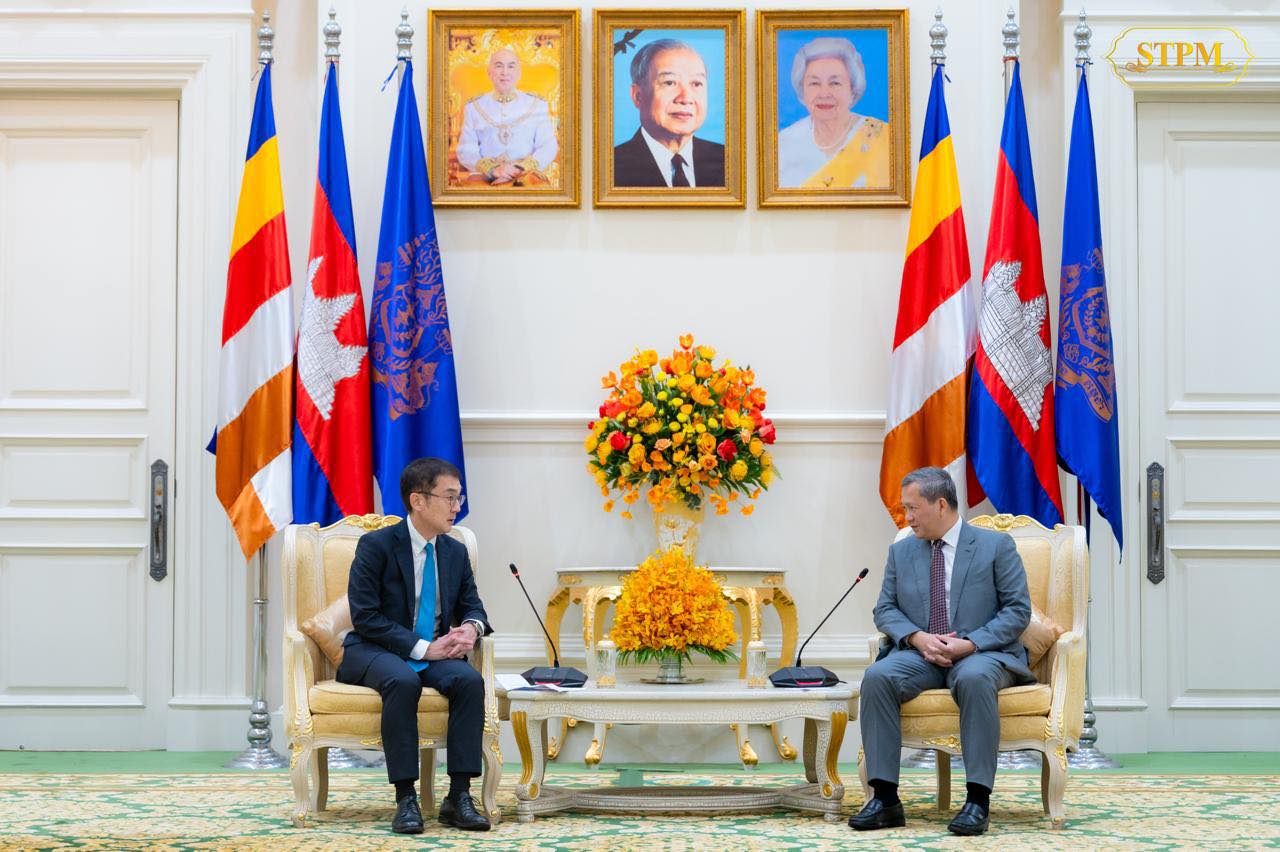
The President of the Economic Research Institute for ASEAN and East Asia (ERIA) has noted Cambodia’s potential to attract Japanese investors, explaining that several Japanese companies are reportedly seeking opportunities to relocate regional production bases to the Kingdom.
ERIA president Tetsuya Watanabe shared his observations with Prime Minister Hun Manet, during a February 9 meeting at the Peace palace.
Tetsuya noted that Cambodia is currently regarded as a promising destination for Japanese investors to establish businesses. This presents an opportunity for Cambodia to transform itself into a “new industrial production base”, which would not only contribute to Cambodia’s economic growth but also support regional and global industrial production supply chains.
He added that many Japanese investors are showing interest, while the Cambodian government regularly organises Cambodia–Japan business forums to provide Japanese investors with opportunities to raise challenges, concerns and other issues, with the aim of identifying solutions.
“At present, Japanese companies are seeking opportunities to relocate their production bases within the region, and they are increasingly looking at new investment opportunities in Cambodia,” he reiterated.
He briefed the prime minister of the findings of a recent study on the “Cambodia–Japan Green Special Economic Zone (C-J GSEZ)”.
Manet expressed his appreciation for the results of ERIA’s feasibility studies.
He noted that his government is focusing on the development of Green Special Economic Zones (Green SEZs), as well as Special Economic Zones tailored to specific countries and specific industries.
He encouraged the professor to continue strengthening engagement and holding more detailed discussions with relevant Cambodian ministries and institutions — especially the Council for the Development of Cambodia (CDC) — as well as with the private sectors of Japan and Cambodia, to assess the feasibility of selecting an appropriate model for establishing bilateral or trilateral special economic zone projects.
Sam Soknoeun, chairman of the Board of Directors of SAM SN Group, told The Post on February 9 that SEZs play a crucial role in attracting and encouraging multinational investors to Cambodia. He noted that if Cambodia were to have SEZs invested in by Japanese investors, this would significantly increase Japanese investment — just as Chinese SEZs have successfully attracted many Chinese.
He added that SEZs offer significant convenience to investors, as they are equipped with supporting infrastructure such as roads, energy supply and administrative offices under a “one-stop service” mechanism, which ensures efficiency, speed and alignment with the needs of factory owners and enterprises.
“All business operations of factories and enterprises within special economic zones are convenient for investors — from applying for imports of raw materials for production and processing to exporting finished goods to international markets. We are actively pushing for the establishment of a Japanese special economic zone in Cambodia,” he continued.
Currently, Japanese direct investment in Cambodia includes factories producing electronic and electrical components, agro-industrial equipment, food processing, hotels, tourism facilities, hospitals and shopping malls, among others, according to Soknoeun.
Japan is Cambodia’s fifth-largest trading partner. In 2025, total bilateral trade reached $ 2.53 billion, up 17.1 per cent on 2024. Exports to Japan amounted to $1.57 billion, up 11.9 per cent, while imports were valued at $956.23 million, up 27 per cent.
