



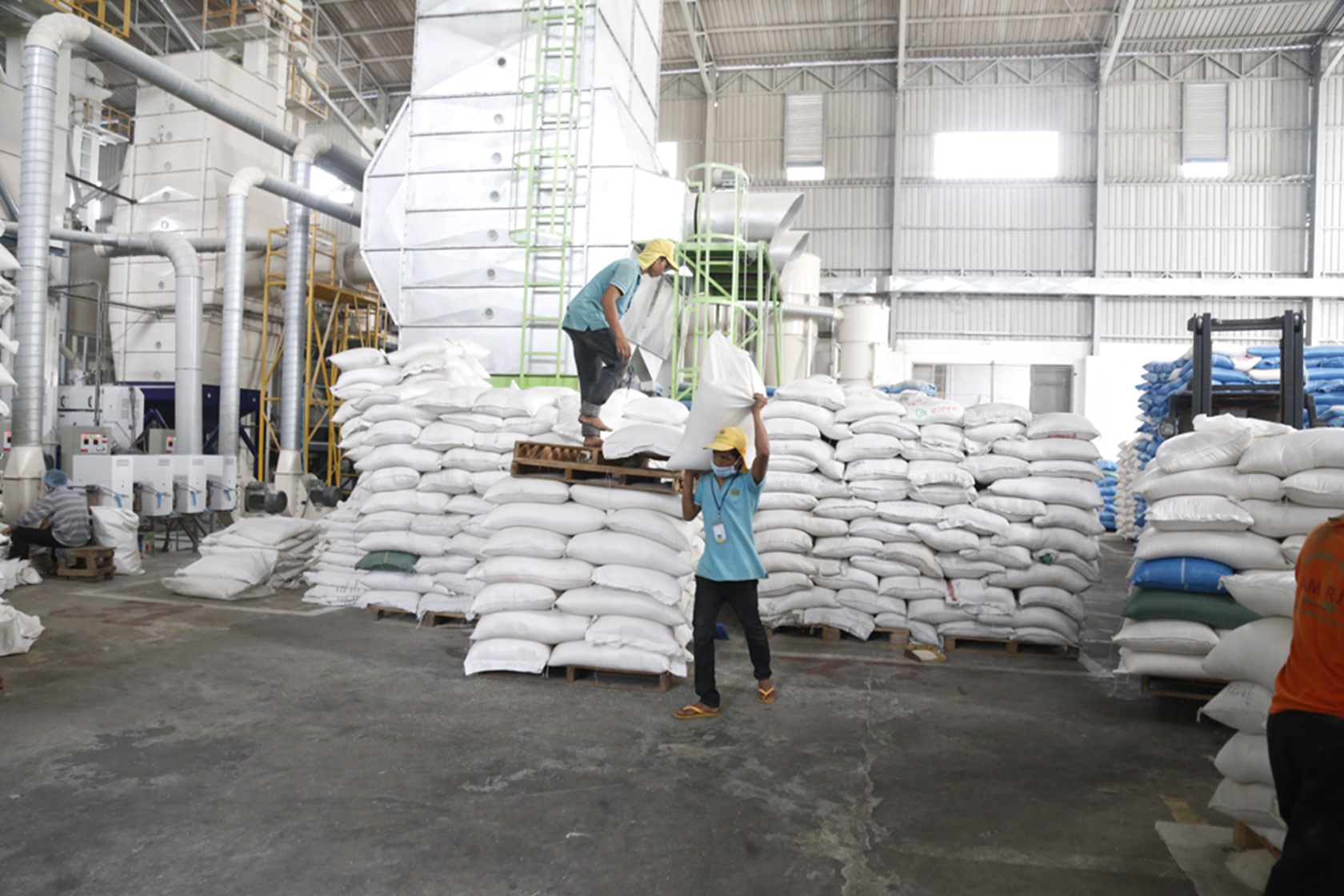
Economists believe that the new “Transit Transportation of Agricultural Products through Laos” agreement, signed between Cambodia and Laos, will play a significant role in boosting the Kingdom’s agricultural export potential to Chinese markets, therefore reducing the bilateral trade deficit with China.
Cambodia’s Ministry of Agriculture, Forestry and Fisheries and the Ministry of Agriculture and Environment of Laos inked the new agreement on January 25.
It opens up a new transportation corridor for Cambodian agricultural exports and is expected to significantly reduce transportation time and costs, expand market opportunities and enhance the competitiveness of Cambodia’s agricultural sector.
The agriculture ministry explained that the agreement covers the transportation of both fresh and dried crops, including bananas, durian, longan, rice, mangoes and cassava flour, with the option of adding more items in the future.
All transit operations will comply with sanitary and phytosanitary (SPS) regulations, relevant laws and legal instruments governing transit through Laos, as well as applicable international standards, including those of the International Plant Protection Convention (IPPC).
The ministry noted that, as a next step, technical officials from both ministries will continue consultations to determine specific border checkpoints, transportation routes, cargo transfer locations and procedures in order to implement the agreement as quickly and effectively as possible.
“This agreement is an example of the cooperation between the Cambodian and Lao agricultural sectors to promote regional connectivity. Both sides have expressed their willingness to expand cooperation in other areas in the future, particularly in mineral investment for agricultural fertiliser production and forest sector management,” it sad.
“This new mechanism will help enhance the competitiveness of Cambodian agricultural exports to the Chinese market by reducing obstacles in land transportation, saving time, lowering costs and especially expanding opportunities for agricultural trade in products such as rice, cassava, fruits, vegetables, and other processed agricultural goods,” said agriculture minister Dith Tina, who attended the signing.
Lor Vichet, vice-president of the Cambodia Chinese Commerce Association, described the agreement as a key contribution to increasing Cambodia’s agricultural export potential to international markets, especially in provinces bordering Laos and China. He added that the agreement will allow Cambodian agricultural products to gain a stronger presence in the Chinese market due to faster, more convenient, and lower-cost transportation.
“Overall, if Cambodia can export more finished products to the Chinese market, the trade deficit will gradually be reduced,” he told The Post on January 27.
“I encourage all farmers and exporters to work together to reduce the export of raw or unprocessed agricultural products and instead increase the export of more value-added finished products,” he added.
According to the General Department of Customs and Excise (GDCE), bilateral trade between Cambodia and China totalled $19.73 billion in 2025, an increase of 29.9 per cent over 2024. Exports to China were $1.69 billion, down 3.6 per cent, while imports were$18.04 billion, up 34.3 per cent.
Cambodia’s trade deficit stood at approximately $16.36 billion, up from $11.69 billion in 2024 and $9.31 billion in 2023.
