



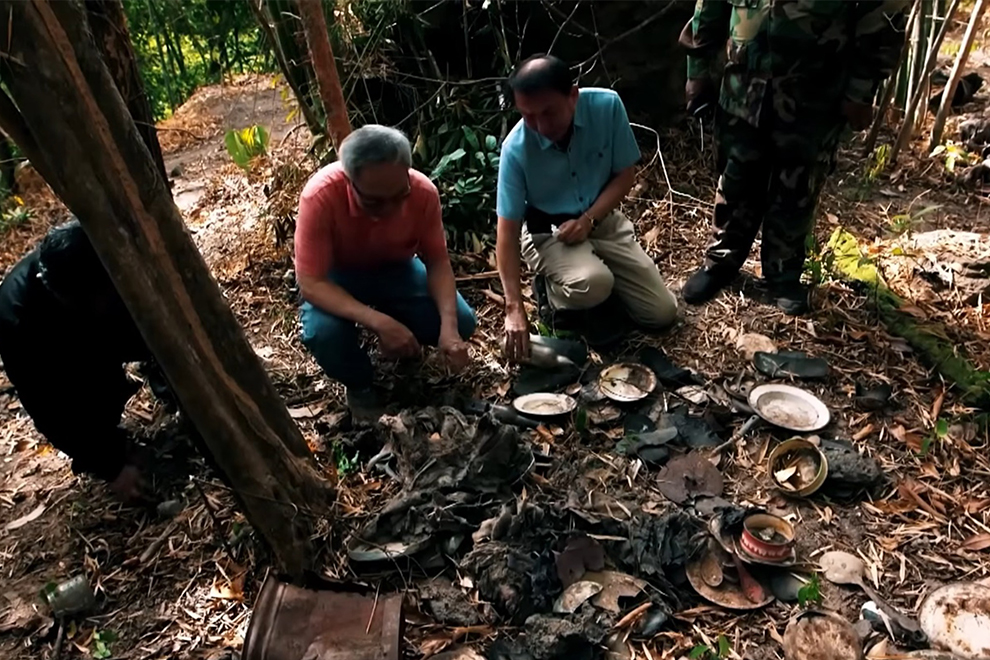
Several analysts have suggested that Thailand is unable to confront the uncomfortable truths presented in the “Ghost Mountain: The Second Killing Fields of Cambodia” documentary, which explores how in 1979, the Thai military forced thousands of Cambodian refugees to return home through heavily-mined areas.
Work began on the film in 2017, and it was released in 2019, when it placed third in the short documentary category by audience voting at the Sedona Film Festival.
It is the work of The Preah Vihear Foundation, which was established in 2016. The film was published to YouTube and other free channels in March 2024.
It was produced by James Taing, the son of Bunseng Taing, a Cambodian refugee and the main protagonist of the film who ended up in Connecticut, the US, in 1980 after surviving both the Killing Fields of the Khmer Rouge and the “Second Killing Field” in the Dang Rek Mountain.
Bunseng was one of the 40,000 refugees who the Thai military removed from refugee camps and forced to walk home through minefields in Preah Vihear province.
While the film was debuted in 2019, it is not well-known among Cambodians; nearly two years after it was uploaded to YouTube, it has attracted just 285K views.
According to the Thai media outlet Khaosod English, officials at Thailand’s Thailand–Cambodia Situation Information Centre reacted negatively to the film, claiming on January 18 that it distorted history and attempted to incite hatred.
“Thailand believes that presenting stories about conflict should be grounded in facts that can be verified and should consider the consequences for bilateral relations,” officials said, as quoted by Khaosod.
What remains true is that Thai forces continue to occupy at least 14 locations on Cambodian territory. They have destroyed homes and erected barriers of shipping containers and razor wire, according to local and official sources.
Analysts believed that Thai concerns about the film stem from a desire to hide their mistreatment of the refugees, effectively rewriting history and preventing young Thais from learning the truth about what took place.
“Ghost Mountain features the true story of a person. It is not fiction. It shows genocide committed by the Thai military on Cambodian refugees in the late 1970s. It was a crime against humanity and could be considered a second Killing Field. The Thais are trying to hide it and distort the truth,” said Kin Phea, director of the International Relations Institute at Royal Academy of Cambodia.
He added that Thais seem to be afraid of the truth and the shadow of history, which recalls the many invasions of its neighbours Thailand has perpetrated throughout its history.
“The Ghost Mountain film is like removing the curtain that concealed the genocide committed by the Thais. From 1975 to 1979, Cambodia went through the genocide of the Khmer Rouge. But their tears and blood continued to spill at Ghost Mountain, this time committed by the Thai military on Cambodians,” he noted.
Youk Chhang, director of the Documentation Center of Cambodia (DC-Cam), said Thailand is likely concerned about the film because all accounts in the film were from the survivors.
“Thailand is concerned about the Ghost Mountain because the evidence is still there and the survivors are still around to tell the story of the crimes, such as genocide, that may have taken place during that time. This will erase the false narrative spread by Thailand that as a nation, they were generous to Cambodian refugees,” he said.
