



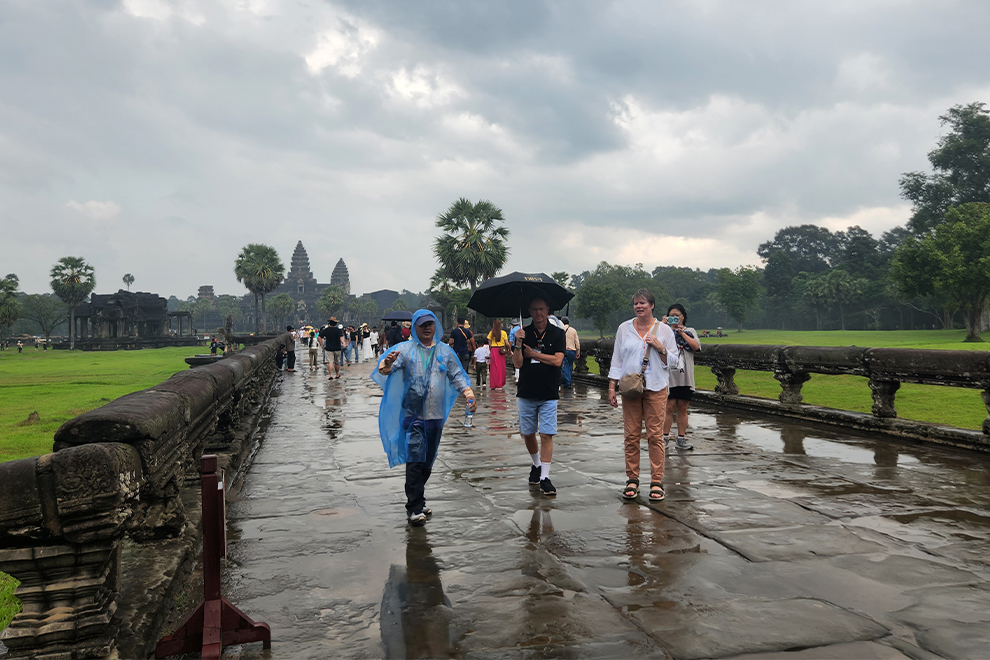
Revenue earned by Angkor Enterprise (AE) from selling tickets to international tourists visiting the Angkor Archaeological Park and a number of other sites in 2025 totalled $46.99 million, a decrease of nearly $2 million compared to the $48.95 million recorded in 2024.
Angkor Enterprise, a public administrative body, was established in 2016. It operates under the technical supervision of the Ministry of Tourism and the financial supervision of the Ministry of Economy and Finance. The institution’s revenue sources include the Angkor Archaeological Park, Koh Ker Temple, Beng Mealea Temple, Kbal Spean and boat tickets at Chong Kneas Port.
Ticket prices for the park are $37 per person for one day, $62 for three days and $72 for seven days.
According to a press release issued by AE on January 1, from January to December 2025 some 955,131 international tourists purchased tickets to visit the Angkor Archaeological Park, generating $44.71 million in revenue. Compared to 2024, the number of ticket-buying visitors declined by 6.7 per cent, while ticket revenue fell by 6.51 per cent.
In addition to ticket sales for the Angkor Archaeological Park, Angkor Enterprise also earned revenue from four other sources totalling nearly $2.28 million. Of this, Koh Ker Temple generated $303,975, Beng Mealea Temple $165,850, Kbal Spean $7,995, and Chong Kneas Port $1.8 million.
The president of the Angkor Tourist Guide Association, Khiev Thy, told the Post that the slowdown in global economic growth, armed conflicts and diplomatic tensions among some countries, as well as the Cambodia-Thailand border crisis caused by the Thai military, negatively affected the global tourism sector, including Cambodia’s tourism industry, in 2025.
He added that Cambodia’s tourism sector in 2026 is expected to perform better than in 2025, as there are now direct flights connecting Cambodia with many countries, including ASEAN nations, China, Japan, India, the United Arab Emirates and Turkey.
“I am optimistic that in 2026 Cambodia’s tourism sector will improve compared to 2025, especially with an increasing number of visitors from India and China,” Thy said.
To boost the potential for attracting more Chinese tourists to Cambodia, the Royal Government of Cambodia in early December 2025 granted a trial visa exemption for Chinese citizens visiting Cambodia for a period of 14 days, effective from mid-June to mid-October 2026.
A notification letter from the Office of the Council of Ministers stated that the Royal Government of Cambodia agreed to provide a trial visa exemption for Chinese citizens travelling from China, allowing a stay of 14 days over a four-month period from June 15 to October 15, 2026, without requiring a visa application or any fees, only the completion of an e-arrival card.
“During the validity period of the implementation, Chinese visitors may enter Cambodia multiple times,” the Office of the Council of Ministers letter said.
It added that the government has authorised the Ministry of Foreign Affairs and International Cooperation to negotiate with the Chinese government to further simplify visa application procedures for Cambodian tourists travelling to China.
This has the aim of eventually implementing reciprocal visa exemptions in the future. For effectiveness, cooperation with the private sector is encouraged to promote Cambodia more effectively in the Chinese market.
