



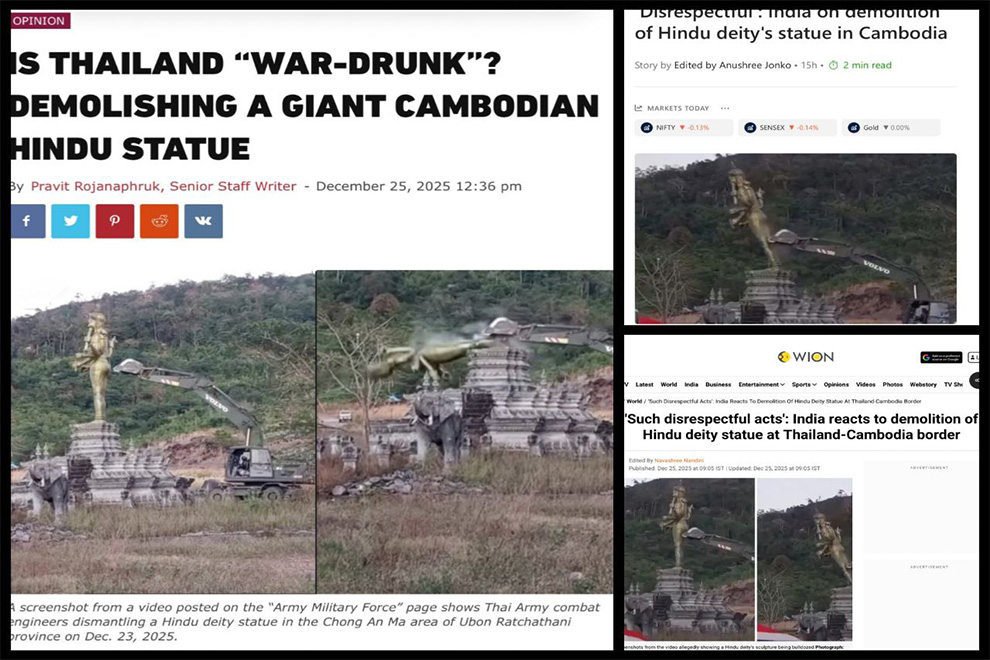
The destruction of a statue of Lord Vishnu on Cambodian territory by the Thai military has sparked sharp condemnation across India and drawn wider international attention, as religious groups, officials and media denounced the act as disrespectful and inflammatory amid an already tense border situation.
Since December 24, Indian media outlets have extensively reported on the demolition of the Hindu deity statue, which was built in 2014 on Cambodian land near the Thailand–Cambodia border.
The incident has triggered strong reactions among Hindu practitioners in India, many of whom described the act as an affront to religious sentiment and shared cultural heritage.
According to Hindustan Times, the Vishnu statue was toppled by a bulldozer operated by Thai military engineers.
“A video showing the demolition circulated widely on social media, fuelling public outrage in India and beyond. Thai authorities have not issued an official explanation specifically addressing the demolition.”
Tensions escalated further following remarks attributed to Thai Prime Minister Anutin Charnvirakul, who was quoted by Thai media as saying, “A destroyed statue cannot be compared with the limbs our soldiers have lost, nor can it be compared with acts of desecration. I would not make such a comparison at all”.
Cambodian Minister of Information Neth Pheaktra said the response from Thai leaders had intensified reactions internationally.
“With the response from the Thai Prime Minister and the Thai spokesperson today, the reaction has become even more heated and there has been condemnation of the Thai military for destroying the Vishnu statue,” he said.
Cambodia has formally condemned the act, insisting the statue was located within its territory.
“The statue was inside our territory in the An Ses area,” Kim Chanpanha, a Cambodian government spokesman in Preah Vihear province, told AFP.
He said the demolition occurred around 100 metres from the border, although Google Maps data suggests the site was approximately 400 metres inside Cambodian territory.
“We condemn the destruction of ancient temples and statues that are worshipped by Buddhist and Hindu followers,” Chanpanha said, warning that such actions risk inflaming religious and nationalist tensions.
The incident has also revived concerns in India over the protection of cultural and religious heritage in the border region.
[img]
Earlier this month, Hindustan Times reported that India had raised alarms over damage to conservation facilities at Preah Vihear, the 12th-century Hindu temple dedicated to Shiva and listed as a UNESCO World Heritage Site.
India’s Ministry of External Affairs echoed those concerns.
In response to media queries, MEA spokesperson Randhir Jaiswal said New Delhi was closely monitoring developments and stressed that Hindu and Buddhist deities are revered across the region as part of a shared civilizational legacy.
He urged restraint, dialogue and diplomacy, warning that disrespectful acts against religious symbols hurt sentiments worldwide and should not occur.
Global media, particularly in India, condemned Thai military toppled Lord Vishnu in Cambodian soil. Supplied
