



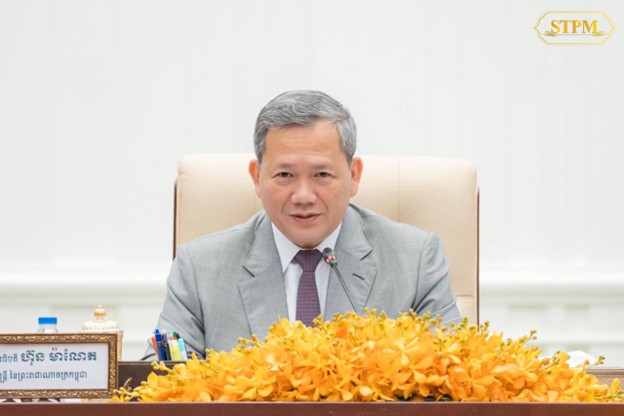
Prime Minister Hun Manet has warned that the Cambodia–Thailand border dispute has expanded beyond military confrontation into what he described as an “information battlefield”, placing journalists on a new front line in defending factual reporting, public trust and national security.
In a letter addressed to the 22nd Cambodia Editors’ Forum on December 19, themed “The Role of Journalists During Border Conflicts”, the prime minister said recent tensions were no longer confined to armed clashes.
“The recent border conflict between the two countries has involved not only armed clashes but also multiple battles within the framework of international law, political diplomacy, information and public opinion,” Manet wrote.
“In these arenas, the conflicting parties and opportunists have employed all available media and social networks to gain strategic advantages and prevail on the military, political, diplomatic and informational fronts in the era of digital technology and artificial intelligence,” he added.
Manet noted that competing narratives, disinformation and the manipulation of public opinion have become tools used by parties to gain advantage in the modern era.
He said the spread of fabricated or distorted information risked inflaming nationalism, provoking hostility and escalating tensions beyond control.
The prime minister stressed that journalists now play a decisive role in this environment, describing accurate and responsible reporting as essential to ensuring the public — both domestically and internationally — understands the “true situation” facing Cambodia.
He praised Cambodian and international media outlets for their efforts to report promptly and professionally amid heightened tensions, saying their work had helped counter misinformation and reduce public anxiety.
Manet also commended the Ministry of Information for coordinating media access and guiding coverage at sensitive locations, allowing journalists to report facts while limiting the risk of further escalation.
Information minister Neth Pheaktra noted on December 17 that global media are finally hearing Cambodia’s side of the border conflict, highlighting Thailand’s military aggression and violation of Cambodian sovereignty.
“Through CNN, Cambodia has brought its voice to the world. We have shared how the Thai military has launched an attack on Cambodia, while Cambodia has tried to be patient and respect the joint statement on the peace agreement signed on October 26,” Pheaktra said, via social media.
He urged the international community to assess the situation based on facts, stressing that global coverage helps counter misleading narratives.
Reports indicate the conflict has caused at least 18 civilian fatalities, 79 injuries and displaced over 470,000 people, including hundreds of thousands of women and children.
Pheaktra noted media outlets such as the South China Morning Post, The Times and Reuters have documented both sides of the conflict, including claims of Thai F16 strikes near refugee camps, the use of toxic gas and the growing humanitarian crisis.
At the same time, the prime minister issued a clear warning against unethical reporting practices, urging journalists to strictly adhere to professional codes of conduct.
He cautioned against publishing unverified claims, fabricated stories or sensitive military details — including troop movements, positions or weaponry — that could endanger national security or the lives of soldiers on the front lines.
“Information that is inaccurate or deliberately misleading can become fuel for conflict,” he said, adding that irresponsible reporting could undermine national unity and public confidence in state institutions.
Manet framed the government’s immediate priorities as protecting civilians and safeguarding Cambodia’s territorial integrity, calling on all ministries, security forces, citizens and media professionals to act in unity “as one national force” in the national interest.
He reaffirmed Cambodia’s commitment to press freedom within the framework of the Constitution and existing laws, describing journalists as indispensable partners in a democratic society.
However, he emphasised that freedom of the press must be balanced with responsibility, particularly during periods of border tension.
The prime minister also reiterated Cambodia’s broader stance of pursuing peaceful solutions through international law and diplomacy, while maintaining vigilance against what he characterised as coordinated information campaigns designed to inflame emotions, sow division and destabilise the country.
Concluding his message, Hun Manet expressed hope that the Editors’ Forum would produce concrete outcomes to strengthen media professionalism and resilience, saying the ability to withstand “information warfare” had become a critical component of national stability in the Cambodia–Thailand border dispute.
Prime Minister Hun Manet has warned that the current border involves not only armed clashes but also multiple battles within the framework of international law, political diplomacy, information and public opinion. STPM
