



Dubai Chambers has placed Cambodia among its top emerging markets for international expansion with a clear message: the Comprehensive Economic Partnership Agreement (CEPA) has shifted bilateral ties from diplomatic intent to concrete commercial engagement.
Sixteen Dubai-based companies from sectors including construction, FMCG, food and beverages, engineering, healthcare and oil and gas joined the mission under the chamber’s “New Horizons” programme, aimed at helping Dubai businesses enter high-potential global markets.
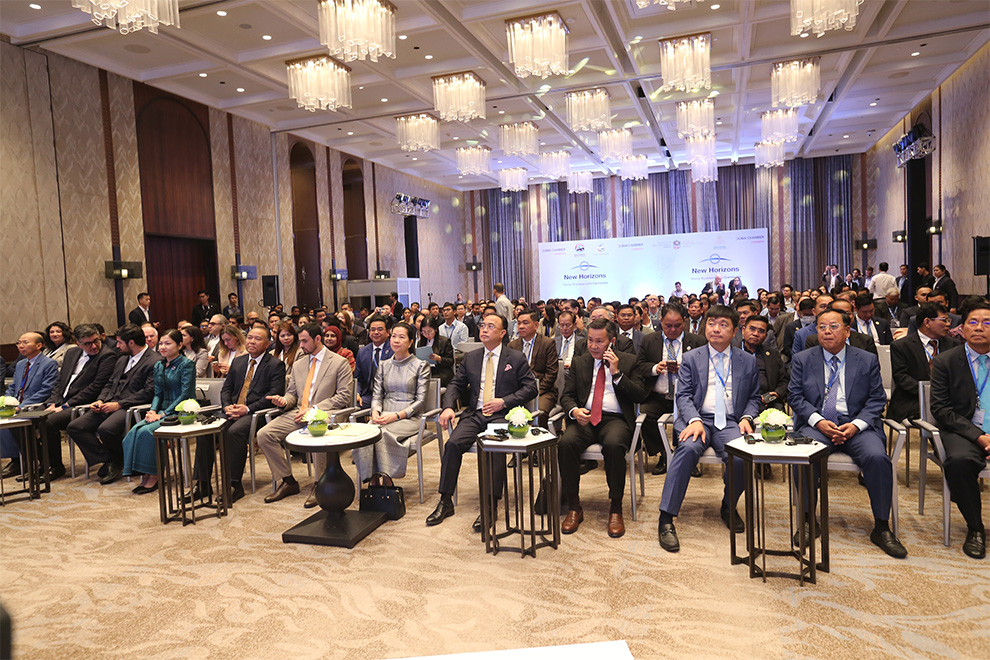
The delegation participated in a series of B2B meetings and a business forum co-organised with the Ministry of Commerce, the Cambodia Chamber of Commerce and the Council for the Development of Cambodia (CDC).
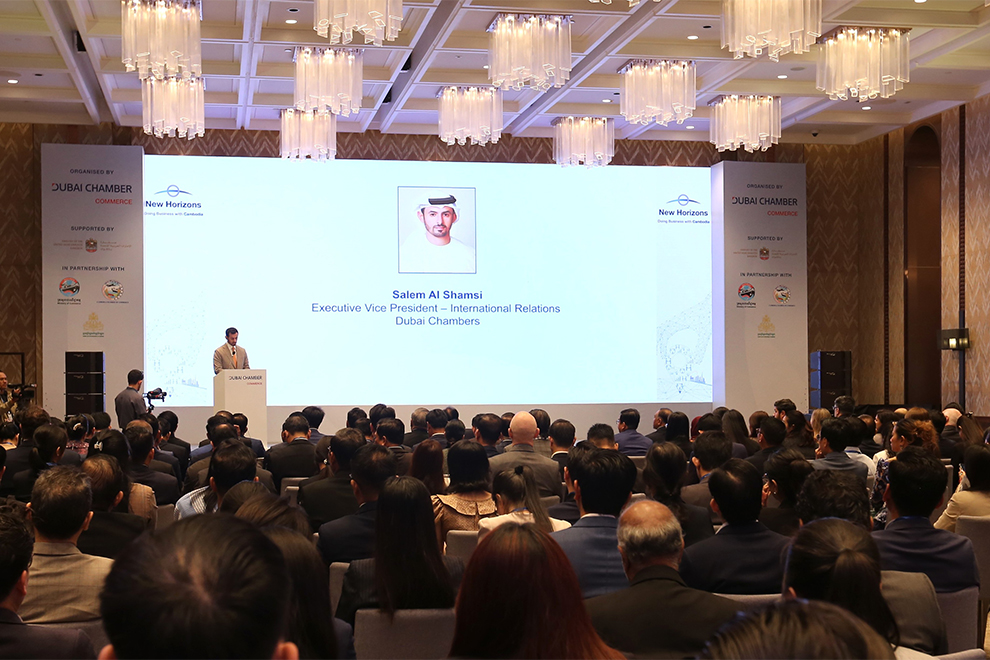
Speaking at the “Doing Business with Cambodia” forum on November 28, Salem Al Shamsi, executive vice-president for International Relations at Dubai Chambers, said the growing interest in Cambodia reflects a deliberate strategy.
“We are committed to enabling Dubai-based companies to build strong partnerships in priority markets and opening new paths for international expansion,” he said.
“Our presence here today reflects the opportunities for stronger economic cooperation between our markets,” added.
Al Shamsi highlighted Dubai’s increasing role as a global re-export centre, noting that the UAE accounts for up to 41 per cent of Middle East re-exports, with Dubai handling the vast majority.
“Dubai offers a strategic platform for Cambodian businesses seeking international expansion,” he said.
“With world-class logistics, advanced infrastructure and global connectivity, our city is a gateway to high-growth markets across Africa, the Middle East and South Asia,” he added.
In an interview, he underlined the scale of Dubai’s logistics ecosystem, pointing to DP World’s global network.
“DP World has more than 90 ports around the world that they manage and operate, and they are now into last-mile delivery as well,” he said.
“The question for us is how Dubai Chambers can help Cambodian companies take advantage of what Dubai provides and bring their products and services to other markets,” he continued.
He added that Dubai is increasingly integrating developing markets into its global trade strategy.
“We are looking into different markets. One of them is North Africa. We see the potential of trading with markets such as Malaysia and Cambodia,” he said.
Beyond trade and logistics, Dubai Chambers also sees scope for Cambodia’s startup sector to plug into Dubai’s expanding innovation ecosystem.
Al Shamsi said discussions were underway to explore how Cambodian startups could participate in Dubai’s flagship startup event, which recently hosted 3,200 startups and 1,200 investors with collective assets under management of more than $1.5 trillion.
Marwan AlMarri, Director for the Asia Region at Dubai Chambers, said CEPA has already boosted economic activity.
He noted that trade under CEPA has grown by 7 per cent from the same period a year earlier, with trade in the first half of 2025 reaching $47 million.
He emphasised that CEPA sits alongside a wider network of agreements that position Dubai as a competitive global trading partner.
According to the chamber, Cambodia’s non-oil trade with Dubai rose to $394.5 million in 2024, a 3 per cent increase year-on-year.
Cambodia Chamber of Commerce President Kith Meng said the mission from Dubai reflects a deepening commercial partnership anchored by CEPA, which entered into force on 31 January 2024.
“CEPA provides the institutional certainty and risk mitigation necessary for large-scale capital deployment,” he said.
“It secures a vital economic gateway for the UAE into the dynamic ASEAN market, and it offers Cambodia the preferential access it needs to integrate into the GCC hub,” he explained.
He noted that Cambodia is presenting targeted opportunities in sectors where UAE capabilities align with national priorities.
“We see immediate synergies in infrastructure, logistics, aviation, tourism, clean energy, FinTech and vocational training,” he said.
“Your expertise in engineering, sophisticated retail and quality control is precisely what we need to elevate our local value chains,” he continued.
Meng urged Emirati companies to strike tangible agreements while in Phnom Penh. He said this is where the real work of connecting, collaborating and closing deals begins.
The CDC provided investors with an overview of the country’s macroeconomic stability, investment incentives and sectoral opportunities, noting that Cambodia aims to solidify its role as a manufacturing and logistics hub for the 680-million-strong ASEAN market.
Dubai Chambers identified a series of promising export and investment areas, ranging from aluminium, iron and steel, and furniture to travel, tourism, construction, warehousing, textiles and consumer goods.
Al Shamsi said the chamber remains committed to deepening its presence in high-growth markets.
“By working together, we can build new paths for economic cooperation that drive mutual success for our business communities,” he said.
