



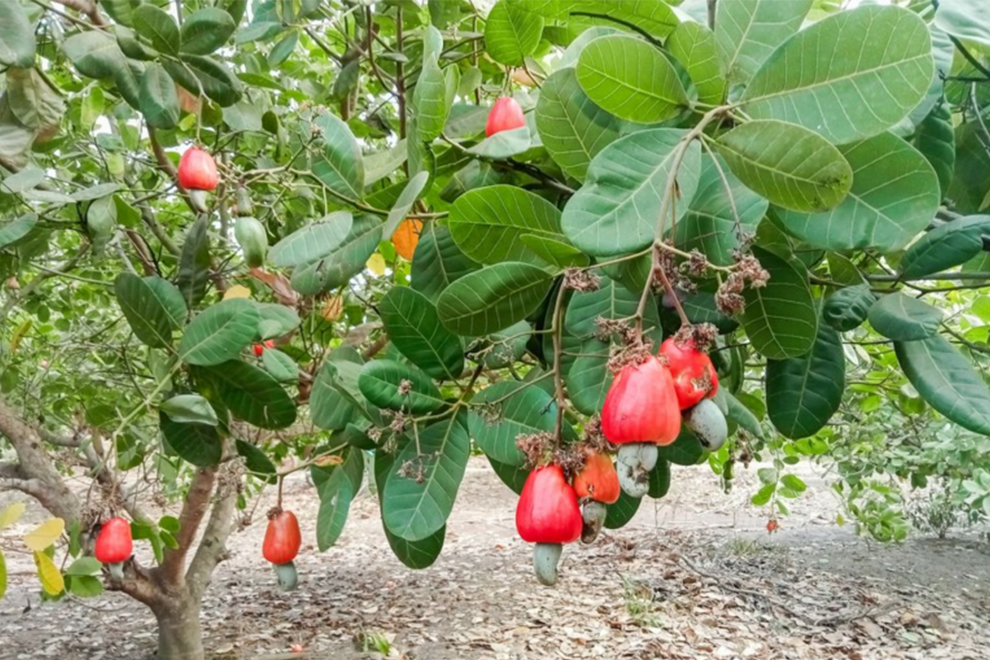
Experts warn that weather conditions will harm the quality and quantity of cashew nut yields for 2025–2026. In the first eight months of 2025 Cambodia earned roughly $1.4 billion from exporting raw cashew nuts.
Agronomist Karthikeyan Ganapathi, from SK Plantation in Ratanakkiri province, recently noted that Cambodia’s cashew industry is confronting mounting challenges as climate change reshapes weather patterns and disrupts crop production across major growing regions.
His field observations over recent months indicate that irregular rainfall, persistent cloud cover and late-season typhoons have significantly affected cashew development, leading to delayed growth and concerns of reduced yields for 2026, especially from September to November.
“These conditions directly impact cashew physiology,” he explained.
Meanwhile, farmers in Kampong Thom and Ratanakkiri have also reported increased losses due to harsh weather, including unpredictable rainfall, strong winds and rising pest infestations.
Ganapathi added that support through water drainage systems, weed management, planting cover crops to maintain soil moisture and closer plantation monitoring could help improve the situation.
“Climate change is not a distant threat — it is already reshaping our fields. With proactive management and adaptation, the cashew sector can remain resilient,” he said.
The Cashew Nut Association of Cambodia (CAC) agrees that climate change presents a major challenge but notes that farmers have already begun preparations to adapt.
CAC president Uon Silot told The Post on November 27 that the association has conducted extensive field research and recommended affordable, homemade foliar fertilisers such as High-Efficiency Microorganisms (HEM) and Indigenous Microorganisms Bacillus subtilis (IMOBs). He added that these methods have boosted cashew yields by more than 10 per cent over the past four years, while also reducing production costs.
According to Silot, since May 2025, CAC has provided 40 training courses which have reached more than 7,400 farmers across 10 provinces.
“Our aim is to empower farmers with real techniques that can help them make more income from their land,” he explained.
Training sessions include demonstrations on producing low-cost fertilisers such as liquid compost, HEM, IMOBs and Bordeaux Mixture — practices that the CAC says strengthen both soil health and crop resilience.
As Cambodia prepares for increasingly unpredictable climate conditions in the coming years, agricultural experts and farmer associations stress that innovation, adaptation and climate-smart practices will be essential to protect the country’s cashew sector.
CAC data shows that in the first eight months of 2025, Cambodia exported about 964,957 tonnes of raw cashew nuts, earning roughly $1.4 billion, an increase of 25 per cent over the same period in 2024. Vietnam remains the largest buyer of Cambodian raw cashews.
According to the CAC, Cambodia currently has about 700,000 hectares of cashew plantations — 580,000 hectares in harvest and around 120,000 hectares newly planted. On average, Cambodia produces between 800,000 and 1,000,000 tonnes of raw cashew nuts per year.
Silot added that as of early 2025, Cambodia has 52 cashew-processing enterprises, including 6 medium-scale factories (with production capacity between 7,000 and 140,000 tonnes per year). The remaining 48 are small family-based enterprises that do not operate year-round.
