



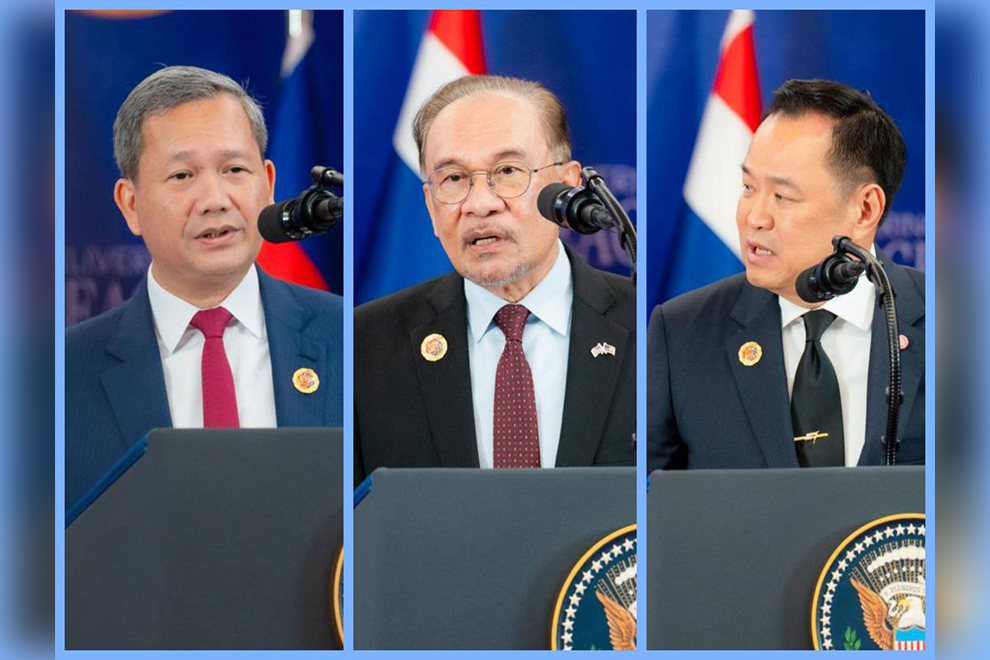
Efforts to maintain calm and reinforce peace between Thailand and Cambodia have taken on renewed urgency after a November 10 landmine explosion was followed by firing which killed at least one Cambodian civilian. Regional leaders have called for restraint and continued dialogue.
On November 13, Malaysian Prime Minister Anwar Ibrahim announced that he had spoken separately with Cambodian Prime Minister Hun Manet and Thai Prime Minister Anutin Charnvirakul to review ongoing peace efforts following the most recent border incidents.
Writing on his social media, Anwar emphasised that both leaders “provided positive feedback and reaffirmed their commitment to pursuing a peaceful resolution”, in line with the Kuala Lumpur Peace Accord, which was reached last month.
Anwar stressed that Malaysia remains ready to continue its role as facilitator, noting that “the friendship and ceasefire between both countries must be further strengthened”.
As current ASEAN chair, Malaysia has been deeply involved in diplomatic stabilisation efforts amid heightened tensions.
Both Thai and Cambodian leaders expressed appreciation for Malaysia’s position and its role as a “friend and close neighbour committed to regional peace”, Anwar added.
The renewed concern stems from Thailand’s decision to suspend the existing ceasefire after members of a border patrol were injured by landmines.
Malaysian minister flips on description of mines
According to Malaysian foreign minister Mohamad Hasan, Thailand claimed the mines were newly laid by Cambodia. However, last night, while speaking to Malaysian media agency Bernama, Mohamad said the ASEAN Observer Teams (AOT) stationed in both countries have assessed the situation and reported that the explosives involved “were not new landmines”.
In a development that has not yet been explained by the state news agency, his comment was altered this morning to remove the word “not”, suggesting that the mines were newly-laid.
The Post is still awaiting clarification from the minister or the state news agency as to whether the minister misspoke or was misquoted, or whether other forces were at play behind the edit.
Mohamad said he had spoken with his Thai counterpart shortly before issuing the statement.
“My hope is for both sides to calm down and to continue the peace talks,” he urged, emphasising that the AOT, though not physically positioned at the exact border line, are “constantly observing and reporting” developments to the concerned parties.
Manet focused on safety of civilians
Manet sharply condemned Thai forces for opening fire on Cambodian civilians in Prey Chan village on November 12, an attack that killed one person and injured at least three others.
Calling the incident a clear breach of humanitarian principles and prior agreements on peaceful border management, Manet urged Bangkok to halt its use of force.
“I urge the Thai side to immediately cease the use of force against innocent Cambodian civilians in Prey Chan village,” he said.
He also demanded accountability through an independent inquiry.
“I call for an independent investigation into this incident and appeal for the involvement of foreign specialists to seek the truth and deliver justice,” he added.
Manet instructed authorities to ensure the safety of citizens along the border and reaffirmed Cambodia’s commitment to diplomacy.
“Cambodia maintains its stance on resolving issues peacefully, in accordance with the spirit of the Joint Declaration of Kuala Lumpur,” he said.
Thais go own way
According to November 13 Thai media reports, Anutin has granted the military the authority to manage the Thai-Cambodian border during his China visit.
Anutin reportedly acknowledged the public’s growing concerns but stressed that the armed forces were prepared to safeguard the country.
“While we hope for peace, we must prepare for battle,” he said.
When asked about Manet’s accusation that Thai troops fired on Cambodian civilians, Anutin said he had seen the statement, but emphasised that Thailand would handle the matter according to its own approach.
Thai media reported on November 12 that Anutin had warned Phnom Penh not to “tuck its tail” if Thailand responds firmly, insisting that his emotions were genuine.
He claimed that the October 26 Kuala Lumpur peace declaration was now void, claiming geological testing showed the landmines were planted on Thai territory after the signing.
Anutin added that Thailand would no longer continue with the MoU 43 and MoU 44 on border and maritime demarcation, asserting that the landmine incident proved Cambodia had failed to uphold the agreement.
