



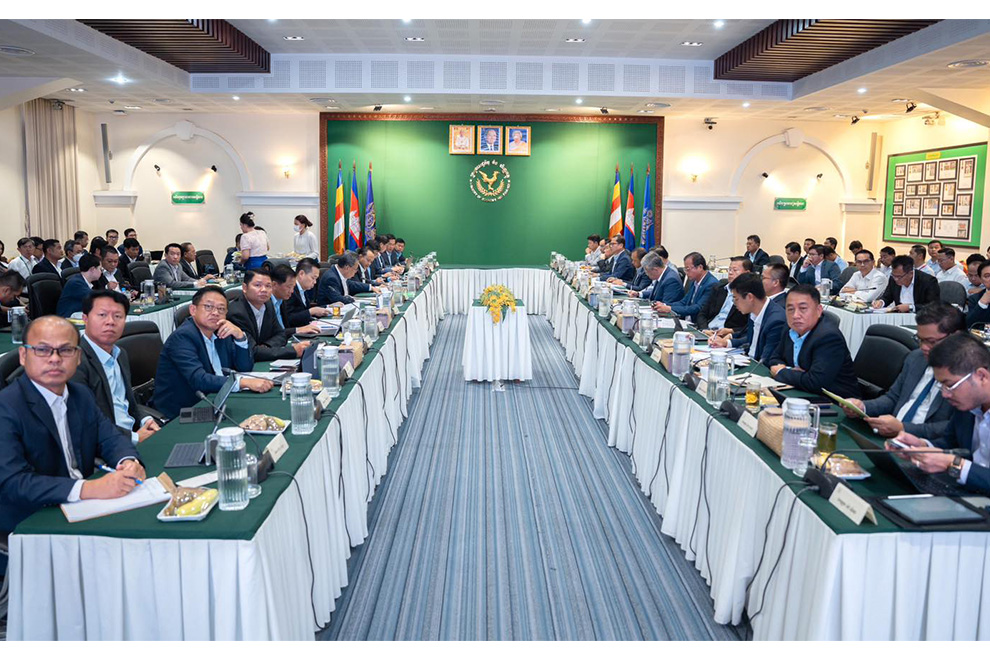
The working group for the Special programme to Promote Investment in the four Northeastern Provinces (SPIN) met yesterday, October 31, to review 11 investment projects in the northeastern provinces, with an estimated capital investment of $400 million and the potential to create about 800 jobs.
The meeting, held at the Ministry of Economy and Finance, was chaired by ministry secretary of state Hean Sahib, chair of the working group, to decide on the granting of special incentive principles from the government.
According to the SPIN Secretariat, the projects include four in Kratie province, one in Stung Treng, four in Ratanakiri and two in Mondulkiri.
They span a number of industries and activities, including the production and processing of agricultural products, the cultivation and processing of agro-industrial crops, the building of hotels and resorts, the establishment of private healthcare and education facilities, and the development of transport infrastructure.
The largest concerns the development of a multipurpose port, supporting infrastructure and related businesses in Kratie province, with an investment capital of approximately $350 million.
The port will become the first of its kind not just in Kratie, but the entire Northeastern region. It will play a crucial role in enhancing waterway transport capacity and developing the area into a logistics hub for transporting agricultural and industrial products, as well as connecting with the Funan Techo Canal logistics system in the future.
“Beyond the diversity of investment sectors, the Northeastern region has also garnered interest from investors of various nationalities. Specifically, for this round of proposals, the SPIN WG has received proposals from Chinese, Japanese and Vietnamese groups, as well as local investors, including both new and existing investors,” said a SPIN statement.
“They are interested in expanding their investment activities after recognising the special benefits provided by the Special Programme to Promote Investment in the Northeastern region,” it added.
During the meeting, Sahib highlighted the proactive approach of the working group, including the Provincial Investment Sub-Committees and relevant institutions at the local level of all four provinces. Their responsibilities include disseminating the special benefits of the SPIN programme and providing maximum support, advice and procedural facilitation to create a conducive environment for investment, while actively engaging in the collective mission to promote and nurture investment in the region.
He instructed the working group and the Provincial Investment Sub-Committees to regularly visit investment sites, whether or not there are submissions of investment project proposals, to meet with investors, listen to their concerns and challenges, and help find appropriate solutions for private investments, noting that Prime Minister Hun Manet has repeatedly emphasized the importance of being a “troubleshooter” not a “troublemaker”.
Sahib called for all relevant ministries and institutions to continue providing active cooperation and support to the working group its role as a “One-Stop Service”.
According to the SPIN Secretariat, once granted special incentives, private investors should focus on implementing their proposed projects as planned, with special attention to job creation, skills transfer, industrial processing and the adoption of new technologies in production chains. Investors are also encouraged to promote a shift from mere production toward higher-value-added processing to enhance national socio-economic development.
The SPIN programme was officially launched by the prime minister in April, with the aim of stimulating investment in priority sectors such as agriculture, agro-industry, and tourism through special incentives in Kratie, Stung Treng, Ratanakiri and Mondulkiri provinces.
As of 31 October, the SPIN working group had received 21 investment project proposals with a total investment capital of approximately $700 million.
