



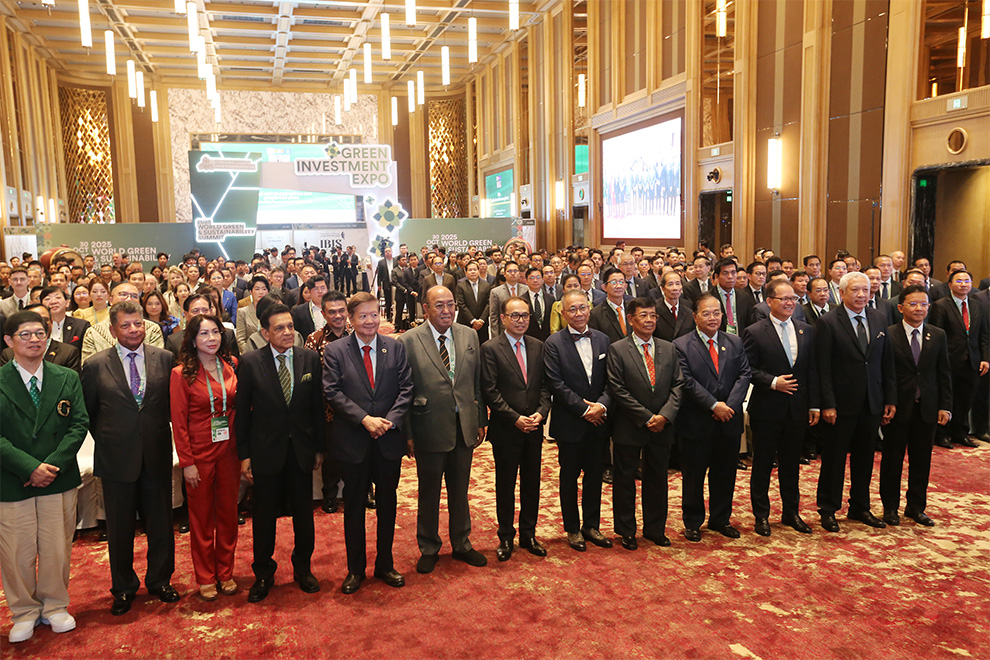
Cambodia has positioned itself as a regional frontrunner in advancing green growth and climate resilience, using the World Green and Sustainability Summit (WGSS), held in Phnom Penh on October 30, as a platform to outline concrete actions toward a low-carbon, inclusive future.
Presiding over the opening ceremony on behalf of Prime Minister Hun Manet, Vongsey Vissoth, Minister in Charge of the Office of the Council of Ministers, said Cambodia is ready to move “from commitment to implementation”, declaring that “sustainability is not a limit to growth — it is the new engine of growth”.
Themed “Shaping the Future of Sustainability and Building a Sustainable World”, the two-day summit brought together regional policymakers, private sector leaders, UN officials and development partners to accelerate the transition toward a greener, more resilient economy.
Vissoth said that while global progress over the past five decades had lifted billions out of poverty, it had also come “at the expense of our planet”.
He noted that global CO₂ emissions have doubled since 1970, warning that “climate change, biodiversity loss and energy insecurity now threaten global stability”.
“Cambodia, one of the most climate-vulnerable countries in the region, faces recurring droughts and floods,” he said.
“As agriculture remains central to our economy, climate change poses a serious threat to farmers’ livelihoods and national growth. To confront this, we must advance sustainable trade, green business practices and climate-smart policies,” he said.
He cautioned against what he called “climate protectionism”, urging developed economies to ensure that green trade measures such as the EU’s Carbon Border Adjustment Mechanism (CBAM) come with technical and financial support for developing countries.
“The future will be defined not by those who hesitate, but by those who act,” he said.
“Regional collaboration in finance, trade and technology is essential to strengthen global climate action and ensure that no country is left behind,” he added.
Vissoth outlined eight key recommendations to accelerate green transformation — including simplifying access to climate finance, reducing borrowing costs for green investments, promoting technology transfer and fostering regional solidarity.
He also reaffirmed Cambodia’s alignment with international frameworks such as the Paris Agreement, the Sustainable Development Goals and the ASEAN Green Deal.
Under the leadership of Prime Minister Hun Manet, Cambodia’s Seventh Legislature is pursuing phase one of the Pentagonal Strategy, which prioritises a green, inclusive and resilient economy.
The country’s Long-Term Strategy for Carbon Neutrality (LTS4CN) aims to achieve net-zero emissions by 2050, targeting key sectors such as energy, transport, agriculture, forestry and waste.
Complementing this are the National Green Growth Roadmap (2021–2035), the Circular Economy Strategy and Action Plan (2023–2028) and the Climate Change Strategic Plan (2024–2033).
Together, these frameworks are guiding the Kingdom’s transition toward sustainable energy, eco-friendly industries and low-carbon cities.
Among the country’s flagship initiatives are the development of a Green Special Economic Zone in Koh Kong, which integrates renewable energy and waste management, and the newly inaugurated Techo International Airport, designed with energy-efficient systems and eco-friendly infrastructure.
The government is also targeting 70 per cent renewable energy in its power mix by 2030, promoting electric mobility under the National Policy on Electric Vehicles (2024–2030) and expanding REDD+ forest protection programs.
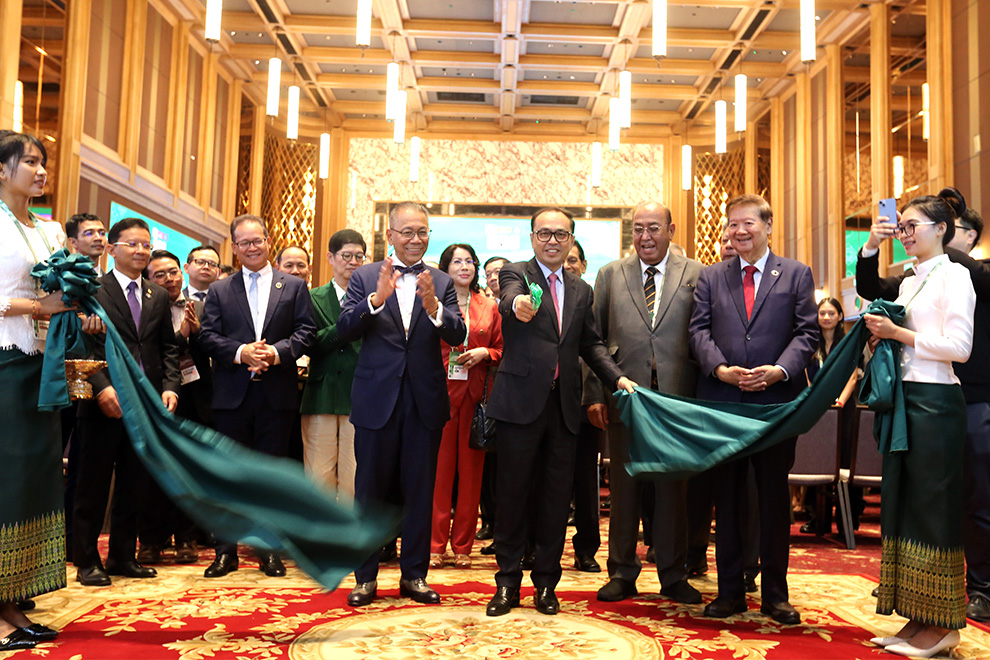
“Green growth lies at the heart of Cambodia’s economic diversification strategy,” Vissoth reiterated.
“Through the Industrial Development Policy and the forthcoming Industrial Transformation Plan, we are fostering industries that are energy-efficient, environmentally responsible and globally competitive,” he explained.
Echoing the government’s determination, Minister of Environment Eang Sophalleth emphasised that climate change is no longer a distant concern but a present crisis costing “billions of dollars in damage and countless lives disrupted”.
As he addressed the event, Sophalleth highlighted Cambodia’s Nationally Determined Contribution (NDC) 3.0, submitted to the UN on August 8, which commits the country to cutting greenhouse gas emissions by 55 per cent by 2030 compared to business-as-usual projections.
“When we say we need $32 billion to achieve these goals, this is not government money,” he clarified, adding that “These funds must come from international sources — from developed countries and climate funds established to support nations like ours”.
He further elaborated on Article 6 of the Paris Agreement, which governs carbon markets, explaining that Cambodia will balance environmental protection with national development priorities.
“We are not blocking development. We are balancing it — ensuring both progress and sustainability,” he said.
Sophalleth added that Cambodia’s carbon credit projects under REDD+ are voluntary and community-focused, helping protect forests and local livelihoods rather than serving as profit-making ventures.
The event also heard from Michael Yeoh, president of the KSI Strategic Institute for Asia Pacific, who praised Cambodia’s growing role in the sustainability dialogue.
“The world is at a tipping point,” Yeoh said.
“We must enhance public-private partnerships to promote the SDGs and balance the interests of developing countries with global climate justice,” he added.
Armida Salsiah Alisjahbana, UN undersecretary-general and executive secretary of ESCAP, underscored the importance of regional cooperation and private sector engagement through the Asia-Pacific Green Deal for Business, an initiative built on green energy, infrastructure, finance, innovation and circular economy pillars.
“Climate change knows no borders,” she said.
“Small and medium-sized enterprises will be critical to the green transition, and tools like ESGpedia will help them track and reduce their carbon footprints,” she continued.
In his closing remarks, Vissoth called for continued partnership and collective action, reaffirming Cambodia’s commitment to global cooperation.

“No single country can achieve sustainability alone,” he said.
“Green growth is not a zero-sum game — it is a pathway to shared prosperity, peace and long-term resilience,” he noted.
The 2025 World Green and Sustainability Summit concludes today, alongside the Green Investment Expo, where regional and international investors are showcasing innovations in renewable energy, sustainable manufacturing and climate finance solutions.
