



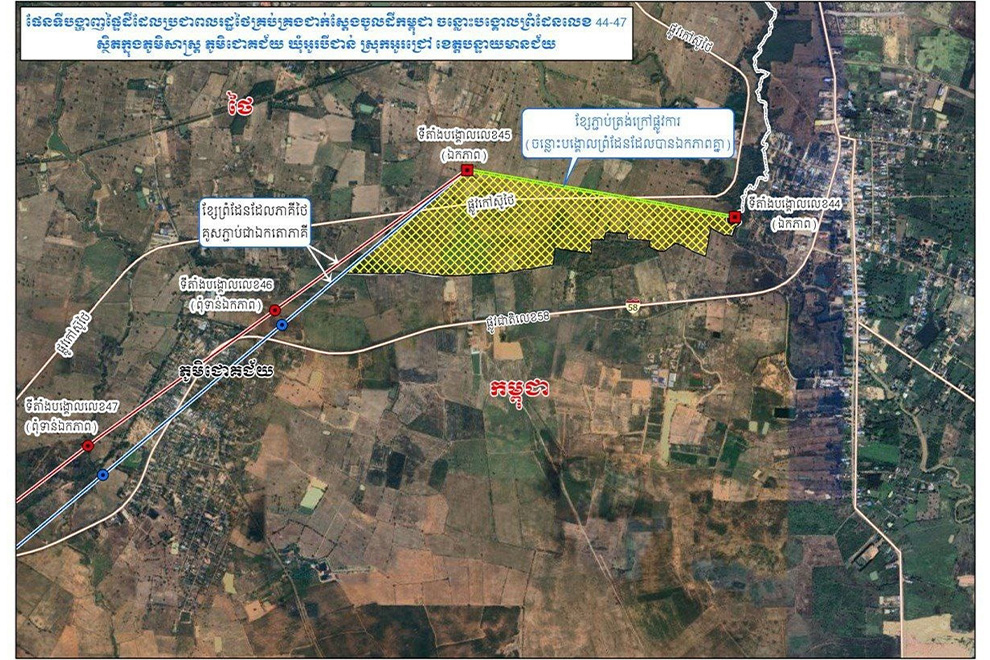
Following the conclusion of the Cambodia-Thailand Joint Boundary Commission (JBC) and Cambodia-Thailand General Border Committee (GBC) meetings, today, October 23, Prime Minister Hun Manet reiterated that there would be no clandestine cession of Cambodian land in exchange for peace negotiations.
Via social media, Manet affirmed Cambodia’s stance on the fate of Prey Chan and Chouk Chey villages, where Thai forces have erected razor wire barricades around at least 12 Cambodian homes, cleared landmines, bulldozed land and demolished at least one of the enclosed houses.
He stated that the progress towards resolving the issues in these two villages is now clearer than before, with both sides able to discuss legal principles to find a peaceful solution.
He noted that Thai actions in the two villages over the past two months have caused difficulties for the residents, leading to tensions among the Khmer people.
He explained that, in the face of such activities, his government’s initial goal was to prevent the situation from escalating, which would affect more people and cause more severe problems, as well as to explore all possible means to resolve the on-site issues as quickly as possible.
Manet explained that the government adopted an approach of working patiently and using peaceful means to find a solution. Using violent means would not only fail to find a solution but could also expand the geographical scope of the conflict, affecting more people more severely, and making it harder to find a quick resolution to the problem, he said.
He expressed understanding of the public’s feelings, acknowledging that they want to see immediate solutions to these issues.
“Some of the actions taken by the Thai side, such as mine clearance, land allocation to Thai citizens, or the destruction of buildings in areas already surrounded by Thai troops, have made citizens feel that there might be no solution. Some might even mistakenly believe that the Royal Government of Cambodia has secretly agreed to cede Khmer land in exchange for a ceasefire or a peace agreement,” he said.
“I want to reiterate that there will be no secret agreement to cede any territory within Cambodia’s legitimate sovereign domain to any country in exchange for ceasefire negotiations or peace negotiations. Cambodia will not violate the sovereignty and territorial integrity of its neighbours, but we will not agree to any violation of Cambodia’s sovereignty or territorial integrity,” he added.
Manet reaffirmed that any acceptable border resolution must be based on the principles of transparency, mutual agreement without coercion between the two sides and the use of agreed-upon mechanisms, based on the principle that the work of measurement and demarcation falls under the jurisdiction of the Cambodia-Thailand JBC and must be resolved peacefully, in accordance with existing treaties, conventions and agreements between the two countries.
To end the conflict in Chouk Chey and Prey Chan villages between border markers 42 and 47, the prime minister explained that both the Cambodian and Thai sides have agreed to continue technical activities to define joint measurements and establish temporary border markers, using the 1/200,000 map, the 1907 treaty and the demarcation records of the Franco-Siamese Border Commission as a basis.
The results obtained from these measurements will be verified against the location of residents on both sides of the border.
“Only through this method can both sides reach a long-term solution and resolve the problems in Chok Chey and Prey Chan villages. This will allow residents to resume their normal livelihoods, while avoiding prolonged chronic issues in the future,” he said.
