



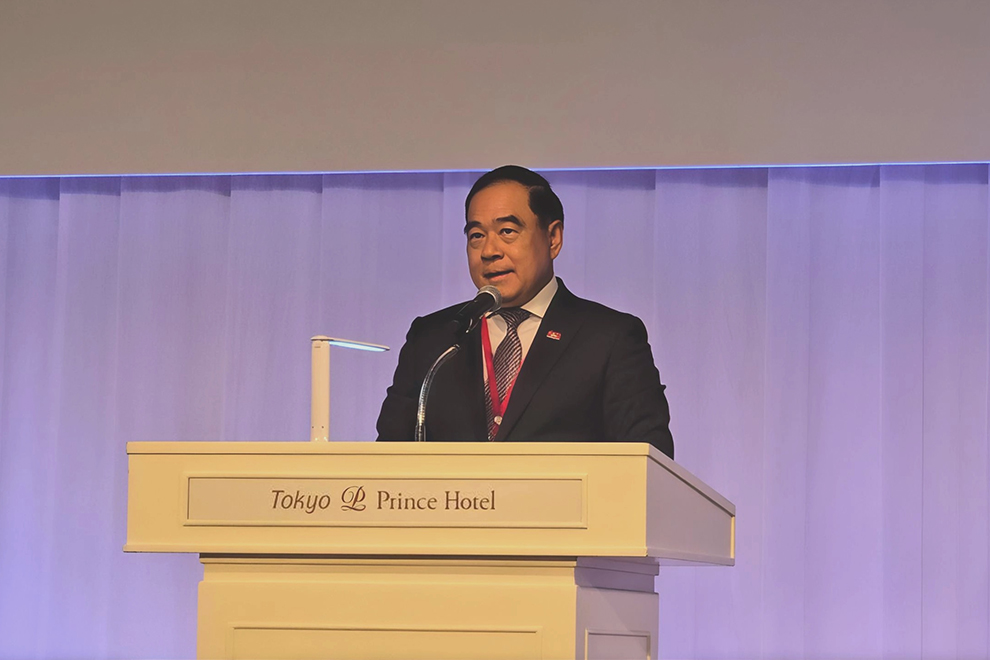
Cambodia has become one of the world’s leading countries in humanitarian mine action, transforming its decades-long struggle with landmines into a model of resilience, recovery, and international cooperation. A leading demining expert reiterated the Kingdom’s commitment to support other nations with their own challenges.
Speaking at the 2025 Ukraine Mine Action Conference in Tokyo on October 22–23, Senior Minister Ly Thuch, first vice-president of the Cambodia Mine Action and Victim Assistance Authority (CMAA), highlighted Cambodia’s transformation “from tragedy to strength” — a journey that has turned once-devastated land into productive ground and inspired other post-conflict nations.
Representing Prime Minister Hun Manet, Thuch expressed gratitude to the Government of Japan for hosting the event and for its long-standing partnership in supporting mine clearance efforts in Cambodia.
“Japan has been a pillar of global humanitarian mine action, extending assistance across Asia, the Middle East and Africa,” Thuch said.
“Through these sustained contributions, Japan has saved countless lives and enabled war-torn communities to reclaim their future with hope and dignity,” he added.
From scars of war to a model of recovery
Once among the world’s most heavily mined countries, Cambodia has spent over three decades clearing millions of explosive remnants of war that claimed tens of thousands of lives.
Thuch emphasised that under the “strong visionary leadership of former Prime Minister Hun Sen, and continued by Prime Minister Hun Manet,” Cambodia has turned the tide — from being a victim of landmines to a global contributor to peace and stability.
“Cambodia now shares its expertise with other nations, including Ukraine, to help them rebuild and restore peace,” he said, referring to a Japan-funded initiative through which the Cambodia Mine Action Centre (CMAC) has provided technical training to Ukrainian demining professionals.
“This cooperation stands as a living example of how countries once torn by conflict can rise to become contributors to peace,” he told delegates.
“Our support to Ukraine is not shaped by politics, but by empathy — because we know too well the suffering caused by landmines,” he continued.
Mine action as a foundation for development
Thuch underscored that mine action is not merely about removing explosives but about creating opportunities for development.
“Mine clearance is the first step to restoring normalcy — to bringing children safely back to school, allowing farmers to return to their fields, and empowering communities to rebuild with hope and dignity,” he said.
He reiterated that Cambodia’s mine action efforts are deeply rooted in humanitarian principles, not political interests, aiming to ensure no nation endures the same suffering.
“Our scars have become our strength, and our experience is yours to share,” he told the participants, addressing countries still grappling with landmine contamination.
A continuing global commitment
Although Cambodia’s presidency of the Ottawa Convention concluded in 2024, Thuch said the country remains committed to its leadership role in global demining.
He noted Cambodia’s proud contribution in leading the Siem Reap–Angkor Action Plan 2025–2029, a global roadmap for achieving a mine-free world.
“Cambodia reaffirms its commitment through continued technical assistance, South–South cooperation, and participation in UN peacekeeping missions,” he said.
“We will continue supporting survivor-centred recovery and sustainable development in mine-affected communities,” he explained.
In closing, Thuch dedicated his message to all mine-affected nations:
“To the people of Ukraine — and to all nations struggling with the deadly legacy of landmines — Cambodia stands with you. Not just in words, but in action. Mine action is not just about clearing land; it is about clearing the way for peace, dignity, and renewal,” he concluded.
