



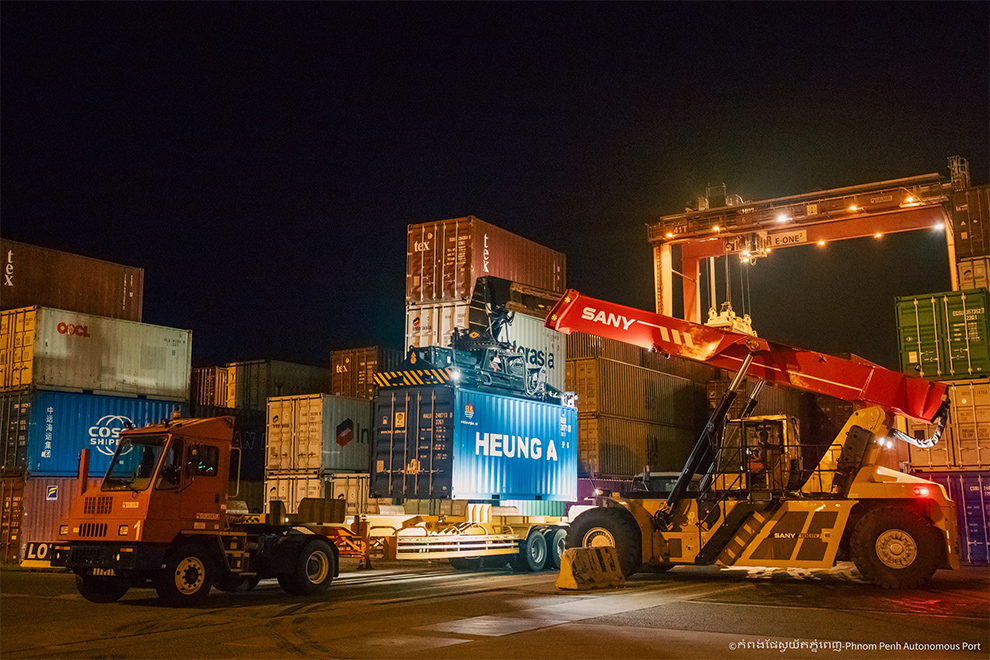
In the first three quarters of 2025, the number of containers passing through the Phnom Penh Autonomous Port (PPAP) exceeded 440,000 TEUs (twenty-foot equivalent unts), an increase of over 20% over the same period last year. Passenger traffic also grew, by 10%.
Experts believe this growth will likely increase further once the Funan Techo Canal becomes operational.
According to the Cambodia Securities Exchange-listed PPAP, business operations continued to show positive signs from January to September. The total number of containers handled was 445,391 TEUs, a 21.7% increase. Meanwhile, the volume of cargo and fuel reached 4,185,701 tonnes, up 16.7%. This was despite a 1,49% decrease in the number of cargo ships, at 2,780.
The number of passenger vessels was 270, an increase of 5.88%, and the number of passengers was 26,392, up 11.51%.
Chea Chandara , president of the Logistics and Supply Chain Business Association in Cambodia, told The Post on October 14 that the positive trend in the transport sector reflects Cambodia’s ongoing economic activity, even though the global economy continues to face challenges.
Currently, due to the lack of a waterway connecting the Tonle Sap and Mekong Rivers to the Sihanoukville international seaport, many goods are still transported via land routes or through Vietnamese waterways.
“Once the Funan Techo Canal Project is operational, activities at the Phnom Penh port will become even more vibrant, as the new waterway will connect Cambodia’s central region to the seaport,” he said.
According to Chandara, the main goods transported through the port are garments and agricultural products.
Sam Soknoeun, chairman of the SAM SN Group, agreed that the port’s logistics activities will see a significant rise when the new canal is launched. It will link goods transportation from the inland river systems to Cambodia’s seaports, passing through Kandal, Takeo, Kampot and Kep provinces, with an approximate length of 180 kilometres. Numerous investment opportunities are expected to emerge in areas near the canal project.
He believed the new canal will offer tremendous benefits to Cambodia, especially the transport sector. It will reduce transportation costs, save time and distance, minimise road damage and traffic congestion, decrease road accidents, reduce customs and shipping procedures and enhance logistics from Cambodia to seaports, while creating commercial and special economic zones and developing new port hubs.
Moreover, the canal will help expand agriculture, irrigation, aquaculture, tourism, mitigate floods during the rainy season, increase freshwater fishery production and stimulate real estate and investment activities.
“In summary, the Funan Techo Canal is a major national interest initiative, especially in terms of Cambodia’s economic and social development. Once the project begins operations, inland water transport from the country’s interior via the PPAP to seaports will be much busier than it is now,” he noted.
In 2024, PPAP saw 4,894 vessels passing through, a 26.82% increase compared to 2023. The number of containers handled was 480,200 TEUs, up 21.19%, and cargo and fuel volume was 4,806,654 tonnes, a 15.91% increase.
