



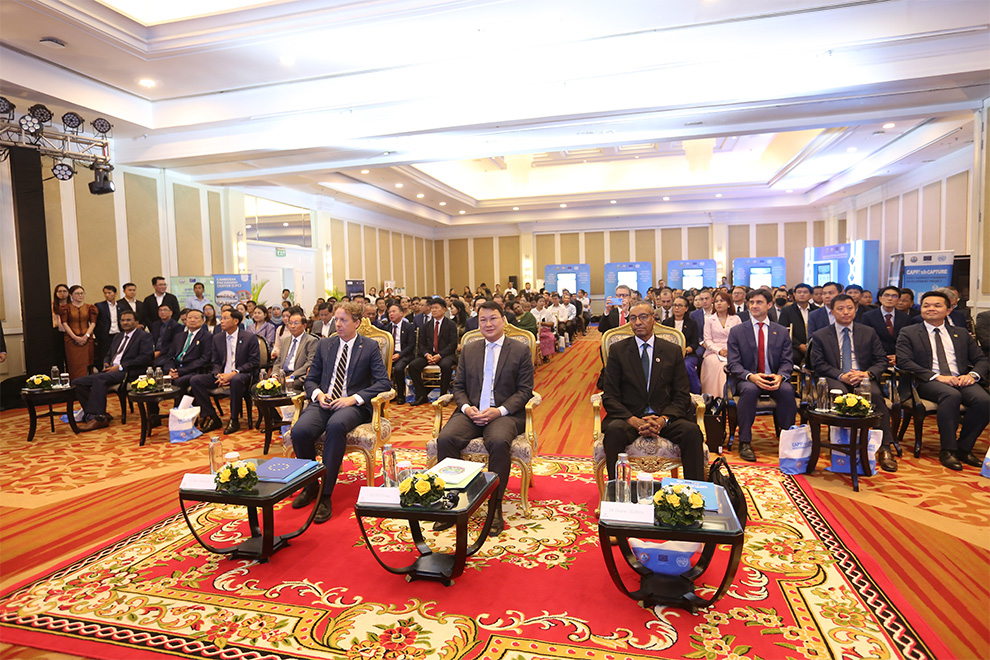
Cambodia’s fisheries sector has reached a historic milestone as the government announced that the country is now ready to undergo an EU audit in 2026 — a crucial step toward exporting Cambodian fishery products to the European market for the first time.
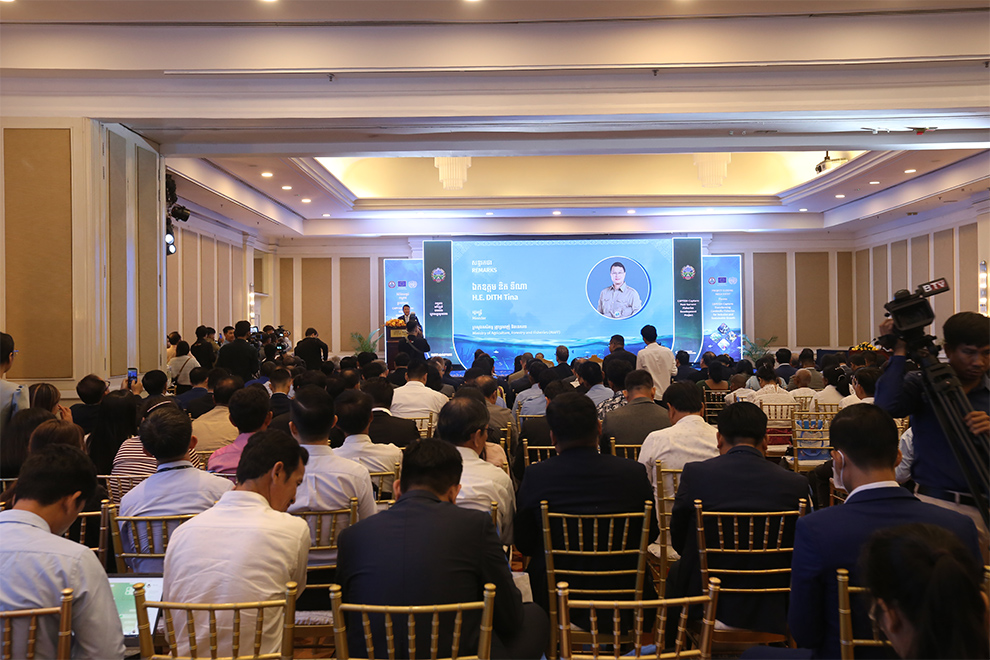
The announcement was made during the closing ceremony of the CAPFISH-Capture: Post-Harvest Fisheries Development Project held under the theme “Cambodian Fisheries Development for Sustainable Growth”.
The six-year initiative, jointly implemented by the Ministry of Agriculture, Forestry and Fisheries and the UN Industrial Development Organization (UNIDO) with funding from the EU, has transformed Cambodia’s post-harvest fisheries sector through modernisation, certification and strengthened food safety systems.
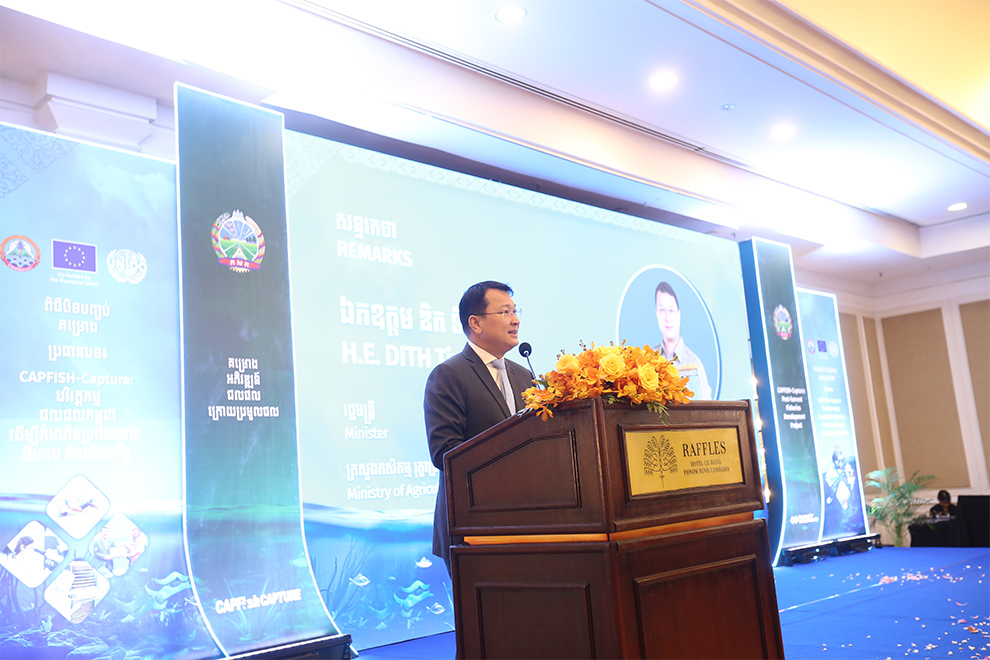
Agriculture minister Dith Tina praised the project for laying a foundation that would benefit the fisheries sub-sector for years to come.
“This closing ceremony is not the end of CAPFISH-Capture, but the beginning of its continuation,” he said.
“The success of this project shows the power of partnership and ownership — between government, the private sector and development partners,” he added.
The minister said the project contributed significantly to phase one of the seventh-mandate government’s Pentagonal Strategy, particularly in promoting sustainable agriculture, improving product quality and safety, and expanding market access.
He highlighted that the agriculture sector contributed 16.7 per cent to Cambodia’s GDP in 2024, with fisheries accounting for roughly 20 per cent of that share, and that fish production rose 10 per cent compared to 2023.
Pum Sotha, Royal Government Delegate in charge of the Fisheries Administration (FiA), said the project’s achievements have placed Cambodia in a strong position to seek EU market access.
“I am confident that Cambodia is ready to receive an audit from the Directorate-General for Health and Food Safety (DG SANTE) in 2026 for registration as a country eligible to export fishery products to the EU,” he said.
He added that the initial export phase would focus on processed freshwater products such as fish sauce and fish meal, followed by aquaculture products.
Since its launch in 2019, CAPFISH-Capture has helped the FiA implement a National Action Plan for Monitoring the Quality and Safety of Aquatic Products (2020–2024), establish Cambodia’s Quality Seal (CQS) certification system and strengthen laboratory testing capacity.
The Pasteur Institute has also been accredited with ISO 17025 for food microbiological testing, meeting EU technical requirements.
Empowering enterprises and creating jobs
Through the project, 64 fishery processing enterprises received technical support and equipment upgrades, with 22 enterprises obtaining the CQS certification and four achieving Hazard Analysis and Critical Control Points (HACCP) standards that align with EU market demands.
The project also developed the Cambodian Digital Traceability System (CamTrace) to ensure compliance for exports and fostered partnerships between businesses and financial institutions.
Approximately €2 million ($2.31 million) in capital support was provided to small and medium enterprises (SMEs), generating €3.7 million ($4.27 million) in business matching, while the Cambodian Credit Guarantee Corporation (CGCC) offered €0.7 million ($0.8 million) in loan guarantees.
“Many Cambodian fishery products are now sold in modern markets and exported to countries such as China, Australia, New Zealand and South Korea and soon, the EU,” Sotha said.
EU hails Cambodian progress
Igor Driesmans, EU ambassador to Cambodia, called the CAPFISH-Capture project a model of how partnership can lead to lasting transformation.
“This project has strengthened food safety compliance, aligned Cambodia’s fisheries sector with international standards and reinforced governance through policy reform and capacity building,” he said.
Driesmans noted that the project supported more than 560 micro, small and medium-sized enterprises (MSMEs) and their value chain actors, generating or sustaining nearly 18,000 jobs.
He said the establishment of a regulatory and certification framework under CAPFISH now serves as “a global passport for Cambodian products”.
The EU ambassador urged the agriculture ministry and its partners to scale up the most successful models — including the CQS certification, the Investment Support Facility and the Food Technology, Research and Innovation Platform (FTRIP) — to other agricultural value chains such as cashew, pepper and other agri-food sectors.
“Beyond metrics and milestones, CAPFISH has built trust — proving that donor-funded projects can and must have local ownership to be impactful,” he said.
“As we close this chapter, let us not see it as an ending, but as a transition,” he continued.
A legacy of empowerment
UNIDO senior technical advisor Thombathu Seetharama Shetty reflected emotionally on the project’s six-year journey, describing it as one that “transformed not only businesses, but lives”.
“When we began CAPFISH-Capture in 2019, we aimed to build a competitive, sustainable and internationally recognised fisheries value chain,” he said.
“Today, Cambodia stands on that foundation,” he added.
Shetty shared inspiring stories of transformation — from small-scale fish processors upgrading to certified exporters — many of them led by women.
“Before, we sold fish. Now, we sell confidence,” one woman entrepreneur told him, capturing the project’s essence.
Over 70 per cent of the enterprises supported by CAPFISH are women-led, earning the project the UNIDO Gender Equality Promotion Award.
UNIDO pledges continued partnership
Dejene Tezera, director of UNIDO’s Division of Agribusiness and Infrastructure Development, reaffirmed UNIDO’s long-term commitment to support Cambodia’s agri-food modernisation.
“CAPFISH has made substantial progress in food safety policy, strengthened private sector compliance with international standards and expanded Cambodia’s readiness for EU market access,” he said.
He confirmed that UNIDO will continue working with the Cambodian government and the EU under the second phase of the Program for Country Partnership (PCP), extending CAPFISH’s successful model to other agricultural value chains.
Building momentum for sustainable growth
The CAPFISH-Capture project is widely seen as one of the EU’s most successful initiatives in Cambodia’s fisheries sector.
Its achievements — from introducing the Cambodia Quality Seal and establishing traceability systems to empowering women entrepreneurs and building export capacity — are now viewed as critical building blocks for Cambodia’s long-term agricultural competitiveness.
“With the right strategy and investment, Cambodia will not only export fishery products to the EU but also become a regional leader in agriculture and agro-industry. This is the legacy of CAPFISH — a journey that continues beyond its conclusion,” Tina summed up.
