



Cambodia earned nearly $4 billion from the export of more than 11 million tonnes of agricultural products to international markets during the first three quarters of 2025, with rice and paddy exports alone contributing around $1.5 billion.
This marked a 30.4% increase in volume over the same period in 2024, according to the General Directorate of Agriculture under the Ministry of Agriculture, Forestry and Fisheries.
From January to September, Cambodia exported approximately 11.13 million tonnes of agricultural products to 88 nations. The figure includes 5.29 million tonnes of non-paddy and rice products, according to the National Phytosanitary Database System.
The report explained that in the 9-month period of 2025, the estimated export value of agricultural crops (based on exporters’ invoice values) amounted to $3,889 billion. Crops excluding paddy and rice were valued at $2.379 billion, paddy totalled $1.054 billion and rice totalled $455 million.
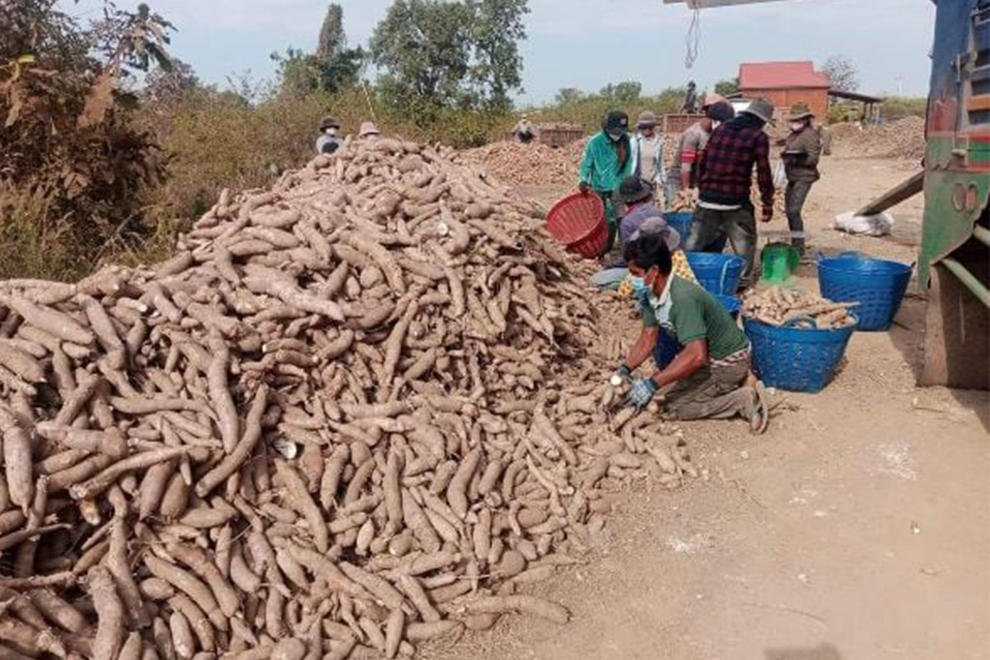
Despite the more than 30% increase in volume, some crops saw a decline, notably cassava and fresh mangoes. This was attributed to increases in processing capacity, as dried cassava or cassava flour have a longer shelf-life and higher value than fresh cassava, while dried mango products are superior to fresh mango.
Dried cassava exports rose by 57.62%, cassava flour by 83.49% and dried mango by 27.54%, compared to the same period in 2024.
The agriculture ministry reported that Cambodia exported 8.5 million tonnes of agricultural products in the first 9 months of 2024, worth over $3 billion. The main exports included paddy, rice, cassava, cashew nuts, bananas, mangoes, longan and pepper.
Hong Vanak, an economist at the Royal Academy of Cambodia, told The Post on October 7 that government policies which focus on strengthening and expanding crop cultivation has enabled Cambodia to meet domestic demand while increasing international exports. He noted that agriculture has become an increasingly important driver of economic growth.
“What is notable now is the rapid development of Cambodia’s agricultural processing capacity. Exporting processed or value-added agricultural products allows the country to earn more compared to exporting raw or fresh products,” he said.
The Ministry of Economy and Finance previously projected that the agriculture sector would grow by 1.1% in 2025.
“The crop sub-sector is expected to maintain strong growth due to ongoing domestic and foreign investment in agricultural processing, increased public investment and government interventions such as financial incentives to boost domestic production and the implementation of various free trade agreements, which will continue to support exports,” it said.
In 2024, Cambodia exported a total of 11.7 million tonnes of agricultural products — a 39% increase over the 8.4 million tonnes recorded in 2023. They were valued at approximately $4.8 billion, according to the agriculture ministry.
