



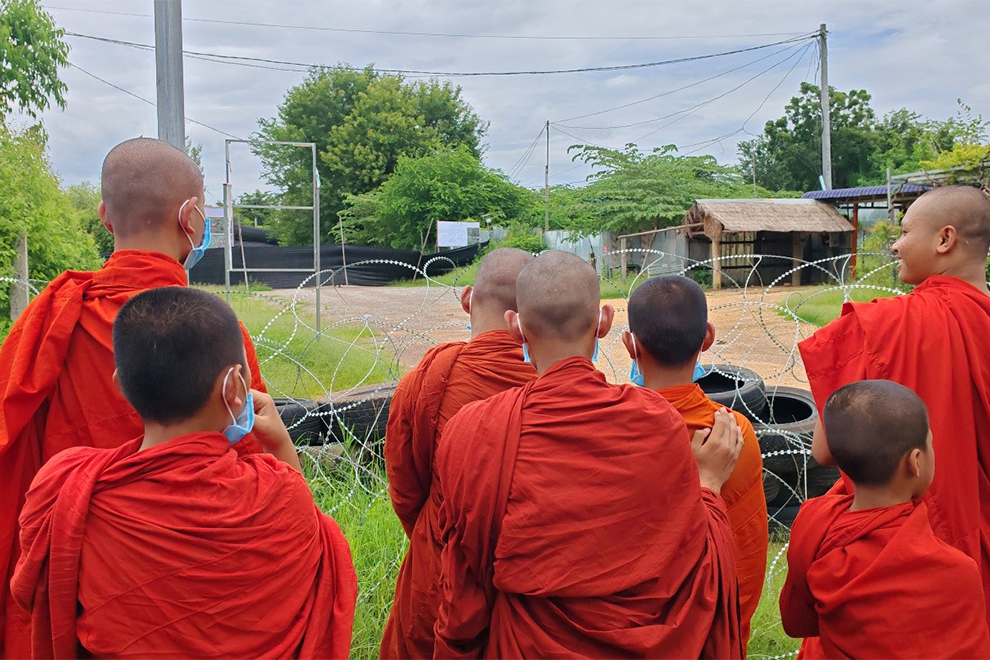
As tensions continue to rise along the Cambodia–Thailand border, concerns are mounting. resolving this sensitive issue is likely to take a considerable amount of time. Given that both countries practice Theravāda Buddhism, what role has the Buddhist approach played in addressing this complex dispute?
As a nation whose identity is deeply rooted in Theravāda Buddhism, it is essential to ask why are the principles of the Buddha not used as a guiding light when conflicts arise? Instead of following the path of compassion, patience, and dialogue, repeated resorts to firepower contradicts the very essence of Buddhist teaching. Such an approach not only undermines efforts toward peace but also erodes the moral foundation on which the nation stands.
The Dhamma teaches non-violence, right speech, and the Middle Way as means of resolving disputes. True strength is not found in the use of weapons but in the ability to transform hostility into understanding and to replace anger with reconciliation. To resort to arms is to betray the wisdom of the Buddha; to seek peaceful resolution is to honour it. For a society that claims Buddhism as its heritage, the responsibility lies in applying these values not only in temples but also in the realm of governance, diplomacy and conflict resolution. Only then can peace be achieved in both principle and practice.
The historical resolution of this conflict is notable for the extensive involvement of multiple mechanisms — national, international, diplomatic and even the influence of major powers. Yet, despite these efforts, tangible progress has remained limited. This raises the question of whether alternative perspectives, particularly those rooted in Buddhism, might offer fresh insights.
Buddhist philosophy, with its emphasis on compassion, non-violence and the cultivation of wisdom, provides an important framework for analysing the nature of conflict and envisioning potential pathways toward resolution. From a Buddhist standpoint, conflict is not solely an external struggle over territory or power but also a manifestation of internal conditions such as greed, anger and ignorance. Addressing these underlying causes is as essential as resolving the external disputes themselves.
In doing so, the practice of Buddhist principles could serve as a constructive complement to existing political and diplomatic mechanisms. The emphasis on right speech, mutual understanding and reconciliation underscores the importance of fostering dialogue that is respectful, empathetic and future-oriented.
In the spirit of regional solidarity, Cambodia and Thailand — as immediate stakeholders and as members of the broader ASEAN community — face the challenge of moving beyond historical wounds. While the past may bear the marks of conflict, the future offers an opportunity to redefine neighbourly relations. For the sake of future generations within a single ASEAN bloc, the priority must shift toward peaceful coexistence, mutual respect and shared prosperity. In this regard, Buddhist philosophy does not replace diplomatic mechanisms but enriches them, reminding all parties that true peace emerges not from dominance but from understanding and cooperation.
The Cambodia–Thailand border has long been a sensitive region, shaped by territorial disputes, cultural heritage and competing national interests. Tensions — whether over ancient temples, boundary demarcations or resources — have at times escalated into diplomatic rifts and armed clashes.
On the other hand, both nations have sought to manage these disputes through diplomacy, international law and military preparedness. While necessary, these approaches often focus on immediate solutions or national advantage rather than fostering genuine reconciliation.
Starting from the Buddhist perspective, however, there are profound lessons for addressing such crises. Buddhism emphasises compassion (karuṇā), non-violence (ahiṃsā), mindfulness (sati) and dependent origination (paṭiccasamuppāda).
Applied to border disputes, these teachings suggest that lasting peace arises not from force or competition but from understanding, restraint and recognition of shared humanity. Instead of viewing the border as a dividing line, Buddhist thought encourages seeing it as a space of coexistence, where communities depend on one another for cultural exchange, trade and mutual survival.
Buddhist philosophy also invites Cambodia and Thailand to move beyond narratives of ownership and rivalry toward a vision of harmony grounded in ethical conduct (sīla), wise reflection (paññā), and dialogue guided by compassion. This does not replace the role of law, diplomacy or defence, but enriches them with moral depth — transforming conflict resolution from a contest of power into an opportunity for healing, cooperation and long-term trust.
Understanding Crisis Through the Lens of Buddhism
In Buddhist thought, conflict is fundamentally understood as arising from the unwholesome state or so-called three poisons are namely greed (lobha), hatred (dosa) and delusion (moha). These inner afflictions are not only the sources of individual suffering but also the root of collective discord in societies and nations. When applied to the realm of territorial disputes, these poisons manifest in visible and destructive ways.
Greed appears in the desire for land, natural resources or strategic advantage. Hatred surfaces when historical grievances, perceived injustices or feelings of national pride fuel hostility toward the other side. Delusion arises through distorted views of history, misconceptions about cultural identity or an inability to see the interdependence of peoples across borders.
In terms of Buddhist perspective, meaningful conflict resolution does not begin with weapons or rigid negotiations alone, but with a recognition of these root causes. If nations fail to see how greed, hatred, and delusion drive their actions, any resolution will remain fragile, merely postponing future disputes. Therefore, the Buddhist approach encourages first cultivating awareness (sati) and wisdom (paññā) to clearly understand the underlying conditions of conflict.
This does not mean ignoring political or legal mechanisms but rather complementing them with inner transformation and ethical dialogue. leaders and communities are encouraged to practice mettā (loving-kindness) to counter hatred, dāna (generosity and willingness to share) to overcome greed, and sammā-diṭṭhi (right understanding) to dispel delusion. By shifting the mindset from confrontation to compassion, from possession to sharing, and from division to interdependence, disputes can be reframed as opportunities for reconciliation rather than domination.
Ultimately, Buddhism teaches that true peace is not simply the absence of open conflict, but the presence of harmony rooted in ethical conduct and mutual respect. When nations acknowledge that their borders are shared spaces shaped by centuries of interaction, rather than rigid barriers of separation, they create the conditions for coexistence. In this way, the Buddhist approach to territorial disputes seeks not only to resolve immediate tensions, but also to transform the underlying attitudes that give rise to conflict in the first place.
Compassion and Empathy as First Steps
The teachings of the Buddha clearly emphasise that compassion and loving-kindness as essential foundations for peaceful coexistence and the cultivation of harmonious societies. These values are not merely abstract ideals but practical principles that can guide the resolution of conflicts, including sensitive issues such as border disputes. In the context of a border crisis, the application of karuṇā and mettā requires the cultivation of empathy toward all parties involved, transcending narrow notions of national pride or exclusive ownership.
For Cambodia and Thailand, two nations that share centuries of cultural, religious and economic ties, this perspective offers profound wisdom. Both peoples are deeply rooted in Theravāda Buddhism, and this shared spiritual heritage provides a common ground for mutual understanding. Through the Buddhist lens, Cambodians and Thais are not simply political entities in conflict over territory, but interdependent neighbours whose lives, economies and futures are intimately connected.
Instead of framing each other as adversaries, Buddhism encourages viewing one another as co-travellers on the same path of human existence, where the well-being of one side inevitably influences the well-being of the other. Trade, cultural exchange, pilgrimages to shared sacred sites and intermarriages over generations have woven a fabric of mutual reliance that cannot be undone by lines drawn on a map.
Practicing mettā (Loving-Kindness) in this situation would mean cultivating goodwill toward the people on the other side of the border, recognising their fears, needs and aspirations as equally valid. As for, practicing karuṇā (Compassion) would involve alleviating suffering wherever it appears — whether among Cambodian farmers who feel dispossessed of land or among Thai villagers who fear encroachment. By acknowledging these mutual vulnerabilities, both sides can move away from hostility and toward dialogue grounded in compassion and respect.
Therefore, the Buddhist approach reframes a border crisis not as a zero-sum struggle for territorial control but as an opportunity to strengthen bonds of interdependence. By applying compassion and loving-kindness, Cambodia and Thailand could build trust, transform suspicion into cooperation and lay a moral foundation for sustainable peace along their shared border.
Dialogue Rooted in Right Speech
The Noble Eightfold Path offers direct guidance in addressing conflict, particularly through Right Speech (sammā vācā), which emphasises the use of words that are truthful, constructive and unifying. In the context of a border crisis, much of the tension is often worsened not by the physical presence of troops or fences, but by the power of language — inflammatory statements, misinformation, political rhetoric or exaggerated claims. Words can quickly transform a local misunderstanding into a national dispute.
Based on the Buddhist concept, speech is not merely a neutral tool; it is a moral act that carries the potential either to create harmony or to sow discord.
Thus, Right Speech calls upon leaders, media outlets and communities to exercise restraint in what they say, write or broadcast. This means avoiding falsehoods that distort the truth, abstaining from divisive speech that pits one community against another, and refraining from harsh or accusatory language that deepens resentment. Instead, the emphasis is placed on cultivating dialogue that is respectful, empathetic and solution-oriented — speech that builds bridges rather than walls.
In practical approach, this guidance could manifest in several ways: government officials choosing words of reconciliation instead of provocation, journalists prioritising accuracy and balance over sensationalism and community members engaging in cross-border communication that highlights shared culture and mutual concerns rather than differences.
By upholding Right Speech, the possibility of escalation is reduced, and the foundation for mutual understanding and peaceful negotiation is strengthened. In this way, Buddhist ethics demonstrate that peace is not only negotiated in diplomatic halls but also shaped in everyday conversations, public statements, and the narratives communities talk about one another.
The Middle Way in Diplomacy
Buddhism teaches the Middle Way (majjhimā paṭipadā) — a path that avoids the extremes of indulgence and denial, or in broader terms, rigid absolutism and reckless permissiveness. Applied to political and international relations, the Middle Way encourages leaders to reject both extremes: on one side, aggressive militarisation and hardline postures that escalate conflict; on the other, a passive or submissive stance that neglects the responsibility to safeguard sovereignty and the well-being of citizens.
Instead, the Buddhist path points toward a balanced approach. This involves practicing diplomacy that is rooted in wisdom and compassion, where the protection of national interests is pursued without hostility, and openness to dialogue and compromise is upheld without surrendering dignity.
In this regard, the Middle Way is not a position of weakness, but one of strength — anchored in patience, clarity and the recognition that long-term peace and security arise not from domination or capitulation, but from fairness, restraint and mutual respect.
Non-Violence as a Principle of Security
In its essence, Buddhism teaches ahiṃsā (non-harming), a principle that extends beyond personal ethics into the realm of statecraft and international relations. While it is natural for states to safeguard their sovereignty and protect their territorial integrity, Buddhist philosophy reminds us that true security does not arise from the mere accumulation of weapons or the threat of military force. Instead, lasting stability is nurtured through trust, mutual respect and cooperative engagement between nations.
Armed conflict, whether at the border or elsewhere, not only destroys lives and livelihoods but also erodes the moral fabric of society. It generates fear, resentment, and cycles of retaliation — conditions directly opposed to the Buddhist path of peace and harmony. Moreover, such violence undermines the very values both Cambodia and Thailand, steeped in centuries of Theravāda Buddhist tradition, profess to uphold, including compassion, loving-kindness and harmony within the community.
By grounding policy in ahiṃsā, leaders are reminded that the highest form of protection is not domination through arms but the cultivation of mutual confidence, dialogue and peaceful resolution of disputes. When states embody non-harming, they not only preserve human life but also honour the shared spiritual and cultural heritage that binds their peoples together. In doing so, ahiṃsā becomes not just a moral teaching but a practical strategy for sustainable peace.
Toward a Harmonious Future
The Cambodia–Thailand border dispute extends beyond the mere demarcation of land; it represents a deeper challenge of how two neighbouring nations, each rooted in centuries of Buddhist tradition, can demonstrate the moral and ethical principles that their cultures espouse. While political leaders often focus on territorial claims, strategic advantage or international legal mechanisms, the situation also calls for a reflection on the human and societal dimensions of conflict. Buddhism provides a framework for addressing these dimensions — one that emphasises inner transformation as a prerequisite for outer peace.
Central to this framework is compassion, which urges both sides to see the humanity in their counterparts. Border communities on both sides share intertwined histories, familial ties and economic interdependence. Compassion encourages policies and actions that consider the welfare of civilians, prevent harm and prioritise the restoration of trust over punitive measures.
Equally important is Right Speech, which in the context of international relations translates into careful, truthful, and non-inflammatory communication. By avoiding exaggeration, misinformation or provocative rhetoric, leaders and media outlets can prevent the escalation of tensions. Dialogue framed in this way nurtures understanding and reduces the likelihood of conflict spiralling out of control.
The Middle Way offers guidance on navigating extremes. For Cambodia and Thailand, this means avoiding both aggressive militarisation and total passivity in the face of disputes. A balanced approach could include diplomatic negotiations, joint management of disputed areas and cooperative development initiatives, all designed to protect national interests while respecting mutual rights and responsibilities.
Significantly, non-violence underlines the principle that lasting security cannot be achieved through force alone. Armed clashes or displays of military might may offer temporary leverage, but they perpetuate cycles of fear, anger and resentment. True security is cultivated by reducing harm, building trust and fostering collaboration.
To sum up these points as raised above, in the spirit of the Buddha’s teaching, peace cannot be reduced to the mere absence of conflict or the triumph of one nation over another.
True peace arises when individuals and societies are able to transcend the three poisons — anger, greed and ignorance — that perpetuate hostility and mistrust. In the case of Cambodia and Thailand, this means looking beyond short-term strategic gains or retaliatory measures, and instead cultivating a mindset rooted in mutual respect, patience and understanding.
Through by integrating compassion, ethical speech, measured action and non-violence into their diplomatic strategies, both nations have the opportunity to transform recurring border tensions into a constructive framework for dialogue and reconciliation.
Such a transformation not only reduces the risk of armed confrontation but also sets a precedent for other regions facing similar disputes. In this sense, Buddhist principles do not remain confined to monasteries or personal spiritual practice; they emerge as practical tools for governance, statecraft and international relations.
Furthermore, adopting this approach highlights that ancient wisdom is not a relic of the past, but a living guide for contemporary challenges. When compassion is paired with principled restraint, and when moral courage is recognised as equal in value to military or economic strength, nations can demonstrate a more holistic vision of power — one that safeguards dignity, harmony and stability.
In terms of this Buddhist philosophical lens, Cambodia Thailand can serve as an example to the world that even in the face of historical grievances and territorial disputes, peace can be achieved not by domination, but by the shared commitment to overcoming inner and outer sources of conflict. This model of reconciliation affirms the enduring relevance of Buddhist philosophy in shaping a just and harmonious regional order.
Prak Samphose, Ph.D. in Philosophy, is a special lecturer at the Graduate School of Preah Sīhanouk Rāja Buddhist University, in Phnom Penh. The views and opinions expressed are his own.
