



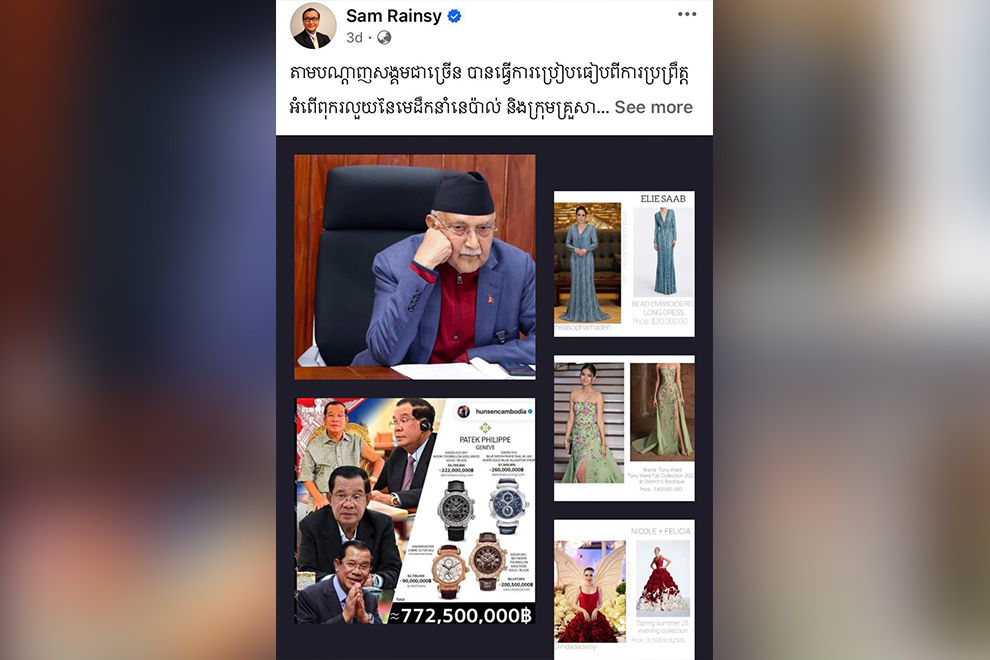
In the wake of opposition accusations that the Cambodian leadership family uses luxury goods, which they suggest shows the social distance between them and ordinary Cambodians, government spokesperson Pen Bona dismissed the claims, calling them a recurrent tactic employed by the opposition for over three decades.
He argued that these accusations were merely attempts to incite anger and mobilise public sentiment against the government.
The opposition figures are amplifying their critique by pointing to the lavish lifestyles of government officials and their families.
“This is the political culture of the opposition in Cambodia,” said Bona.
“For over 30 years, they have done nothing but smear, slander and incite anger to undermine the government. They have no new ideas, no constructive policies to offer. Instead, they wait for an opportunity to exploit events abroad and provoke the people,” he noted.
Bona emphasised that the opposition lacked a clear vision for the country’s future and instead relied on external events — such as political unrest in other nations — to fuel their rhetoric.
[mg]
This, he suggested, was the opposition’s consistent strategy: to mimic and draw inspiration from other countries where government opposition movements had succeeded in overthrowing the ruling party.
Bona said whenever a country experiences a political shift or a rebellion, the opposition here sees it as an opportunity to provoke similar unrest in Cambodia.
He stated that they are not studying the unique history, culture and political traditions of Cambodia, which makes such comparisons misguided and harmful.
“For 20 to 30 years, they have been doing this because they have no new political ideas for leading the country, and they do not win elections,” Bona told The Post.
“There are only two approaches: to incite, smear, accuse and slander the government and its officials, or to wait and benefit from unforeseen events happening around the world,” he asserted.
His comments came in the context of an ongoing opposition-driven narrative that compares Cambodia’s political system to the mass uprisings seen in countries like Nepal and Bangladesh, where political movements — often driven by younger generations — have gained momentum.
In Nepal, for example, the 2025 protests were ignited by widespread anger over the elite’s opulent lifestyles, which stood in stark contrast to the poverty many citizens faced.
The protests escalated in September after the government imposed a ban on major social media platforms, such as Facebook and YouTube, which the youth used to organise their protests.
The youth-led movement, largely fuelled by resentment against “nepo kids” (the children of wealthy political families), spread quickly across digital platforms, culminating in the resignation of Prime Minister K.P. Sharma Oli and the appointment of Nepal’s first female prime minister, Sushila Karki.
The parallels between the Cambodian and Nepalese situations have not gone unnoticed, with some in the opposition attempting to use Nepal’s protest movement as an inspiration for their own cause.
However, Bona firmly rejected these comparisons.
He argued that Cambodia had enjoyed political stability and peace, which was in sharp contrast to the turmoil in other nations.
He stressed that the leadership of former Prime Minister Hun Sen and current Prime Minister Hun Manet, had steered the country through periods of reconstruction and development after the Khmer Rouge genocide, contributing to the nation’s stability.
“Cambodia is not like other countries,” he said.
“We are living in a state of social and political stability,” he added.
Yang Peou, secretary-general of the Royal Academy of Cambodia, also weighed in on the issue, stating that while it was natural for the opposition to draw attention to events in other countries, it was misguided to equate Cambodia’s political situation with those facing instability.
“Cambodia is a constitutional democracy, with elected representatives,” Peou explained.
“We are not experiencing the same kinds of social and political upheavals that other countries are. The opposition’s argument about wealth disparity and social inequality is not grounded in Cambodia’s reality,” he continued.
Despite these assertions from government officials, opposition figures continue to challenge the ruling party’s narrative, citing growing inequality and the concentration of wealth among a small group of political elites.
They argue that this widening gap between the rich and the poor is contributing to the public’s increasing discontent, particularly among the youth.
In the face of these accusations, the government has reiterated its commitment to stability and development.
“The opposition fails to understand the circumstances and does not know how to distinguish between national and internal political issues, which leads to a loss of support from the people,” Bona added.
