



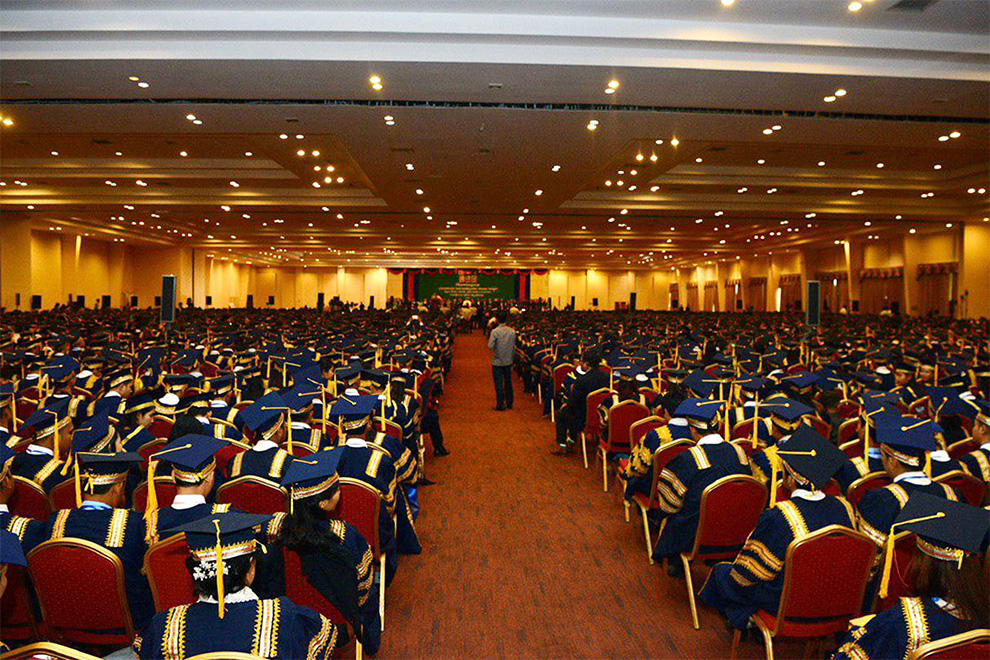
Higher degree by research theses shouldâ be characterised by rigor, originality and ethical scholarship. However, master’s and PhD theses produced by many Cambodian students tend to fall short in quality. The root causes do not stem entirely from students’ lack of knowledge or goodwill, but there are a range of structural and supervisory issues that lead to poor scholarship or low-quality master’s and PhD theses.
In Cambodia, various problems are seen to contribute to poor-quality theses produced by postgraduate or research students. Key issues include a quantity-oriented higher-education expansion, limited resources and facilities, a lack of incentives for research, unclear academic career pathways, weak supervision and language barriers. These factors have all contributed to the low quality of many master’s and doctoral theses. To improve the quality of these theses, it is essential to recognize the causes of the problem, as it will be the first step toward better quality of master’s and PhD theses.
Why Cambodian master’s and PhD theses are low quality
1. Weak supervision
First and foremost, weak supervision is one of the major causes of poor-quality theses. Both master’s and doctoral students need mentorship and training from their supervisors to learn the ropes of academic writing and research. They need consistent support to be able to succeed in academic publishing and other research-related work such as conference presentations.
When supervisors are overburdened with teaching and other administrative workloads, inexperienced in supervision, or mismatched to a student’s topic, poor guidance or weak supervision will occur. As a result, there are unclear expectations, infrequent and ineffective feedback, and shallow or poor thesis review.
Research on factors influencing Cambodian students’ decision to choose between thesis and coursework programmes has shown that Cambodian master’s degree students tended to choose a coursework rather than thesis pathway for graduation because of their limited research skills, time constraints, and the need to balance between study and family commitments.
Other research studies investigating Cambodian academics’ research engagement have also indicated that heavy teaching loads, administrative duties and low academic salaries are the key reasons contributing to Cambodian academics’ limited research engagement.
Their limited engagement with research is somehow linked to their low quality of supervision, as a lack of strong research and publication experiences will definitely limit their ability to provide expert knowledge and evidence-based feedback to students to enhance the quality of their research work and theses.
2. Poor research design
Some theses are poorly designed, with unclear research questions and unfit methodologies. The results are that they do not lend themselves to careful or meaningful investigation. Sometimes the questions and research methods are not aligned. For example, topics that should be investigated qualitatively are examined quantitatively, and vice versa.
Weak methodologies also lead to superficial analysis and unreliable results. The results are theses that have no substance. Once completed, not much value or use can be drawn from them. These issues are coupled with weak quality control mechanisms on the part of the universities, leading to low-quality theses being awarded the degrees.
3. Weak literature reviews
Theses with weak or shallow literature reviews are common, and so are those with unclear theoretical frameworks. A good literature review must discuss relevant theories or concepts, provide sufficient details of relevant studies, and identify gaps in knowledge. This means new research being conducted should speak to existing research or should be situated somewhere in the existing body of knowledge, not being conducted in a vacuum. Another problem is the lack of critical analysis in the literature review or limited use of relevant sources.
I have seen firsthand theses that have fewer references than those of a research paper. I have also oftentimes seen theses with badly formatted reference lists. Without a strong literature review, theses tend to fail to demonstrate originality or scholarly contribution. All of these issues are perhaps linked to the limited access to international academic databases such as the Scopus database, one of the world’s largest abstract and citation databases.
However, the key issue may be related to ineffective supervision, making the students unable to write a good literature review.
4. Poor academic writing
Academic writing is not easy. It requires years of studies and practices to master its nuances. Oftentimes, students can collect good data. They can also conduct good data analysis; however, when it comes to presenting the findings, they fall short.
This issue is linked to their academic writing ability and the weak supervision mentioned above. Few students have been properly trained before they begin writing their theses. Many have no knowledge of academic conventions, including knowledge of in-text citations and the reference list.
As a result, their theses tend to have problems with inconsistent in-text citations and an incorrectly formatted reference list. Moreover, institutional guidelines are often not clear or not widely disseminated to students and faculty members. Therefore, the final version of the thesis may not strictly follow academic conventions, with key elements such as the literature review or the discussion missing or references not up to the academic standards.
5. Limited access to resources
Resource deficiency is another major barrier to high-quality theses. High-quality research, no doubt, needs access to a range of resources, including academic databases or libraries, laboratories and facilities, research funding, quantitative and/or qualitative analysis support, mentorship and academic writing support.
Without effective support mechanisms, students will be left behind, making them unable to develop the necessary knowledge and skills required to produce high-quality theses or complete their theses in an efficient manner.
6. Academic integrity issues
Plagiarism and predatory publishing is another factor linked to low-quality theses. Because many Cambodian students work full-time during their postgraduate studies, they tend to have little time and commitment dedicated to their studies and research.
Therefore, they tend to resort to shortcuts, such as plagiarism by copying and pasting materials from the internet or other sources. They may also opt to publish their work in predatory journals to meet their degree requirements in a quick and easy way. Some researchers have discussed the growing concern of publication in predatory or low-quality journals among Cambodian PhD students and even their advisors.
This practice is a threat to Cambodia’s academia and raises a major concern that could, if not properly addressed, damage the credibility of the individual, institutional and national research standing.
7. Poor thesis examination processes
While weak supervision is common, low-quality thesis examination or assessment processes are also another key issue contributing to low-quality theses. In fact, this issue seems to be one of the main contributors to poor-quality theses.
If weak supervision occurs, a quality thesis examination will save the day. It will help improve the quality of the theses before they are approved for fulfilling students’ graduation requirements. However, based on anecdotal evidence and my own experience as a researcher and university lecturer, I often see examiners not sufficiently motivated to assess or examine theses to the expected standards.
Sometimes a list of 5-7 examiners on the examination committee does not prevent the limited quality of the theses, resulting in low-quality theses being passed or approved for graduation. This is a serious issue that needs immediate action to mitigate the consequences and long-term negative effects of poor thesis examination. Thus, measures to tackle low-quality or ineffective examination processes need to be in place.
Clear and transparent assessment rubrics as well as consistent and high-quality examination practices are essential to ensuring the quality of master’s and PhD theses.
Practical solutions
In seeking practical solutions to the above-mentioned issues, I informally gathered primary data from social media users, including Facebook and Telegram users. The central question asked to collect the data was: What can we do to improve the quality of master’s theses? Although the question focused on master’s theses, it is argued that the proposed solutions can be applicable to PhD theses as well.
Based on a thematic analysis of all comments from 22 social media users (13 on Facebook and 9 on Telegram) who have diverse backgrounds and qualifications (mainly master’s degree students/graduates and PhD students/graduates), seven categories of practical solutions are identified.
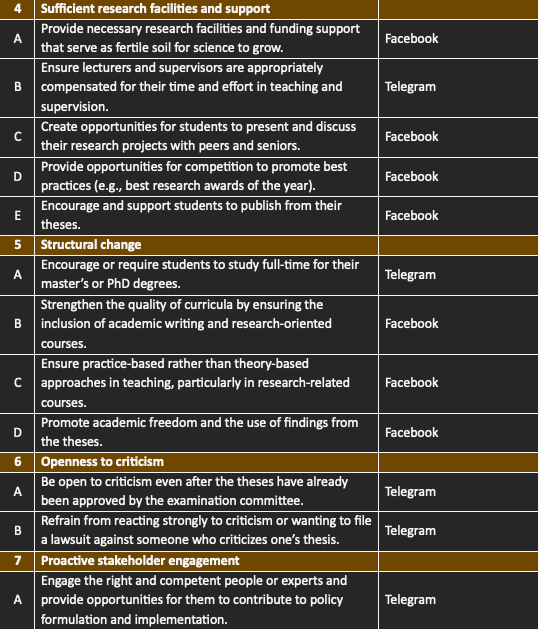
These solutions, albeit not comprehensive, provide a glimpse of what should be done to improve the quality of master’s and PhD theses in Cambodia. These solutions are summarized in Table 1 and briefly discussed below.
Table 1. Practical solutions to improve the quality of master’s and PhD theses
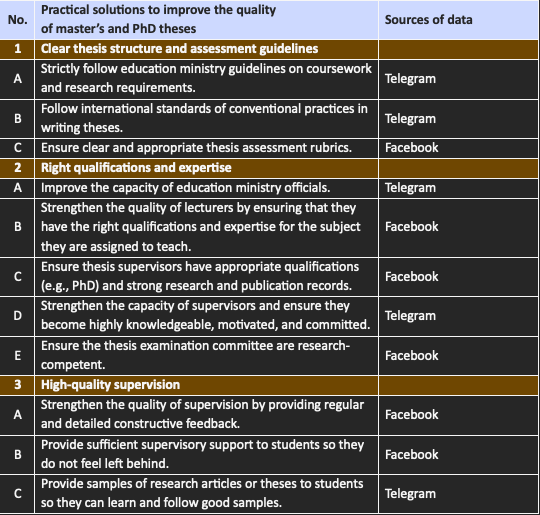
1. Clear thesis structure and assessment guidelines
One important step to improve thesis quality is to ensure students know exactly what is expected of them. This means providing them with clear thesis structures and transparent guidelines for how a thesis will be assessed. To ensure the effectiveness of this solution, the education ministry and higher education institutions should design clear thesis structures and provide well-defined guidelines for thesis evaluation.
These guidelines on thesis structures and assessment should also be widely disseminated to students, supervisors and examiners, as they will help them in writing, mentoring and evaluating theses, respectively.
2. Right qualifications and expertise
High-quality theses, no doubt, also depend on a range of people whose roles are to support students in their thesis writing journey. They include officials, lecturers, supervisors examiners, and administrators. Ministry of Education, Youth and Sport officials need the knowledge and skills to oversee the quality of the provision of master’s and PhD programs.
Lecturers must have the right qualifications and expertise to teach, while supervisors should possess strong academic qualifications and research records. For examiners, they must be research-competent and capable of evaluating theses. As for administrators, they need to provide relevant administrative support to ensure a smooth research process from the beginning to the end. All of these actors need to have the necessary knowledge and skills to make sure students are sufficiently supported to complete their research and write their theses successfully.
3. High-quality supervision
High-quality supervision is essential for high-quality theses. Many master’s degree students and those pursuing PhDs lack the necessary knowledge and skills to conduct research and write theses.
Some of them may have never experienced conducting research when they were bachelor’s degree students. Thus, they need supervisors to give regular feedback and guidance in a process of mentor-mentee relationships. They need their supervisors to guide them, not just sign on their theses at the end.
Effective supervision can build students’ confidence, keep them motivated, and help them complete their theses in an efficient manner. If no proper supervisory support is provided, students will struggle with their thesis writing, potentially leading to delayed completion, poor-quality theses or even dropouts from the programmes.
4. Sufficient research facilities and support
Research facilities and support are essential. Without them, it will be difficult, if not impossible, for a research project to succeed. High-quality research requires access to research facilities, funding and opportunities to share findings or research ideas to like-minded people to receive constructive feedback for improvement.
It is therefore crucial to create plenty of spaces for students to present their research, engage with peers and seniors, or compete for best thesis or research paper awards. All of these will inspire students to try their best to achieve more. It is equally important to encourage and support students to publish their work in peer-reviewed journals to contribute to the academic debates beyond their research contexts.
5. Structural change
Broader structural reforms are also needed to improve the quality of master’s and doctoral theses. Many Cambodian students are pursuing their master’s and doctoral degrees on a part-time basis.
Thus, they may not have sufficient time to commit to their studies and research. They then tend to choose an examination rather than a thesis pathway for graduation. Research is therefore their last option when it comes to meeting the requirements for graduation.
If they choose the thesis pathway, it is essential to create ample opportunities for them to learn to do research and write quality theses. Encouraging them to study full-time is an option but may not be practical, as students need to work full-time to make a living. Thus, curricula should be designed in a way that can allow flexibility of study schedules for students, strengthen their academic writing skills and include research-focused courses early in the programmes.
These research-oriented approaches are essential to support students and prepare them for thesis writing. It is also important to ensure that students have the freedom to select the research topic in which they have strong interest. Findings from their research should also be made available publicly so their research has utility and contributes to the wider academic community.
6. Openness to criticism
Master’s and PhD theses should not be viewed as perfect research products that have no mistakes or issues. In fact, problems are bound, and therefore questions and debate concerning any thesis should be encouraged, rather than shut down. This means that students, their supervisors, and institutions need to be open to criticism or accept criticism, even after their theses have been approved by the thesis examination committee.
Openness to criticism is critical to knowledge advancement and research quality improvement. Students who are new to research may not be able to produce high-quality theses without difficulty. They need feedback and mentoring support from their supervisors and independent constructive feedback from thesis examiners.
If criticism of their theses is received, they should not react to the criticism defensively or, in a worst-case scenario, threaten to file a lawsuit against critics. What they should do instead is to view feedback or criticism as a chance for revision and improvement.
Criticism should in fact be promoted because it can serve as a catalyst for thesis improvement. Rejecting criticism or constructive comments is tantamount to rejecting feedback for improvement.
7. Proactive stakeholder engagement
Finally, stakeholder engagement should be the way forward for improving the quality of master’s and PhD theses in Cambodia. Therefore, it is important to proactively engage all stakeholders beyond the university setting. For example, policymakers, practitioners, educators, researchers and experts need to have opportunities to work together in a harmonious and collegial way to achieve a common goal.
In this respect, a tripartite relationship between the government, universities and industry, or a quadripartite relationship by adding development partners into the equation, should be promoted, as they can serve as a shareholder engagement model for improving master’s and doctoral theses produced by Cambodian students.
When all concerned stakeholders join hands and work together closely, any gaps in knowledge and practices will be reduced. This is critical to bridge the discrepancy between policy and practice, which will potentially result in better policy formulation and implementation.
All in all, there are many challenges and problems that have contributed to low-quality theses produced by Cambodian students. Although the situation may have improved with time, given the rapid development of the Cambodian higher education sector, many issues remain.
While Cambodia aspires to become a knowledge-based society and looks set to transform itself into an upper-middle-income and a high-income country, human capital development in the country needs to keep up with the pace of the development vision and the changing society.
The quality of master’s and PhD theses are indicators of the quality of the education system and the quality of university graduates.
Improving the quality of master’s and PhD theses is not just anyone’s responsibility. It is the responsibility of everyone, including relevant ministries, higher education institutions, lecturers, supervisors, examiners, and students themselves.
Donors and development partners can also provide technical and financial support to address this issue. While multi-stakeholder engagement and collaboration are critical, what is really needed is a clear vision and strong commitment, along with genuine political will and the utilization of both top-down and bottom-up approaches, to raise the standard of master’s and PhD theses produced by Cambodian students.
Kimkong Heng is a Cambodian lecturer and researcher. He is the co-founder and editor-in-chief of the Cambodian Education Forum. The views and opinions expressed are his own.
