



Cambodia’s agricultural sector has long been the backbone of its economy, supporting the livelihoods of millions and contributing to national food security.
As the country strives toward its vision for 2030 and 2050, higher education is increasingly seen as a critical player in transforming this sector to meet both domestic and global demands.
At the heart of this transformation are Cambodia’s agricultural higher education institutions, which are playing a pivotal role in equipping the next generation of agricultural professionals.
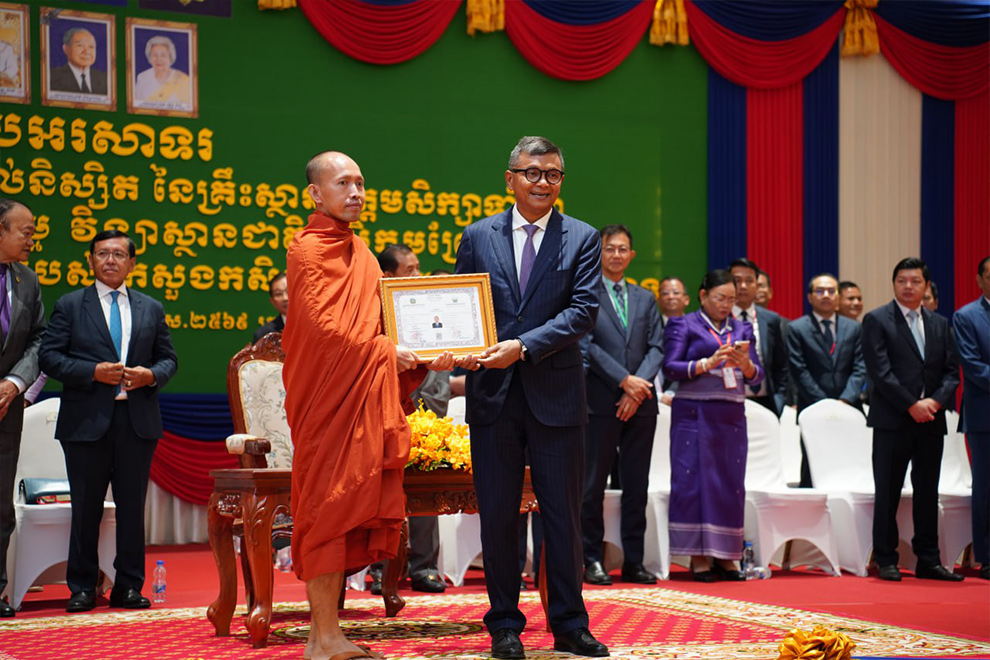
During a September 16 graduation ceremony, 1,487 students from the Royal University of Agriculture, Prek Leap National Institute of Agriculture and Kampong Cham National Institute of Agriculture received degrees in various fields, including veterinary science, agriculture and agricultural engineering.
According to Minister of Education, Youth and Sports Hang Chuon Naron, the high calibre of graduates from these institutions is vital in the country’s quest to accelerate socio-economic development and achieve its long-term goals.
“These graduates are not just students; they are human resources that will contribute to the development of Cambodia, particularly in the agricultural sector,” he emphasised.
Transforming agriculture through education
In Cambodia, agriculture has long been considered a vital sector in ensuring food security, improving living standards and fostering national economic growth.
Over the past 40 years, agricultural higher education institutions have trained more than 30,000 students, 98.8% of whom have found employment, according to Dith Tina, Minister of Agriculture, Forestry and Fisheries.
“The excellent results that the students have achieved cannot be separated from the support, care and encouragement of their families and friends, as well as the dedication and hard work of their professors and teachers,” said Naron.
A standout statistic from the recent graduation ceremony was the 40% female representation among the graduating class.
With 607 women completing their degrees, the agriculture sector in Cambodia is becoming increasingly inclusive, providing women with new opportunities in a traditionally male-dominated industry.
Agricultural education in Cambodia has also kept pace with the changing global landscape, integrating modern technologies such as artificial intelligence (AI) and digital farming into its curricula.
This move is essential as Cambodia seeks to modernise its farming practices, improve productivity and adapt to new challenges, including climate change and fluctuating market prices.
“We must continue to modernize our curriculum to reflect the needs of the labour market and ensure that our students are equipped with the tools and knowledge to succeed in a rapidly evolving agricultural landscape,” Naron explained.
Bridging education and employment
One of the most notable achievements of Cambodia’s agricultural education system is its success in bridging the gap between education and employment.
The country’s agricultural institutions have a long track record of producing graduates who not only enter the workforce quickly but also excel in their careers.
Many alumni have gone on to become commune agricultural officers, a key role in implementing agricultural policy and supporting local farmers across Cambodia.
Agriculture minister Tina highlighted the success of this initiative.
“More than 60 per cent of Cambodia’s 1,600 commune agricultural officers are graduates from these agricultural institutions, showcasing the vital link between education and employment,” he noted.
The emphasis on hands-on learning, fieldwork and internships with both public and private sector partners ensures that students are prepared for real-world challenges and able to contribute to the country’s agricultural development from day one.
Government support and infrastructure development
The government of Cambodia recognises the importance of education in the agricultural sector and has invested heavily in strengthening agricultural institutions.
These investments include infrastructure development, modernised teaching methods and increased funding for research and innovation.
“We are constructing new academic buildings, veterinary hospitals and research facilities to ensure that our students have access to cutting-edge resources that keep them competitive in the global market,” said Tina.
The government’s commitment to improving agricultural education is also reflected in its investment in agricultural research.
The Royal University of Agriculture alone has launched 81 agricultural research projects in recent years, focusing on areas such as crop cultivation, animal husbandry and food processing.
“These research initiatives are crucial not only for academic knowledge but also for addressing practical challenges faced by farmers in Cambodia,” Tina added.
Modern agricultural communities: A key development strategy
Another major initiative supported by Cambodia’s agricultural education institutions is the creation of modern agricultural communities.
These communities bring together farmers and agricultural professionals to create sustainable and profitable farming environments.
By offering long-term contracts with fair prices and access to modern agricultural practices, the government and educational institutions have helped to ensure that farmers are able to sell their products at competitive prices without falling victim to market volatility.
Naron encouraged farmers to join these modern agricultural communities.
“By joining these communities, farmers can access not only better markets but also the support they need to reduce production costs and ensure fair prices,” he said.
Students graduating from agricultural programmes are encouraged to become active participants in these modern agricultural communities, where they can apply their skills to solve real-world challenges while ensuring that the agricultural sector continues to grow and meet the demands of an evolving global market.
Looking ahead: Building a sustainable future
As Cambodia works to achieve its national development goals, agricultural education will remain a central pillar of the country’s success.
With the continued focus on education, innovation and infrastructure development, Cambodia’s agricultural sector is well-positioned to thrive in the years to come, thanks to the graduates who are driving this transformation forward.
“Learning does not stop at school or with a diploma. Continue developing your skills to contribute to the development of Cambodia’s agricultural future,” noted Naron.
As Cambodia looks toward the future, higher education in agriculture will continue to play a vital role in building a prosperous and food-secure nation.
