



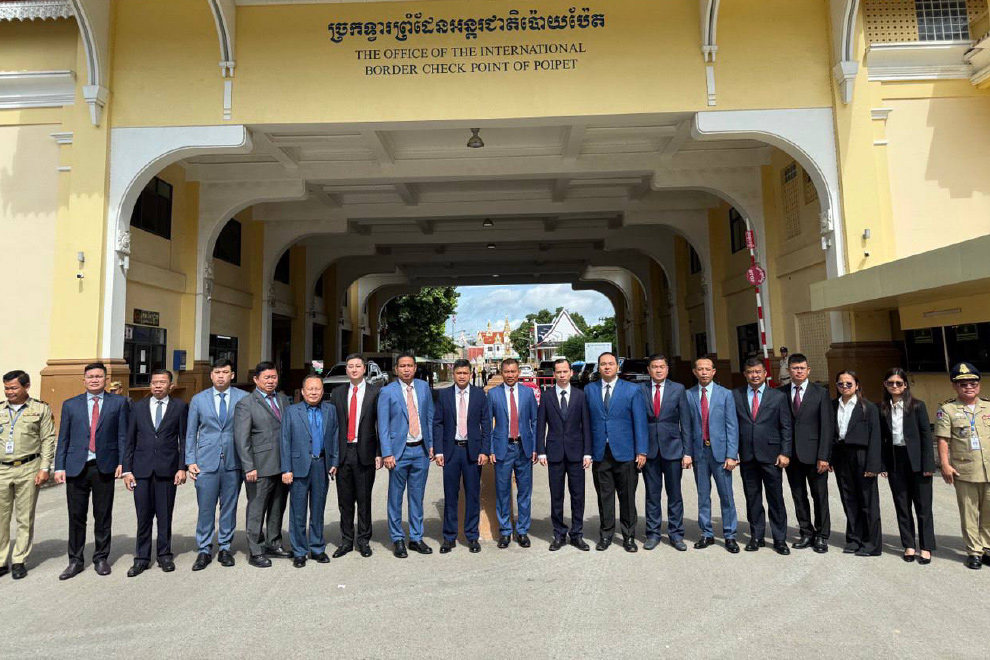
The Cambodian National Police met with their Thai counterparts to discuss strengthening cooperation in preventing and suppressing cross-border crimes, particularly online scams, today, September 16, in Sa Kaeo province, Thailand.
The meeting was held in line with the spirit of the 1st Special Meeting of the General Border Committee (GBC) in Koh Kong Province on September 10, where both sides agreed that the Ministries of Interior and National Police of both countries would meet within a week to establish a joint task force responsible for developing action plans to prevent and suppress cross-border crimes, according to the AKP news agency.
Cambodia has committed to combating all cross-border crimes, including technology-based fraud, and hopes the Thai government will demonstrate similar commitment to ensure the safety of their respective citizens, said a police official who attended the meeting.
Thailand has accused Cambodia of close links to online scam networks, despite evidence that Thailand itself serves as a hub for distributing criminal groups and victims, as recently reported by UNODC. Earlier this year, several Chinese celebrities were deceived by criminal groups in Thailand and trafficked to their networks in Myanmar.
Analysts have suggested that Thailand used the issue of online scams as a pretext to create tensions along the border with Cambodia, such as erecting barbed wire fences, which one prominent analyst said was clearly aimed at seizing land, as seen in the cases of Prey Chan and Chouk Chey villages in O Bei Choan Commune, Ou Chrov District, Banteay Meanchey Province.
Kin Phea, director of the International Relations Institute at the Royal Academy of Cambodia, noted that online scams are a global issue and a cross-border crime, often committed by foreigners in Cambodia, and require joint efforts to suppress. He emphasised that the crimes are not the root cause of Cambodia-Thailand border disputes.
“Online scams are a borderless, visa-less insecurity issue that can be perpetrated from various locations. However, Thailand has repeatedly tried to capitalise on the issue to place blame on Cambodia, portraying it as the source of such activities, while Thailand itself has far higher levels of online scam activities,” Phea said.
He added that both nations should collaborate, with each tackling crimes within their own territories, and not use the suppression of online scams as a pretext for border disputes.
Phea noted that using this issue to fuel border conflicts is a way to divert attention from Thailand’s internal issues and serves as an excuse to pursue expansionist ambitions over Cambodian territory.
