



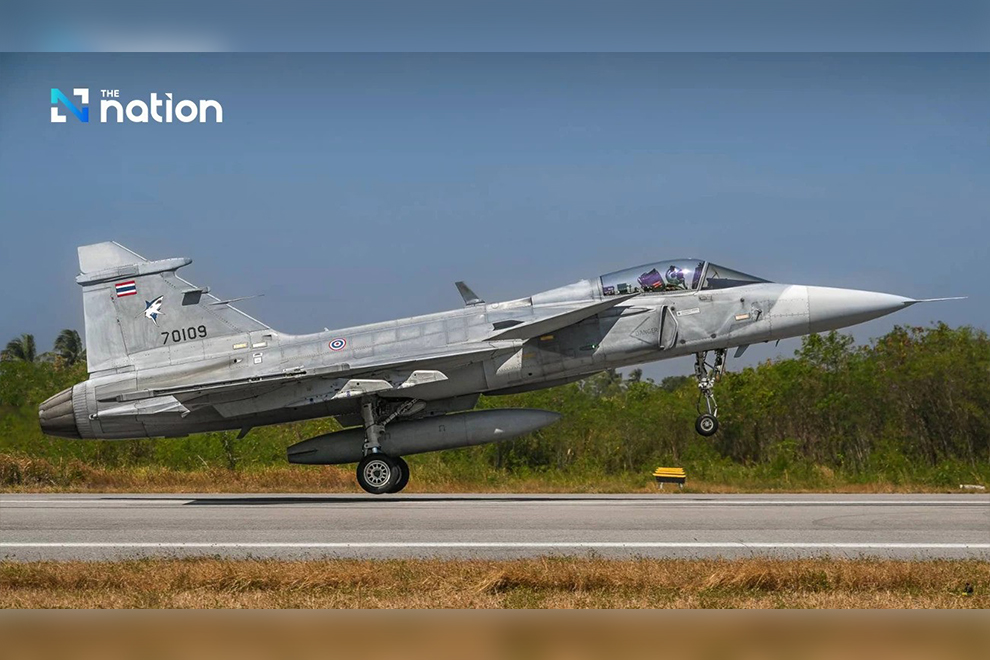
Swedish company Saab’s sale of additional Gripen fighter jets to Thaiand has received a backlash from the Cambodian public. Thailand’s existing Gripens carried out air strikes on Cambodian soil during the July 24-28 border clashes, with some striking civilian infrastructure.
The Swedish government’s decision to approve the half a billion-dollar bid has raised eyebrows in Cambodia, particularly when set against Sweden’s claims of being human right champions.
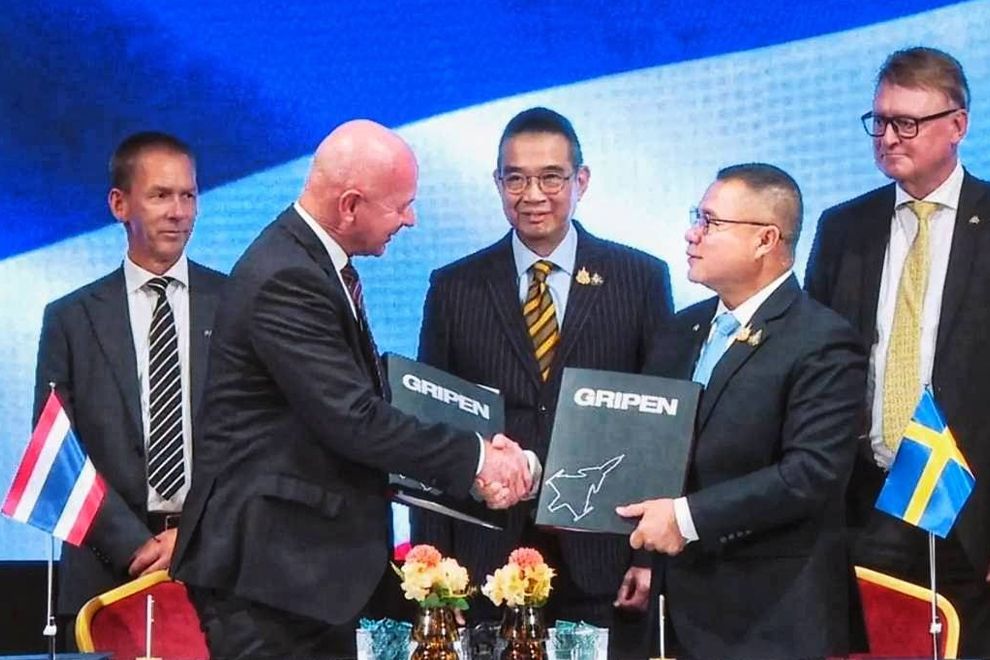
A sale agreement for four jets was signed on August 25 by Thai Royal Air Force Commander-in-Chief Punpakdee Pattanakul, director-general of the Swedish Defence Materiel Administration Mikael Granholm, and Micael Johansson, president and CEO of Saab.
The jets will reportedly cost $556 million, with deliveries to begin this year and continue until 2030.
Swedish Minister for Defence Pål Jonson and Thai Minister of Foreign Affairs Maris Sangiampongsa attended the signing ceremony, according to a Swedish government press release.
“This agreement creates long-term capability, a stronger partnership and deeper defence cooperation between Thailand and Sweden,” said Jonson on X.
Use in combat
Thailand currently operates a fleet of twelve Gripens, with plans to double this figure in the future. They also operate dozens of US-made F-16 Fighting Falcons.
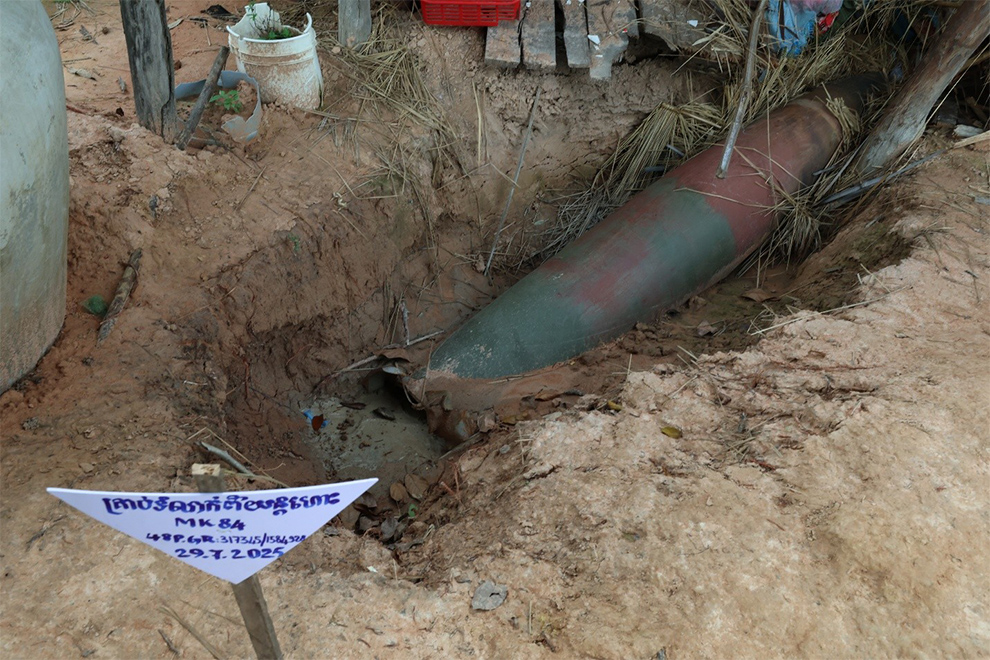
Both types of aircraft were used to attack Cambodian targets during the armed clashes of late July, with the Cambodian Mine Action Centre (CMAC) confirming the use of MK-82 and MK-84 aerial bombs.
Thai media covered the use of the jets extensively, with Khaosod English reported that six F-16s were deployed on July 24. The Thai air force confirmed the use of Gripens on July 26, saying they had been used to hit targets near the Ta Krabey Temple. This marked the first time the aircraft were used in combat anywhere in the world.
CMAC determined that MK-84 and MK-82 bombs were dropped on civilian infrastructure, including Ta Moan Senchey pagoda, where a Buddhist abbot was killed and two laymen injured. Schools and health centres were also struck, and unexploded air-dropped ordnance has been found in people’s homes.
Swedish foreign policy
In June 2020, the Swedish government opted to focus on bilateral development cooperation with Cambodia. It began phasing out its support for the education sector, decentralisation, and environment and climate action.
“The bilateral country window within the regional strategy for development cooperation with Asia and the Pacific allowed for continued direct support to non-state actors in Cambodia in the areas of human rights, democracy and the rule of law,” it said, at the time.
On September 30, last year, the Swedish government closed its section office in Phnom Penh, citing their policy shift, and moved to Bangkok. Civil society organisations in Cambodia attributed the relocation to issues of human rights and democracy.
Analysts view on $500M deal
Several analysts believe the sale of fighter jets discredits the Swedish government, which criticised the human rights situation in Cambodia before relocating their embassy section office to Thailand in 2024.
Pa Chanroeun, president of Cambodian Institute for Democracy (CID), noted that although the sale is a business matter, it appears to contradict Sweden’s position as a country that promotes respect for human rights.
“The sale of fighter jets to Thailand should come with a set of conditions that prohibit the buyer from using them in an unjust and unproportionate war or to attack other nations, violate international laws or cause civilian casualties,” he said.
“These conditions should be imposed, or Sweden may be seen as a bad role model that, on the one hand calls for respect for human rights, but on the other does business with a country that used jets to kill innocent people,” he added.
Kin Phea, director of the International Relations Institute at Royal Academy of Cambodia, warned that Sweden has probably lost the respect of millions of Cambodian people.
“It is not right that a country that always boasts to promoting the value of human rights opts to sell military equipment that was used to cause harm to civilians and cultural heritage sites during the recent conflict. This sale should not happen at all,” he said.
“We are not opposed to any country doing business, but during this period they should not sell weapons to a country that invaded a weaker country and caused so much damage,” he added.
According to Phea, Sweden can no longer preach to other countries about human rights and democracy when they themselves appear to pay no attention to human rights and how their arms were used to kill civilians, destroy infrastructure and damage tangible cultural heritage sites.
“This is immoral and miserable. Sweden has previously criticised the human rights situation in Cambodia, but they don’t really care. Clearly, they have chosen to place money before humanity,” he said.
