



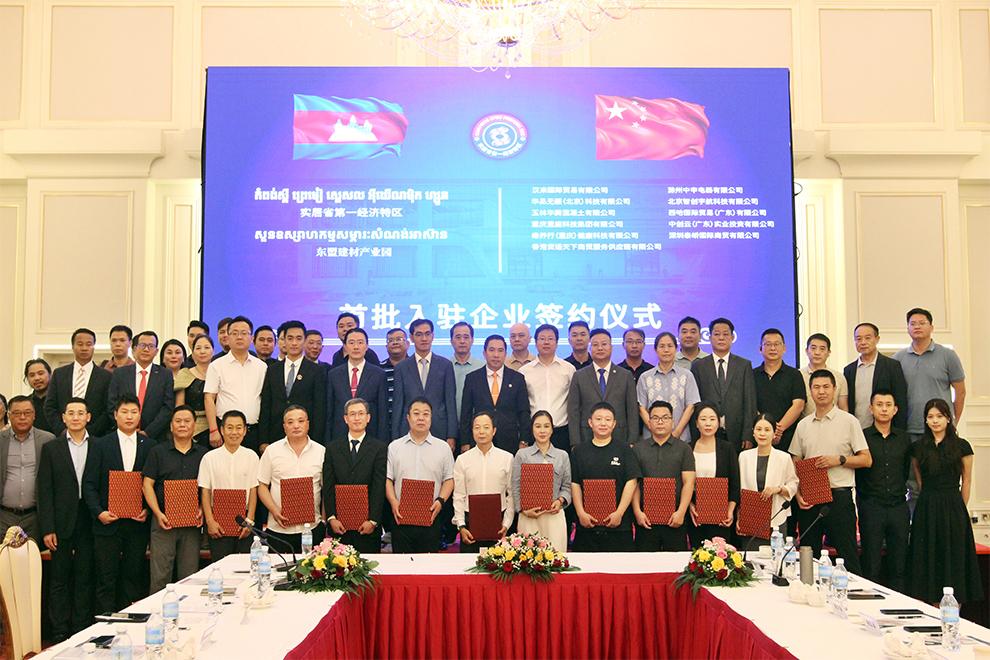
Cambodia is strengthening its industrial base, thanks to fresh Chinese investment in Kampong Speu province. The launch of the ASEAN Building Materials Industrial Park and the signing of 11 new company agreements mark a turning point in the province’s transformation into the country’s second-largest industrial hub, after Phnom Penh.
A signing ceremony for the agreement between the zone and the ASEAN Building Materials Industrial Park Project took place on August 23.
Seng Leap, vice-president of the Kampong Speu Premier Special Economic Zone, explained that 11 companies had signed agreements to invest in the zone, covering industries such as wood processing and textiles, and covering the full production chain from raw materials to finished products.
“Today’s achievements confirm the trust of investors in Cambodia, under the leadership of Prime Minister Hun Manet, and with the guiding vision of Senate president Hun Sen, who has steered the Kingdom towards peace and progress,” said Leap.
The Kampong Speu Premier Special Economic Zone, covering an area of 400 hectares, is located in Phnom Sruoch district, and will absorb a workforce of between 60,000 and 70,000 people when it is fully operational.
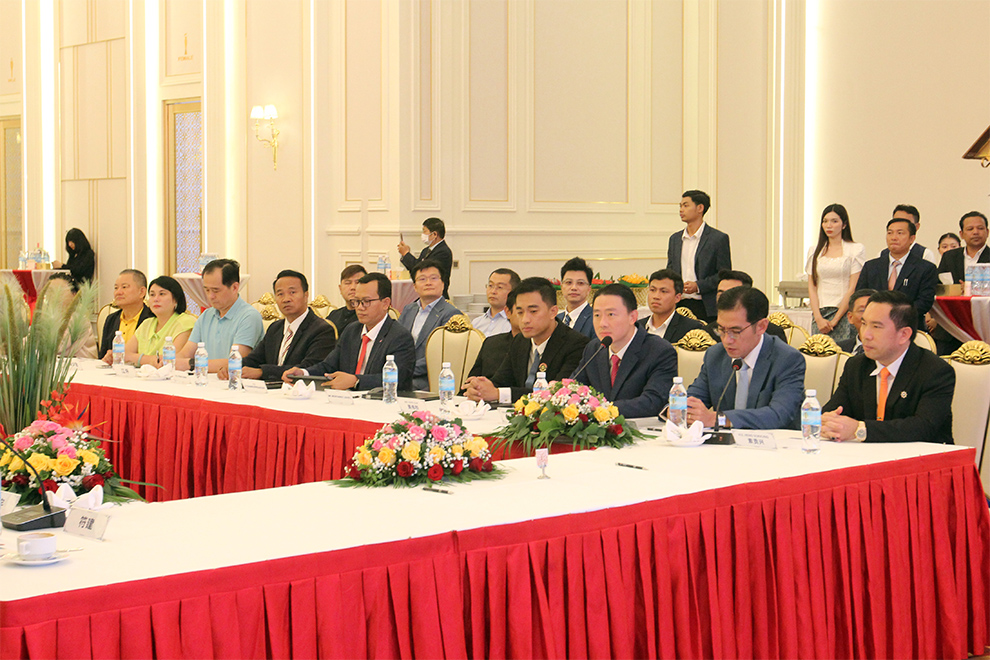
The Council for the Development of Cambodia (CDC) reported that the investment sector grew by 8.5 per cent in 2024. This is projected to rise to 8.6 per cent in 2025, contributing more than 43 per cent of national GDP.
CDC deputy secretary-general Lim Visal said tariff reductions from the US — from 49 to 19 per cent — had also helped maintain Cambodia’s competitiveness.
He noted that former Prime Minister Hun Sen had laid the foundation for this growth more than two decades ago by initiating special economic zones (SEZs).
“Cambodia currently has 32 operating SEZs, attracting nearly 1,000 investment projects and creating more than 200,000 jobs. Exports from these zones have increased significantly to about 6.5 billion dollars in 2024, accounting for 25 per cent of Cambodia’s total exports,” Visal said.
The new Kampong Speu projects highlight China’s role in Cambodia’s industrial expansion under the Belt and Road Initiative.
During the signing ceremony, Quan Shunji, president of the China Asia Economic Development Association, praised Cambodia’s support for Chinese enterprises.
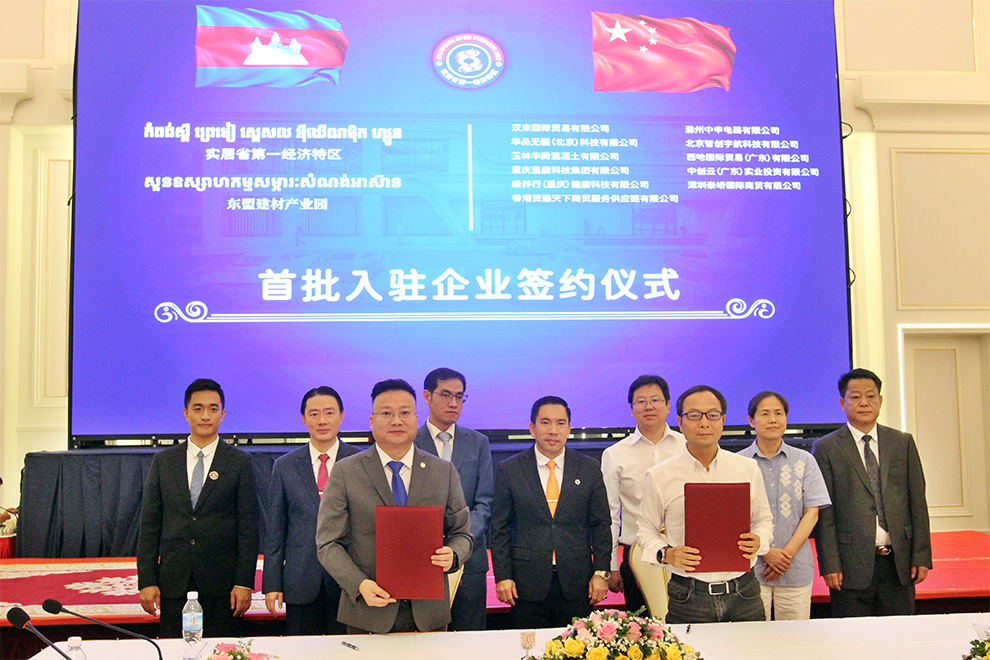
“The ASEAN Building Materials Industrial Park is a national platform for cooperation in the field of building materials and industrialization, jointly established by China and Cambodia,” Shunji noted.
He added that the park is designed to serve the wider ASEAN market.
“Taking advantage of Cambodia’s geographical and policy strengths, the park will focus on the development of green building materials, new materials, furniture, and home appliances injecting new momentum into regional economic development,” Shunji said.
He welcomed Cambodia’s introduction of preferential policies to attract foreign investment and called on enterprises already committed — or preparing to invest in Cambodia — to seize the opportunity and pursue “mutual benefits and win-win growth”.
Among the new investors is Yulin Huateng Concrete Co., Ltd. Company director Mo Zeji sshared how the business is honoured to contribute to the ASEAN industrial chain, calling it “a vivid example of shared growth and mutual development”.
He outlined three priorities for the company’s operations in Cambodia: ensuring product standards that meet Chinese, Cambodian and ASEAN requirements; expanding investment with a second-phase plan to build infrastructure pipeline networks and municipal utility systems, while advancing prefabricated building design and construction; and fulfilling professional responsibilities by respecting local culture, promoting employment and contributing to regional economic development.
“We will provide a stable and reliable supply of concrete to partner companies across various projects in the industrial park,” he said.
Heng Sokkung, secretary of state of the Ministry of Industry, Science, Technology and Innovation, stated that trade between Cambodia and China consistently grow.
He explained that in 2024, bilateral trade with China reached $15.19 billion, setting a new record. In the first seven months of 2025 alone, trade accelerated to $11 billion, a 26.1% increase compared with the same period last year.
Kampong Speu has been designated as one of three provinces prioritised for industrial growth.
Sokkung noted that the government plans to build two logistics hubs in the province, linking it to seaports in Koh Kong and Kampot, as well as the upcoming Techo International Airport and Techo Canal.
“Cambodia’s resilience is further strengthened by multiple free trade agreements, including those with China, South Korea, the United Arab Emirates and the Regional Comprehensive Economic Partnership (RCEP),” he added.
With Kampong Speu rising as a symbol of Cambodia’s rural industrialisation strategy, the government hopes end-to-end production — from raw materials to finished goods — will boost domestic value added and sustain long-term economic resilience.
