



A long-standing territorial dispute led to a 5-day deadly armed confrontation between Cambodia and Thailand along the border from 24 to 28 July 2025. This short-lived but intense military invasion from Thailand underscored two clear vulnerabilities for Cambodia: First, the fragility of border security; and second, the country’s economic dependencies.
As tensions subside, thanks to the immediate and unconditional ceasefire, the current environment presents an unexpected yet strategic and significant economic opportunity: to transform crisis into productive capacity, strengthen domestic production and reduce structural reliance on imports, particularly from Thailand. The surge in nationalist sentiment among Cambodians has fuelled a renewed sense of collective identity and urgency for economic self-determination. This moment calls for a bold national strategy to channel nationalist sentiment into productive reform, especially in hospitality, agro-processing, manufacturing and the production of essential goods.
A significant share of the essential goods consumed domestically, ranging from processed food and construction materials to household items, originates heavily from Thailand. In 2024, Cambodian exports to the neighbouring Kingdom totalled $844.9 million, while imports from Thailand reached $3.44 billion, according to the General Department of Customs and Excise.
The export basket remains concentrated in low value-added goods, such as unprocessed agricultural goods and garments. However, Thai exports to Cambodia consist primarily of refined petroleum, machinery and other high value-added products. This asymmetry reflects a structural trade imbalance that highlights Cambodia’s dependency on Thai industrial output.
Although industrial policies have been introduced to mitigate the imbalance, persistent reliance on imported goods will further constrain domestic industrial development. It also heightens exposure to supply chain disruption and external shocks, as evidenced by the recent unilateral closure of the border by Thai authorities. It severely disrupted trade logistics, supply chains and labour mobility, with immediate adverse effects on household welfare and market functions, particularly in border provinces.
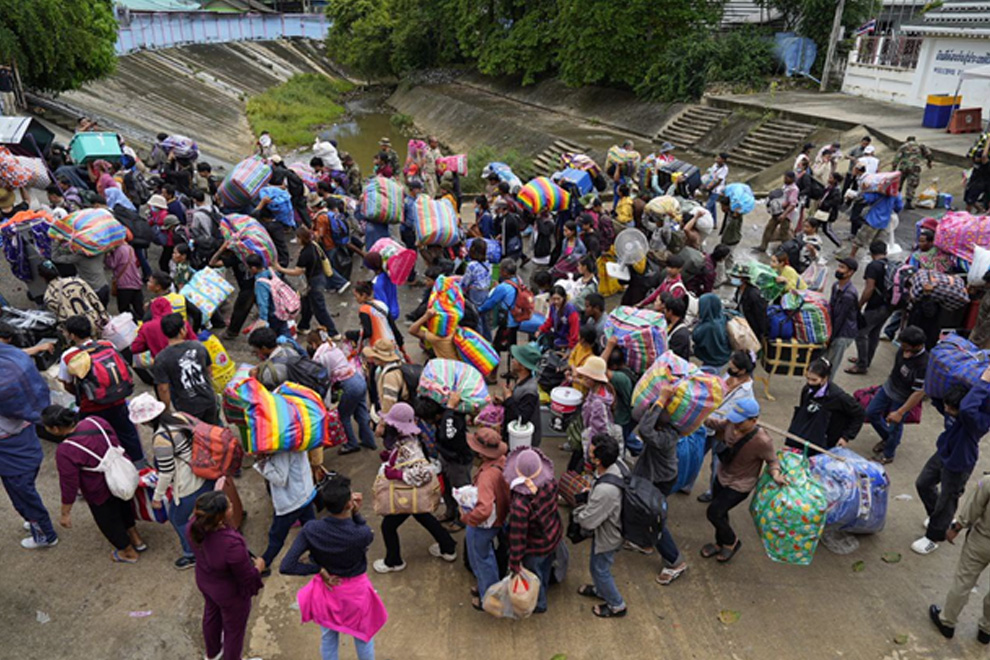
Equally concerning is the heavy dependence on cross-border labour migration. For years, hundreds of thousands of Cambodians have sought employment in Thailand, sending home critical remittances that support household consumption and rural economies. With the escalation of conflict, recent estimates indicate that 203,706 Cambodian workers have already returned from Thailand, and the total will potentially rise to 400,000. The ongoing crisis threatens to deteriorate labour flows, leaving many returnees jobless and their families economically vulnerable. The erosion of remittance income, compounded by trade disruptions, has made it painfully clear that Cambodia must build and pursue a more self-sufficient and resilient economic model by turning a short-lived border conflict into an opportunity for structural reform and domestic capacity building.
Meanwhile, nationalist sentiment is on the rise. Calls to boycott Thai imports have gained traction across social media platforms. The surge in nationalist sentiment, therefore, can be repurposed as a powerful economic lever. History has taught us with numerous examples where national crises catalysed transformation reforms, South Korea’s post-war industrialisation and Vietnam’s Doi Moi economic renewal being among the most cited.
In Cambodia, the current groundswell of national pride and collective identity can be harnessed to support the changes in economic and industrial structures. Policymakers can use this momentum to re-launch “Buy Cambodian” or “Made in Cambodia” campaigns, initially introduced by the former prime minister, to foster consumer patriotism, incentivise local entrepreneurship and, more importantly, promote import-substitution strategies.
Instead of advocating for a blanket boycott of imported products (i.e., boycott Thai’s imported goods), such initiatives, spurred by public outrage over the recent conflict, can play a pivotal role in strengthening domestic supply chains and encouraging the consumption of locally produced goods.
While domestic production may currently face challenges in terms of quality and price competitiveness, heightened national sentiment could induce Cambodian consumers to shift their preferences and accept short-term trade-offs in favour of long-term economic self-reliance. Besides, this sentiment can help mobilise public and political will around ambitious industrial policy goals, particularly the development of small and medium-sized enterprises (SMEs) as engines of domestic production.
Harnessing nationalism as an economic lever can be effectively complemented by the reintegration of (unskilled, semi-skilled and skilled) migrant workers who have returned from Thailand. The return of Cambodian migrant workers represents both the most pressing challenges and promising opportunities for Cambodia’s post-crisis recovery.
As thousands of Cambodian migrant workers have returned home, the country now holds a potential labour force which is ready to be mobilised. These returnees bring with them valuable human capital accumulated through experience in sectors such as construction, textiles, machinery and agriculture. Considering that their skills can be matched with the domestic needs, they could become a cornerstone of Cambodia’s new production economy. Industrial agglomeration zones should be developed in high-potential regions to foster productive investment and promote economies of scale, knowledge spillover and supply chain efficiency, while vocational training programmes can help returnees facilitate the upskilling or reskilling and reallocation into domestic industry. In this regard, the Cambodian government has prioritised technical and vocational education and training (TVET) for 1.5 million young people from poor and vulnerable families, providing a scalable framework that can be leveraged also to include returned migrants.
Realising this potential indeed requires targeted and coordinated policy interventions aimed not only at reducing labour market frictions and maximising skill absorption, but also the mobilisation of capital to support expansion of labour- and knowledge-intensive sectors (e.g., hospitality, agro-processing and manufacturing). However, continued constraints on capital availability and infrastructure gaps will limit the ability of these sectors to scale up and absorb the large influx of returned migrant workers.
As such, mobilising the private sector to accumulate productive capital, either independently or through public-private partnership, could serve as a strategic response. In parallel, revisiting the public financing framework should be treated as an immediate and high-priority policy objective. Key instruments such as tax reforms, expenditure (re)allocation, concessional borrowing and utilisation of a portion of national reserves should be considered to ensure fiscal sustainability. These mechanisms are targeted explicitly toward SME financing and the provision of start-up grants or concessional credit for forming worker cooperatives, particularly those engaged in import-substituting activities.
Such intervention would expand industrial capacity and absorb the returning labour force, while simultaneously generating positive externalities in (rural) economies through employment generation, and local supply chain development and demand spillovers.
Ultimately, transforming crisis into opportunity will hinge on the government’s capacity to align nationalist sentiment with inclusive economic reform, thereby laying the ground for a more sovereign, resilient and self-sufficient Cambodia. Cambodia has endured numerous episodes of hardship and disruption, and this moment will not be an exception.
Hun Seyhakunthy is a citizen of Cambodia and a doctoral student at Nagoya University. The views and opinions expressed are his own.
