



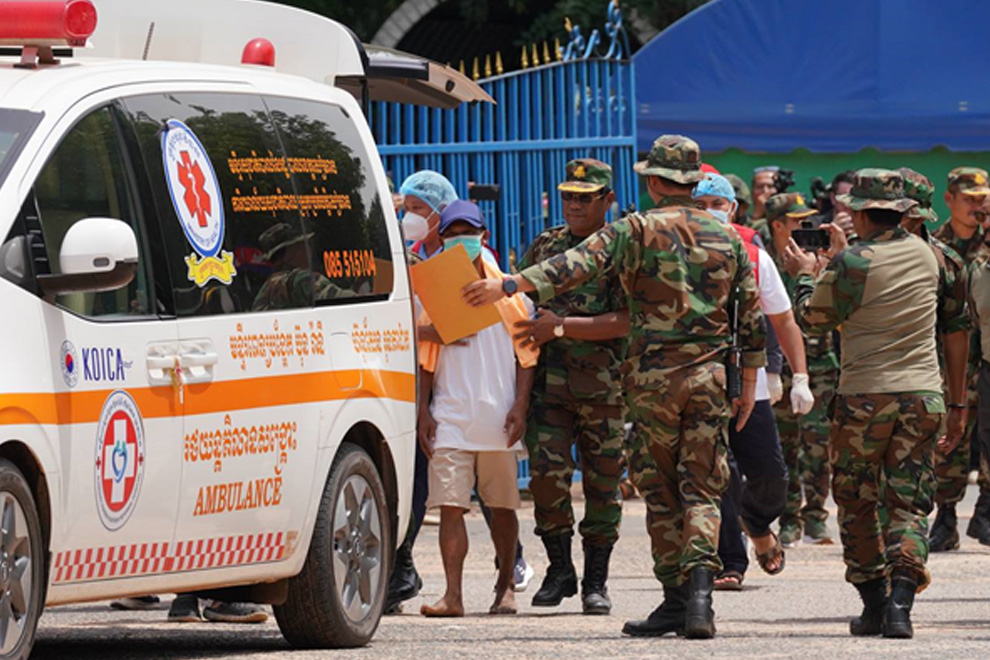
Two Cambodian soldiers came home yesterday. Not whole. One carried a broken arm and a deep wound on his side. The other bore no visible scars but carried the heavy burden of trauma. When they were captured, they were healthy. When they were returned, they were changed.
Their return brought relief, but also anger. Relief because two of our sons are back on Khmer soil. Anger because eighteen of their brothers remain detained. Anger because promises of full repatriation were delayed, adjusted and reduced to gestures. Anger because even in the language of return, conditions were attached, oaths demanded, narratives twisted.
Our anger is real, and it is earned. But it is also dangerous, because provocation is the trap set for us.
History has shown us: when Cambodia was led by reckless extremism and blinded by rage, as under the Pol Pot regime, it was our people who suffered most. We must never repeat that mistake.
That is why Cambodia has chosen a different path today. We remain calm. We remain disciplined. We continue to respect the ceasefire we signed, even when the other side delays, even when we are tested, even when we are humiliated. This is not weakness. It is strength. It is dignity.
And it is also law.
Under the Third Geneva Convention (1949), captured soldiers must be treated humanely (Article 13), never coerced (Art. 17) and repatriated without delay after hostilities cease (Art. 118). The Universal Declaration of Human Rights guarantees the right to life and security (Art. 3), freedom from arbitrary detention (Art. 9) and protection from torture or cruel treatment (Art. 5). The International Covenant on Civil and Political Rights reinforces these protections, requiring freedom from torture (Art. 7), liberty and security (Art. 9), and the right to humane treatment (Art. 10).
Both Cambodia and Thailand are parties to the Convention Against Torture, which prohibits practices such as physical injury, psychological trauma, coercion and denial of care – conditions that have been observed or publicly reported in connection with our returned soldiers. Cambodia has also ratified the Convention on Enforced Disappearance, which Thailand has signed. These obligations are not optional; they are binding duties under international law.
Selective release is not generosity. It would constitute a flagrant violation. It is a breach of obligation.
Cambodia, in contrast, has kept its commitments. We have opened our border sites to international diplomats and media, not for theatre, but for transparency. Others may invite observers to staged tours, carefully managed for optics. We welcome scrutiny because we have nothing to hide. The truth is not choreographed. It is steady, open and verifiable.
Even for the upcoming General Border Committee (GBC) meeting, Cambodia called for the third parties who helped broker the ceasefire to attend as witnesses throughout the talks.
Thailand has now agreed to their presence, though only on the final day. Our request is not for favour, but for fairness: that what is discussed in the room can be confirmed beyond the room. Transparency ensures that when the meeting ends, there is one shared record of what was agreed, not left open to competing versions. True transparency is complete, not partial, and only when it is whole can it strengthen peace.
And in that same spirit of discipline and openness, we must also guard our own response.
Even as we hold to peace, we know provocations will not end. Provocations, even when presented as gestures of peace, will keep coming. But we must not fall into their trap.
We must remain calm for the eighteen who are still in captivity. We must remain calm for the thousands of soldiers still at the border. We must remain calm for Cambodia itself. Because one reckless move, one angry act, could undo the fragile peace that we have managed to hold. And if we lose that peace, it is not only soldiers who will pay, but our families, our farmers, our children.
Two returned is progress. But two is not enough. All must return, not as a gesture, but as a duty under law.
Every delay, every excuse, every oath forced under duress is already written down – in history, in the region and in the eyes of the world. And the world will know who respected the ceasefire, who complied with the Geneva Conventions and who tried to manipulate them.
We will continue to act with discipline and law, and time will tell who honoured peace, who respected law and who played with it.
The world will see. History will judge. And Cambodia will endure.
May courage guide us, and time prove us right.
Meas Sopheak is a citizen of Cambodia and a doctoral student at Nagoya University. The views and opinions expressed are his own.
