



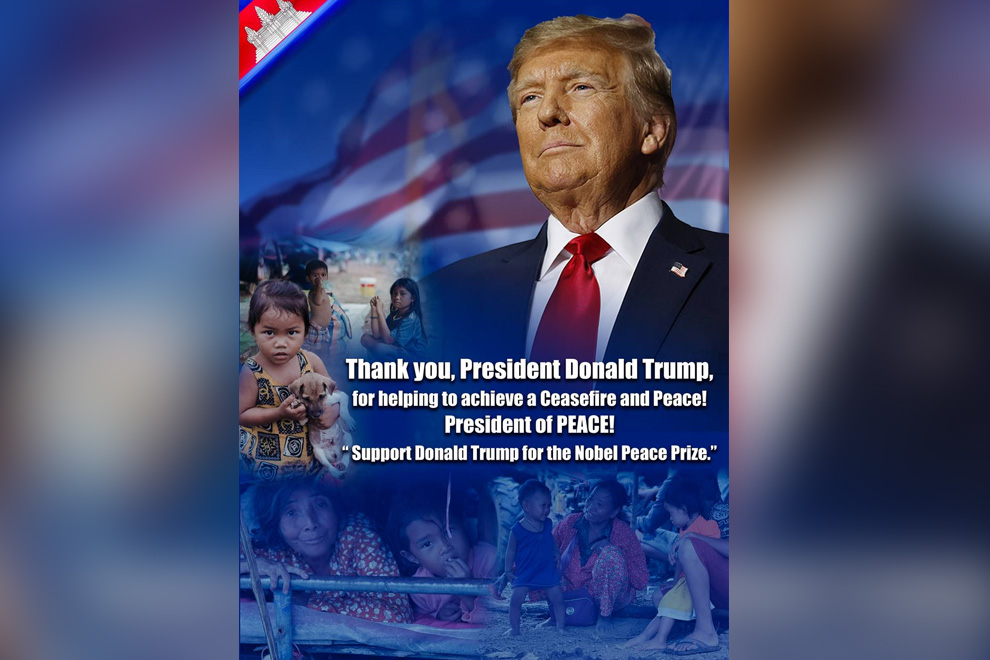
World peace is not made by chance — it requires resolve, leverage and sometimes a willingness to use the instruments of power to save lives. In recent weeks, a brutal border conflict between Cambodia and Thailand claimed dozens of lives and displaced hundreds of thousands. It was at this precipice that US President Donald Trump intervened — and his actions warrant serious consideration for the Nobel Peace Prize.
From July 24, escalating clashes along the Cambodia–Thailand border — especially around the disputed Preah Vihear and Ta Mone Thom temples — left at least 41 people dead and displaced 200,000 to 300,000 civilians. Shockingly intense combat involved land mines, artillery shells, tank assaults and even F‑16 airstrikes by Thailand.
The violence followed a May 28 skirmish which killed a Cambodian soldier, escalated nationalist rhetoric and led to diplomatic breakdowns.
Under Malaysia’s leadership as ASEAN chair, Prime Minister Anwar Ibrahim hosted Cambodian Prime Minister Hun Manet and acting Thai PM Phumtham Wechayachai in Putrajaya for peace talks on July 28. They agreed to an out‑of‑cycle “immediate and unconditional” ceasefire, set to begin at midnight and to be followed by the establishment of military and diplomatic coordination committees in early August.
The ceasefire held, though observers warn it remains fragile without on‑the‑ground monitoring and concrete de‑escalation mechanisms.
Crucially, Trump intervened via strategic pressure: he privately called the leaders of Cambodia and Thailand on July 26, warning that no US trade deals would proceed — and tariffs as high as 36% would be imposed — while fighting continued.
He publicly stated the same on Truth Social, emphasising that trade talks would only resume when hostilities ceased. Hun Manet confirmed the call took place and stated Cambodia’s full support for the ceasefire proposal; Thailand also affirmed its agreement “in principle”.
US Secretary of State Marco Rubio confirmed US officials were on the ground in Malaysia to support negotiations & facilitation.
Within 72 hours of Trump’s message, both sides agreed to meet, negotiate and cease fire. On July 28, Malaysian‑led talks produced a ceasefire that halted troop movements, planned military‑level meetings and allowed displaced civilians to return home.
Trump publicly declared himself the “President of Peace”.
“By ending this war, we have saved thousands of lives… I have ended many wars in just six months,” he said.
He expressed the same sentiment in an earlier meeting, noting that he “solved that war … we solved it through trade”.
The Nobel Peace Prize honours peace promoters whose actions have tangible impact, not just rhetoric.
Trump’s intervention fits that mould.
He prevented a violent war, one between two sovereign states, that endangered civilians across Southeast Asia.
He employed economic diplomacy — no troops, no UN resolutions, just clear consequences tied to real negotiations.
He has done this before: Trump brokered the Abraham Accords, reducing Middle East tensions; he engaged North Korea diplomatically; he is one of few presidents in recent decades who did not start a new war.
That ASEAN and Malaysia provided the venue and initial framework is true, but those talks stalled without clear pressure.
Thailand remained sceptical publicly and insisted Cambodia act first, yet the ceasefire proceeded once US leverage was applied, highlighting the gap between diplomatic window-dressing and real de-escalation.
As the peace remains fragile and requires monitoring, experts recommend international observers to ensure adherence; US trade leverage helped jump‑start follow‑through committees.
Trump’s intervention in the Cambodia–Thailand conflict showcases modern peacebuilding: fast, force‑aware results‑oriented. He didn’t send troops — he sent a message. When diplomacy stalled, he wielded trade tariffs to open talks and save lives.
That is precisely the kind of high-impact, real-world intervention the Nobel Peace Prize seeks to recognise. Critics may deride his style, but when it comes to outcomes, few can dispute facts: a war was halted, refugees can return and two governments agreed to negotiate.
If this is not merit for a Nobel Peace Prize, then the prize’s own criteria need revaluation. Donald Trump’s leadership in averting conflict deserves serious global consideration — for the sake of peace, stability and the lives saved.
Vichana Sar is a researcher based at the Royal Academy of Cambodia. The views and opinions expressed are his own.
