



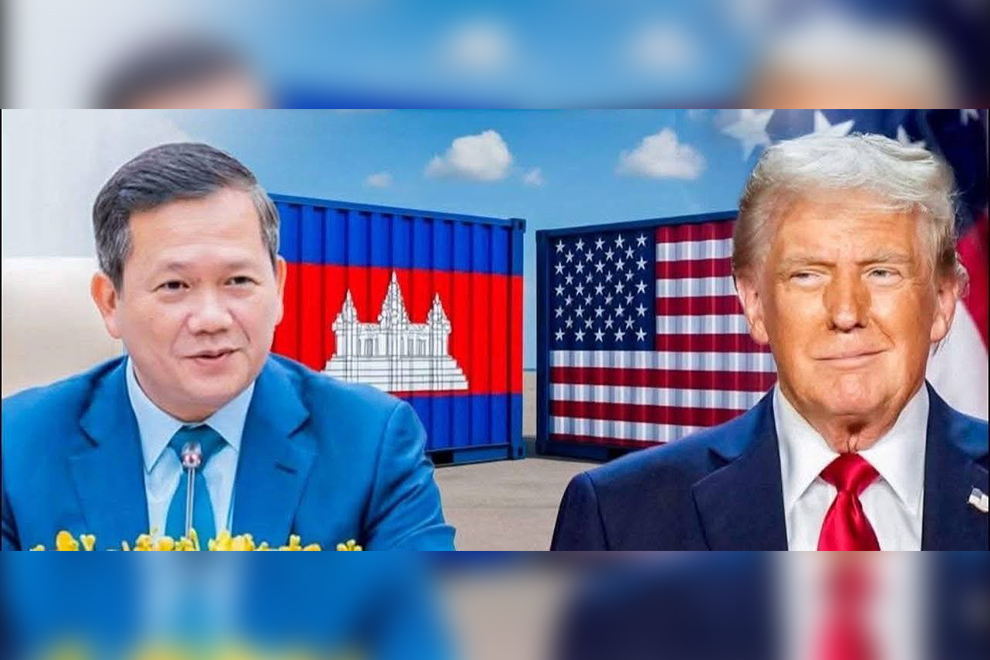
Senior representatives from the Cambodian government and the private sector have expressed their appreciation for the positive outcome which resulted from the hard work of the Kingdom’s tariff negotiation team’s efforts — ultimately achieving results that exceeded expectations.
US reduces tariffs on Cambodian goods to 19%
Just hours before new “reciprocal” import tariff rates on goods entering the US took effect on August 1 (US time), the US administration of President Donald Trump announced that the rate imposed on Cambodian goods would be 19%, a substantial reduction from the 36% he announced on July 7, and far lower than his initially shared plan of 49%, announced on April 2.
Cambodian Prime Minister Hun Manet took to social media this morning to share the positive change. He called this great news for the people and the economy of Cambodia, supporting further national development.
“I would like to thank President Donald Trump for personally taking interest in initiating and pushing for a ceasefire between Cambodian and Thai troops, and for continuing to monitor the implementation of that ceasefire until lasting peace and normalized Cambodia–Thailand relations are achieved. Moreover, the president has shown understanding toward Cambodia by providing opportunities to strengthen economic development and trade relations between our two countries,” he said.
He explained than during his July 26 and 28 phone calls with the US president, he emphasised the importance of peace and development in Cambodia — especially since the country has only recently emerged from over 500 years of internal conflict. During these conversations, he requested that the US consider reducing reciprocal tariffs on Cambodian goods to a level that would support national development and improve citizens’ livelihoods.
He noted that Trump expressed a strong interest in Cambodia’s painful history and showed his compassion in helping the Cambodian people find peace and pursue development. In response to the reciprocal tariff request, Trump reportedly said on July 28, “I will make you happy”, and has now fulfilled that promise by reducing the reciprocal tariff to 19%.
Manet also took the opportunity to praise the task force that handled the tariff negotiations with the US, chaired by Sun Chanthol, for their tireless efforts in securing such a favourable outcome.
Cambodia has stronger potential to attract foreign investment
During an August 1 press conference at The Council for the Development of Cambodia (CDC) headquarters, Sun Chanthol, CDC first vice-president and chair of the Cambodia-US Trade and Investment Coordination Task Force, shared his belief that the 19% rate would allow Cambodia to boost exports to the US and serve as an incentive for authorities and the private sector to promote and attract more foreign direct investment.
He highlighted ongoing government efforts to improve infrastructure — roads, ports, airports and notably the construction of the Funan Techo Canal — to facilitate faster and cheaper goods transportation.
Chanthol also mentioned Cambodia’s efforts in developing renewable energy plants, which further enhance the country’s attractiveness to investors and increase international orders.
“This reciprocal tariff rate will help sustain existing factories in Cambodia and allow for expansion. It will also attract more investment, leading to job creation for the people,” he said.
He also noted that Cambodia has set reciprocal tariffs on US imports at 0%.
The new rate will boost Cambodian exports to the US
Ly Kunthai, president of the Cambodian Investors Federation and the Cambodian Footwear Association, told The Post on August 1 that the US government’s decision to reduce reciprocal tariff from 49% to 36%, and finally to 19%, will have numerous positive economic and social effects. It will increase foreign direct investment in factories and enterprises, boost international orders and create jobs — especially for Cambodians returning from work in Thailand. He called this a major achievement for both the government and private sector.
“The tariff reduction will increase the volume of Cambodian exports to the US and encourage factories to expand their production lines, which could require tens of thousands more workers. This result will make Cambodia more competitive in the region and among US exporters,” he said.
He also noted that alongside the reciprocal tariff success, Cambodia is making progress in resolving the armed conflict with Thailand.
“I strongly believe this is a major achievement under the wise leadership of Prime Minister Hun Manet, especially with the top leadership’s strategic approach and negotiation methods. This is a great success for investors, factory owners and the Cambodian people,” he added.
Cambodia’s tariff rate Is more competitive than most peers
Economist Lor Vichet noted that the 19% rate on Cambodian goods will have numerous benefits in accelerating economic growth and development. He believes the lower rate will attract more foreign investors to set up businesses in Cambodia.
He also pointed out that Cambodia now enjoys a lower rate than countries like Bangladesh, Vietnam, Laos, Myanmar and Sri Lanka, which export similar products to the US (garments, travel bags and footwear).
Nonetheless, he said Cambodia must continue developing its logistics, energy systems and legal framework to reduce production costs and enhance international competitiveness.
“We need to consistently streamline our customs procedures and improving our logistics connectivity in order to reduce overall transportation costs for producers to optimise their supply chain efficiency and cost effectiveness. We also need to align regulations with international standards and business practices so that Cambodia can improve on its ease of doing business index and increase its competitiveness for attracting future FDIs,” he continued.
Cambodia–US bilateral trade continues to grow
According to the General Department of Customs and Excise (GDCE), bilateral trade between Cambodia and the US in the first five months of 2025 reached $4.48 billion, an increase of 27%. Cambodia exported $4.35 billion (up 27%) and imported $120 million (up 25.6%).
In 2024, total trade between Cambodia and the US was $10.18 billion — an 11.2% increase. Cambodian exports to the US reached $9.9 billion (up 11.4%), while US imports totalled $264.14 million (up 2.7%).
