



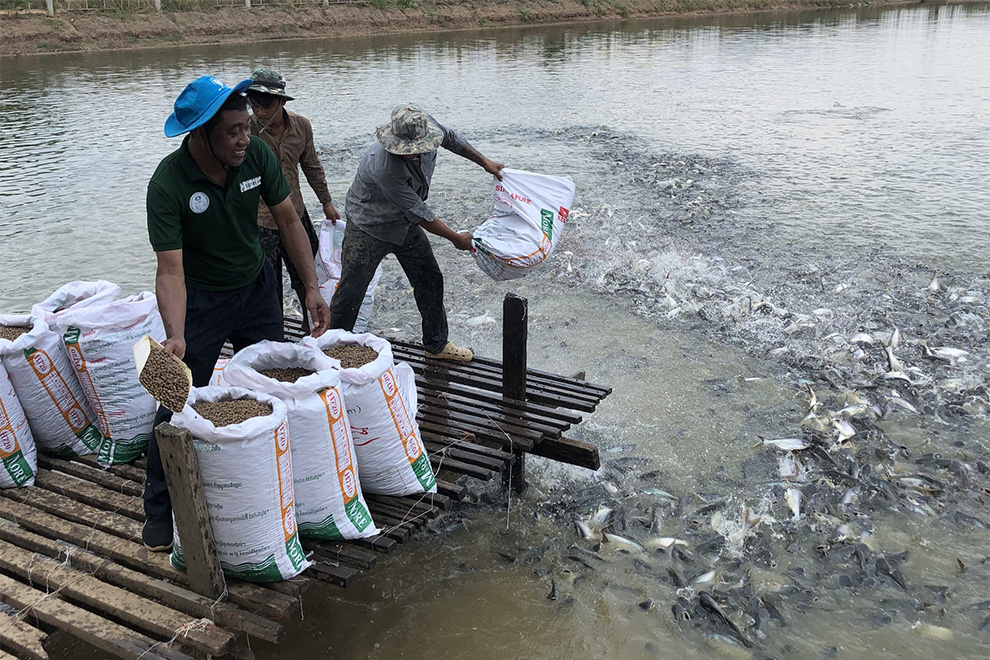
The Cambodian Aquaculturist Association (CAA) has expressed their support for the Ministry of Agriculture, Forestry and Fisheries’ policy of promoting the increased use of domestically produced aquaculture products, while ensuring that imported fish products are subject to quality checks and clearly defined quotas.
Cham Sam Ath, a fish farm owner in Rokar Kong 2 commune, of Kandal province’s Mok Kampoul district, took to social media to share how in his more than fifteen years in the industry, he has noted the market difficulties faced by his fellow aquaculturists. Buyers frequently depress prices, leading to low profits, which has caused some farmers to abandon fish farming for other livelihoods.
“I fully support the government’s policy to limit fish imports in order to promote high-quality, safe local products. I call on the government to strengthen measures to stop imports and support the domestic fish industry,” he said.
Meanwhile, in Kampong Chhnang, fish farmer Hay Chenghorn also expressed his gratitude to the ministry for consistently supporting local fish farming and not siding with the Association of Fish Suppliers in Cambodia, which aims to increase fish imports from neighbouring countries.
“I support the agriculture ministry and the Fisheries Department in tightening fish import regulations into Cambodia. I urge the Association of Fish Suppliers to prioritise the purchase of local products, so fish farmers can enjoy a better livelihood,” he said.
On July 6, ministry spokesperson Khim Finan announced that fish imports from neighbouring countries will be subject to specific market demand quotas. All imported fish must undergo strict inspections from this point forward. The ministry is not outright banning fish imports but will carefully regulate and set quotas to protect local aquaculturists and consumers.
“The ministry’s policy aims to protect both producers and consumers, with the goal of ensuring that Cambodia’s aquaculture sector can provide consumers with an affordable, sufficient supply. The ministry’s long-term goal is to strengthen domestic aquaculture production. That’s why we’ve recently tightened import controls and are only allowing imports of fish species that are not farmed locally or are required to meet domestic demand,” he said.
He reiterated that imports are not completely banned. As the governing authority on this issue, the ministry urged businesses to purchase all available local fish before seeking to import more.
“The concerns raised by local aquaculturists are in response to the Fish Suppliers Association, which has opposed the ministry’s measures because they want unrestricted import rights without clear regulation. However, the ministry is committed to protecting and prioritising the development of domestic aquaculture,” he added.
CAA chairman Lempho Sothavrith expressed support for Prime Minister Hun Manet’s recommendation to promote local production and consumption. He added that natural fish sources are insufficient to meet the national market demand, making aquaculture vital for supply.
He explained that the CAA has four clear positions.
Fish fry (juvenile fish) imports must have a clear origin. All aquaculture product imports must follow quota regulations to protect local producers and be monitored from source to destination. Imports must be taxed. Finally, the association requested that the government implement a quota system to allow local producers to grow strong enough to meet 100 per cent of national demand.
