



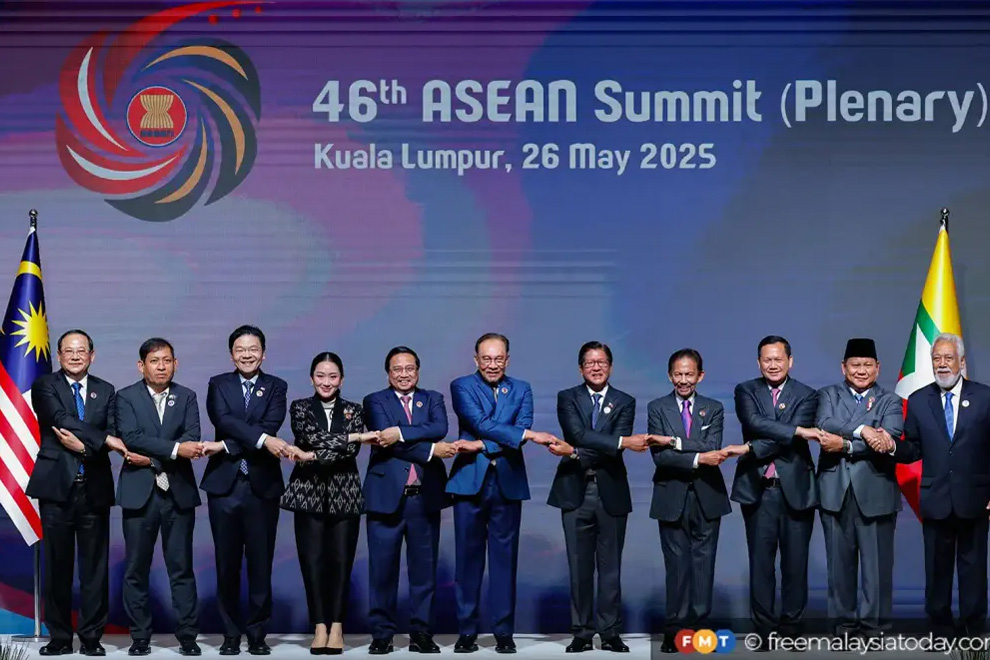
As Malaysia reaches the halfway mark of its 2025 Chairmanship of Asean, five major developments are quietly influencing the regional agenda.Here’s a look at how Kuala Lumpur is steering the bloc with quiet determination.
Asean Community Vision 2045
During the 46th Asean Summit in May, leaders unveiled the Asean Community Vision 2045 (ACV2045) — a long-term strategy aimed at preparing the region for future upheavals and opportunities.
The declaration emphasises building Asean resilience and encouraging collaborative, forward-thinking responses to regional and global shifts.
Asean Secretary-General Kao Kim Hourn explained that the vision takes into account global megatrends and outlines practical strategies to address them over the next two decades.
“This year marks a decade since the adoption of Asean Vision 2025, also launched under Malaysia’s leadership. Now, we’re doubling the horizon to 20 years with greater ambition,” he explained.
The ACV2045 is based on four foundational pillars: political-security, economic, socio-cultural cooperation and regional connectivity.
Myanmar: Quiet Progress Toward Stability
After the devastating earthquake in Myanmar this March, Malaysian Prime Minister Anwar Ibrahim initiated dialogue with both the junta and opposition forces, leading to a brief truce to allow aid deliveries.
At the Asean Summit, member states also considered assigning a permanent special envoy to Myanmar, replacing the previous rotating system to ensure more consistent engagement.
This move reflects Asean’s shift toward a more structured response to the ongoing crisis, which began with the 2021 military coup and has since worsened.
Thomas Daniel of the Institute of Strategic & International Studies noted that the change suggests Asean is beginning to acknowledge the need for a more permanent approach — though much will depend on how the envoy’s responsibilities are defined.
“Asean has always balanced ideals with practicality, and the same should apply in how it handles Myanmar,” he added.
Asean-GCC-China Summit
Against a backdrop of global economic division, Kuala Lumpur hosted the first-ever Asean-GCC-China Summit on May 27.
Prime Minister Anwar expressed confidence that enhanced cooperation between Asean, the Gulf Cooperation cCouncil (GCC) and China could drive greater resilience and prosperity.
Oh Ei Sun of the Singapore Institute of International Affairs noted that as tensions between China and the West continue, Beijing is strengthening ties with Southeast Asia and the Global South.
Julia Roknifard of Taylor’s University pointed out that the Gulf states are increasingly looking for reliable partners beyond traditional Western allies. Trade between Asean and the GCC is expected to reach $180 billion by 2032, while Asean-China trade reached nearly $697 billion in 2023.
Timor-Leste
Timor-Leste is on track to become Asean’s newest member by October 2025, marking the bloc’s first geographic expansion in nearly 20 years.
Azmi Hassan of Akademi Nusantara said Malaysia’s long-standing support — and Prime Minister Anwar’s emphasis on regional unity — have smoothed the way for Timor-Leste’s accession.
He added that full membership for Timor-Leste could also enhance the bloc’s overall economic strength.
Asean Power Grid
The long-planned Asean Power Grid (APG) initiative — meant to link the region’s power infrastructure — is gaining momentum, with member countries set to sign an updated memorandum of understanding (MoU) by October.
Following the 43rd Asean Senior Officials’ Meeting on Energy, Malaysian energy official Mad Zaidi Karli confirmed the finalisation of the MoU’s terms.
The EU has expressed keen interest in the project. During the 3rd Asean-EU Energy Dialogue, EU ambassador Sujiro Seam said European governments, investors, and private companies are eager to support the APG.
“This isn’t just about governments or institutions,” he noted.
“Our private sector is also ready to invest in Southeast Asia’s energy future,” he added.
