A group of young Cambodian artists and social innovators are turning imagination into a form of climate action, using the global “Solarpunk” movement to reimagine what a greener, more community-driven Phnom Penh could look like.
The “Solarpunk 2.0” exhibition, set to open on February 21 from 1pm at Maloop Garden, brings together artists, researchers and environmental advocates to explore hopeful and culturally rooted visions of Cambodia’s sustainable future.
The initiative builds on last year’s showcase during Clean Energy Week and expands discussions around renewable energy, green urbanism and community resilience.
Rather than focusing on climate anxiety, the exhibition promotes optimism and collective agency.
Solarpunk, a literary and artistic movement, envisions futures powered by renewable energy and shaped by local communities, blending ecological awareness with do-it-yourself ethics and cultural identity.
“For Phnom Penh to be a green utopia, it should first start with an idea, an imagination,” said Norak, one of the participating artists and a young researcher at Future Forum, explaining that “It’s not with the first brick, or the first layer of concrete. But it starts with the fiction that is our dream.”
Cambodia and the broader Southeast Asian region are among the most climate-vulnerable in the world, facing rising temperatures, flooding and environmental degradation.
While policy debates often centre on mitigation and adaptation strategies, organisers say there is an urgent need to inspire public imagination about what sustainable futures could look like.

The exhibition is supported by the Heinrich Böll Foundation, which has worked for more than two decades on commons-based economies and community self-organisation, including with Indigenous communities in Cambodia.
Organisers say the Solarpunk framework aligns with efforts to envision decentralised, community-focused development models that draw from local traditions and knowledge systems.
Solarpunk 2.0 also continues the Solar Art Residency initiated during Clean Energy Week by Energy Lab Asia.
The residency previously brought artists to Kampong Thom province, where they engaged with Sambor Village and the Kui Indigenous community of Phum Andas, exploring traditional ecological knowledge and community concepts such as collective support systems.
This year’s exhibition features a mix of returning works and new interactive installations.
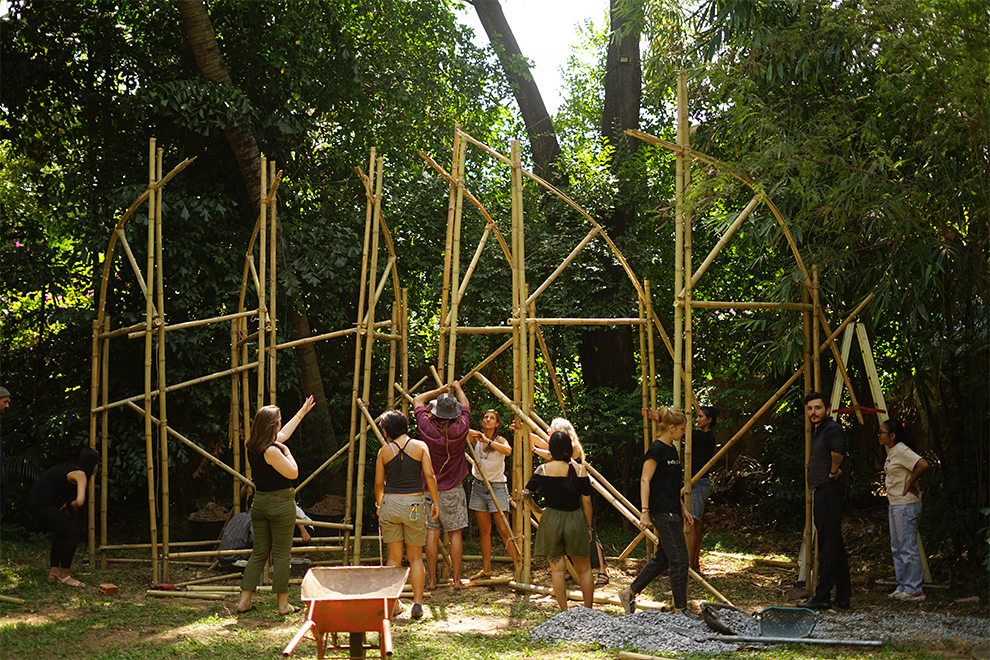
Live painting on recycled solar panels donated by private partners will take place near a bamboo pavilion at Maloop Garden, symbolically merging renewable energy materials with artistic expression.
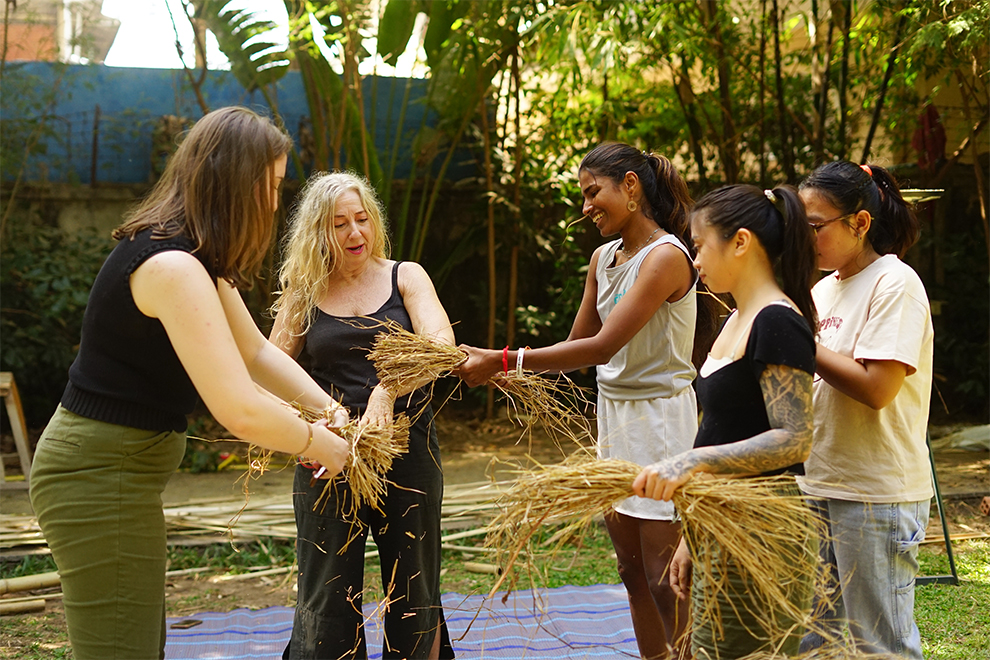
Artists will also present collaborative mapping projects exploring green urbanism and community redesign, including outcomes from workshops involving more than 20 Cambodian youths.
Organizers say these sessions aim to translate abstract climate concerns into tangible, locally relevant ideas for pilot projects in 2026.
Multimedia performances and installations form another key component of the event.
A video projection visualising tree spirits, accompanied by an audiovisual improvisation concert blending Cambodian traditional musicians with international artists, will explore themes of metamorphosis in nature, culture and architecture.
An augmented reality mirror installation created in collaboration with a Myanmar refugee-led tech company will invite visitors to interact with digital Solarpunk imagery layered over their reflections.
The exhibition brings together Cambodian and international artists working across digital illustration, painting, photography, installation, poetry and interactive media.
Many of the featured works imagine Cambodian landscapes transformed by renewable energy, restored waterways, and redesigned public spaces where community networks are central.
Organisers say the goal is not simply to display art, but to foster dialogue between artists, scientists, policymakers and communities.
By translating complex climate challenges into accessible and visually compelling narratives, they hope to cultivate a sense of possibility rather than paralysis.
As Cambodia continues to urbanise rapidly, debates over development, sustainability and cultural preservation are intensifying.
Through Solarpunk 2.0, young creators are asserting that the future of Phnom Penh should not be shaped solely by concrete and capital, but also by imagination, heritage and collective action.
In the words of Norak, the path toward a greener city may begin not with infrastructure, but with a shared vision of what is possible.