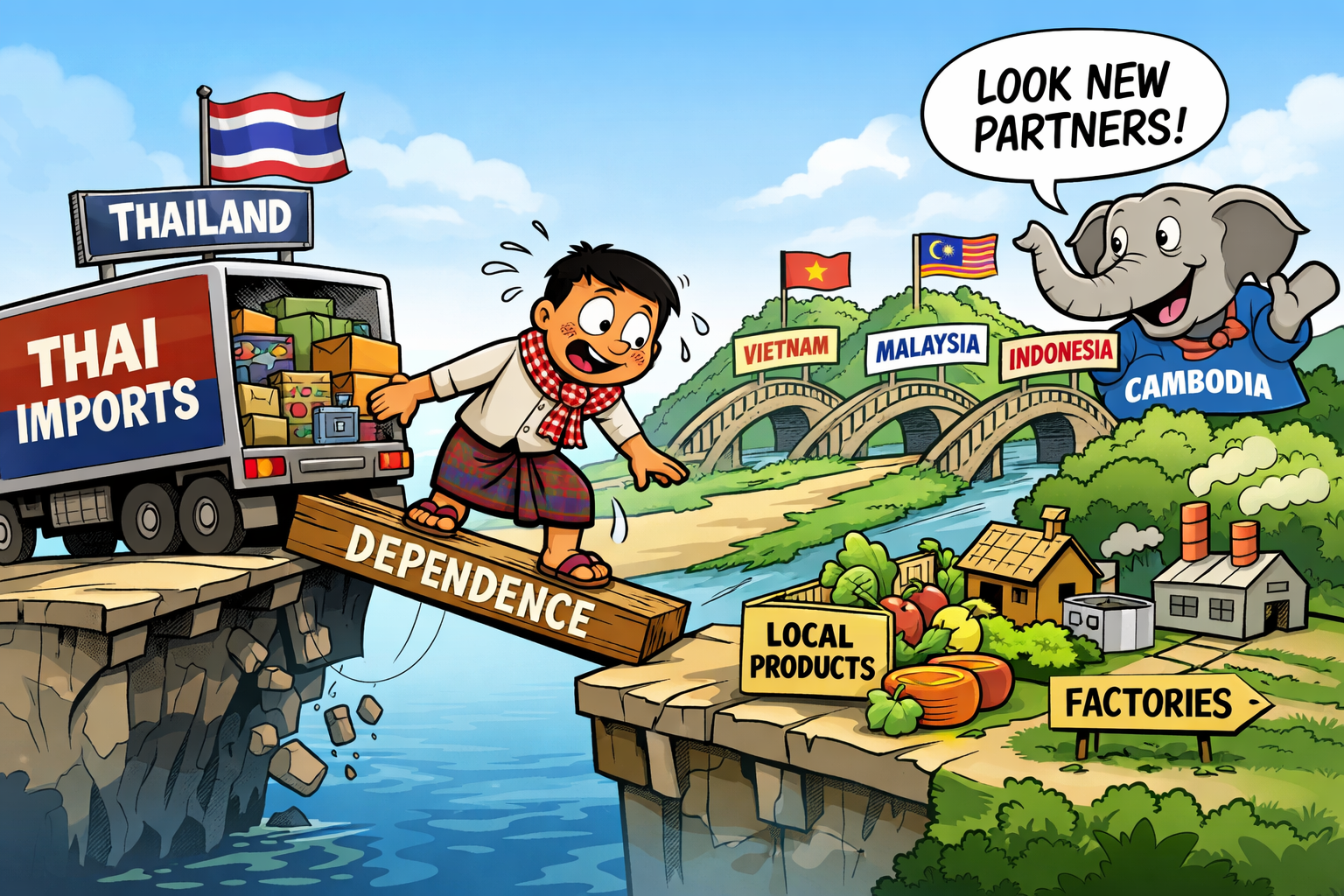
Cambodia is being encouraged to accelerate trade diversification and strengthen domestic production after ongoing border tensions with Thailand exposed the country’s heavy reliance on Thai imports and supply chains, business leaders and economists warned, during a private-sector briefing in Phnom Penh.
The European Chamber of Commerce in Cambodia (EuroCham) and UNICEF convened business leaders, logistics experts and humanitarian partners for a February 10 breakfast discussion examining the economic and social fallout of the border crisis.
Participants warned that prolonged disruptions could reshape trade patterns while heightening risks for vulnerable communities along the border.
Opening the session, UNICEF representative in Cambodia Will Parks stressed that economic shocks and humanitarian pressures are increasingly interconnected, particularly for children and families displaced by the tensions.
“We firmly believe that the challenges faced by children and youth cannot be addressed without the active engagement of the private sector,” Parks said, noting that every child deserves access to essential services, including safe water, healthcare and inclusive education.
Business representatives described early signs of strain across several sectors, including declining tourism activity, rerouted supply chains, rising logistics costs and labour shortages linked to returning migrant workers.
Some companies also reported shifting consumer behaviour, with a growing preference for locally produced goods amid boycotts of Thai-affiliated products.
Martin Brisson, EuroCham executive director, said the situation should serve as a wake-up call for policymakers and businesses alike.
“The current border situation highlights the importance for Cambodia to diversify its sourcing and strengthen self-sufficiency,” he said.
“This includes exploring alternatives from countries such as Vietnam, Malaysia and Indonesia, and investing in domestic capabilities for products that currently rely heavily on the Thai market,” he added.
Brisson noted that Cambodia has an opportunity to expand value-added production, particularly in agro-processing, as much of the country’s raw agricultural output is still sent abroad for processing.
“By building capacity locally, Cambodia can increase value addition and create export opportunities, including to the EU, without depending on external processing,” he said.
Logistics operators also pointed to structural inefficiencies that continue to inflate trade costs.
“Successful trade does not always depend on having close or friendly relations between countries; it can thrive simply when there are shared needs,” said Rutger Heijsteeg, country managing director of Maersk Cambodia.
While acknowledging progress in customs procedures and documentation, he noted that administrative costs and buffers for unexpected delays still raise the overall cost of trade.
“By addressing these inefficiencies, the country can reduce unnecessary costs and strengthen its trade competitiveness, while ongoing infrastructure improvements continue to support growth,” he added.
Panellists said the disruption has intensified conversations around economic resilience, including diversifying trade routes and investing in domestic manufacturing to reduce exposure to external shocks.
Financial sector pressure and broader operational uncertainty were also cited as emerging concerns, should tensions persist.
The second half of the discussion focused on the humanitarian situation in border provinces, where displacement has disrupted access to education, healthcare, water and sanitation services.
UNICEF said children — including those with disabilities — face heightened vulnerability as families struggle to adapt.
The agency reported it is working with government partners to deliver emergency assistance, restore essential services and support recovery, while calling on companies to contribute through responsible business practices and targeted partnerships.
Cambodian small and medium-sized enterprises (SMEs) have stepped up efforts to expand local production following a surge in public support triggered by recent border tensions with Thailand.
The crisis — which saw Cambodia impose import bans on several essential goods — exposed the country’s heavy dependence on foreign supplies and prompted stronger solidarity around national products.
Business associations and government institutions have since promoted locally made goods through exhibitions that attracted large crowds.
In November 2025, Te Taing Por, chairman of the Federation of Associations of Small and Medium Enterprises of Cambodia (FASMEC), said the tensions served as a wake-up call, encouraging consumers to back domestic producers while pushing manufacturers to improve quality and competitiveness.
However, challenges persist. Higher production costs, limited market access and small-scale operations continue to hinder SMEs’ ability to compete with cheaper imports.
Industry leaders have called for stronger government support, improved standards and tighter inspection of imported goods, while urging producers to meet international benchmarks and expand export capacity.
Despite the growing “buy local” movement, business leaders stress they are not seeking an import ban but rather a lasting shift in consumer behaviour — one that prioritises Cambodian products and strengthens long-term economic resilience.
EuroCham reaffirmed its commitment to facilitating dialogue between the private sector and humanitarian actors, emphasising that coordinated action will be essential to help businesses navigate uncertainty while supporting Cambodia’s longer-term social and economic resilience.