The General Department of Customs and Excise of Cambodia (GDCE) has reported notable progress in tax and duty collection for the first half of 2025, reaching nearly $1.5 billion, an increase of one-fifth compared to the same period in 2024. This accounts for nearly 60% of The Budget Fiscal Year 2025.
The 2025 fiscal year document stipulates that the department must collect 10,146 billion riel (approximately $2.5 billion) in revenue.
According to the GDCE, total revenue collected in the first half of 2025 amounted to approximately $1.4782 billion (6.009 trillion riel), an increase of $256 million (1.0421 trillion riel) or around 21% compared to the first half of 2024. This figure represents 58.6% of The Budget Fiscal Year 2025.
By tax category (as a share of total revenue), value-added tax (VAT) earned 40.7%, special tax 35.1%, customs duty 15.8%, petroleum product surcharge 3.9%, and export duties and other fees 4.4%.
By product group, revenue came from vehicles and machinery 36.2%, mixed goods 32.2%, fuel and energy 23.7%, and construction materials and other items 7.9%.
In June 2025, tax and duty revenue totalled 1.0237 trillion riel ($252.8 million), a 7.1% decrease compared to May but a 14.4% increase from June 2024.
During a July 11 mid-year review meeting, GDCE director-general Kun Nhim attributed the positive results to the leadership and customs officers’ commitment to maximising transparent revenue collection.
“Beyond revenue collection, the department made strong progress in areas such as digitalising customs procedures, anti-smuggling operations, audits, risk management, public-private partnerships, international cooperation and institutional development,” he noted.
Looking ahead, Nhim outlined several key directives, including continuing the implementation of the GDCE 2025 action plan, enhancing and upgrading technological infrastructure, collaborating with the private sector to address issues and facilitate trade, strengthening anti-smuggling efforts, institutional capacity building and actively contributing to the implementation of government strategies and policies.
In February 2025, Kun he acknowledged that revenue collection faced major challenges including expansion and deepening of free trade agreements, growth in local production replacing imports, more generous tax exemptions to attract investment, increased use of small-engine and electric vehicles, and emerging and more complex smuggling methods.
Economist Hong Vanak of the Royal Academy of Cambodia believed the GDCE’s more than 20% revenue growth was due to stricter, more transparent enforcement of tax laws amid rising international trade activity.
He explained that an increase in customs revenue means that Cambodia has been importing more goods from international markets. However, in recent years, he has observed that most of the goods Cambodia imports are raw materials or components used to supply factories for processing or manufacturing, which are then re-exported to international markets.
“Customs and excise taxes are a vital source of government revenue used to develop the country through human resource development, healthcare, infrastructure and more. With nearly 60% of The Budget Fiscal Year 2025 target already achieved, I am optimistic that customs revenue will continue growing at a strong rate this year,” he told The Post on July 14.
He urged all revenue collection authorities, especially the customs and taxation departments, to demonstrate greater commitment to fair and transparent tax collection in order to encourage equitable and fair investment and business practices.
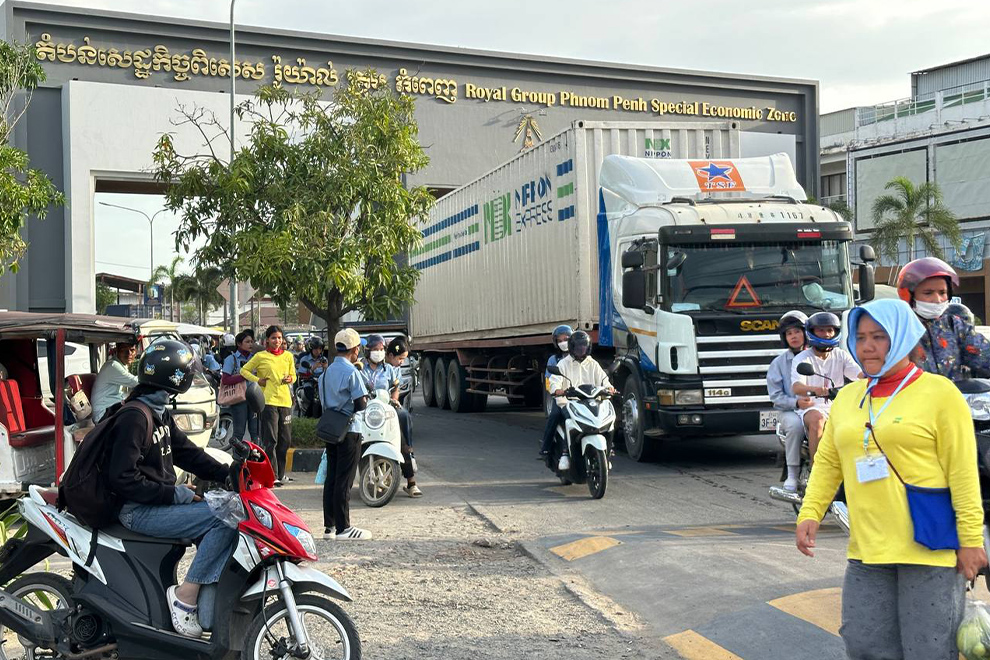
GDCE data also shows that in the first half of 2025, Cambodia’s international trade volume improved. Imports rose to $16.2789 billion, up 18% from H1 2024, and exports reached $14.4188 billion, up 16.1%.
In 2024, the GDCE collected a total of $2.59 billion (10.552 trillion riel) in taxes and duties — an increase of 13.8% compared to 2023.