As of the end of 2025, more than 3,000 large factories were operating in Cambodia, representing an increase of nearly 30% over 2024, according to the Ministry of Industry, Science, Technology and Innovation.
A ministry’s report showed that by the end of 2025, Cambodia had 3,083 large factories in operation, an increase of 658 factories or 27.13%. This was despite the closure of 42 large factories, compared to just 26 closures in 2024.
Among the Kingdom’s factories, 895 are located in Phnom Penh, 603 in Kampong Speu province, 403 in Kandal, 327 in Svay Rieng, 305 in Preah Sihanouk and 231 in Takeo, among others.
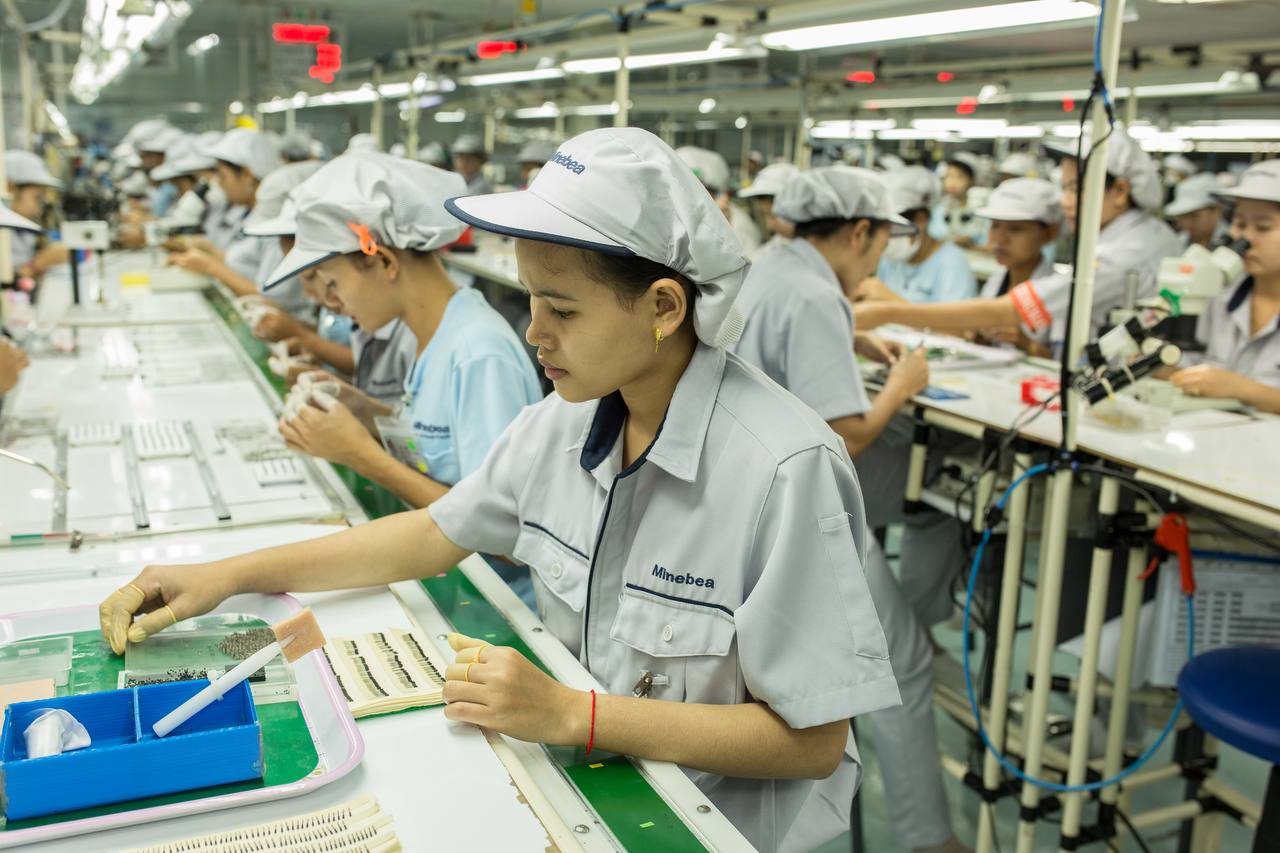
Most of them engaged garment manufacturing, as well as leather processing, paper and paper products, food processing, electrical equipment, rubber and plastic products, furniture, non-metallic mineral products and timber goods, said the report.
In 2025, the total workforce employed by factories nationwide was approximately 1.27 million people, an increase of 9.38% compared to 2024, according to the ministry.
The ministry noted that since the beginning of its 7th mandate, the government has undertaken continuous reforms, forming an important foundation for sustainable socio-economic development.
The government continues efforts to strengthen competitiveness, resilience and crisis resistance by improving the business environment, further diversifying the economy, enhancing domestic production chains to better integrate into regional and global supply chains, promoting higher value-added manufacturing activities, creating more skilled jobs and broadening the national economic base, it said.
“The industrial, science, technology and innovation sector has been identified by the government as a crucial strategic tool to achieve the visions outlined in phase one of the Pentagonal Strategy, and as a key driver of Cambodia’s economic growth and social development,” it explained.
“In 2025, the industrial sector continued its upward trend, growing by around 9.3%. In 2026, despite facing numerous challenges, including border tensions with a neighbouring country, the sector is still projected to grow by 7.2%,” it added.
Hong Vanak, an economist at the Royal Academy of Cambodia, told The Post on February 25 that reforms to investment laws, rising labour productivity and access to broad export markets have helped Cambodia attract more domestic and international investors to establish manufacturing plants.
He added that the growth in the number of factories, especially large-scale factories, is highly significant. Factories in Cambodia today are no longer limited to light industry as in the past.
“Improved and attractive investment laws, an abundant workforce, strong overseas demand, and the implementation of bilateral and multilateral free trade agreements that Cambodia has signed with various countries are key factors driving export growth and Cambodia’s economic expansion,” he said.
“The progress of the manufacturing sector will provide greater strength and clarity to Cambodia’s economy. The growth in factories will enhance the country’s capacity to export goods to international markets,” he added.