The value of imports from Laos has climbed slightly, to around $58 million in the third quarter of 2025. Many industry insiders expressed surprise that the increase was not higher, as Laos now serves as an alternative transit point for Thai goods, due to the land border closures which followed the late-July armed clashes between Thailan and Cambodia.
They have suggested that the smaller-than expected jump may be due to a growing trend among Cambodians to support local products.
According to the General Department of Customs and Excise (GDCE) of Cambodia, in the third quarter of the year (July, August, and September), Cambodia imported a total of $57.74 million worth of goods from Laos, up from $55.01 million (or 4.96%) in the third quarter of 2024. In Q2 2025, they amounted to $59.06 million, and in Q1, $42.18 million.
Data from the GDCE shows that Laos imports in July were up 3.4%, to $18.05 million. August imports climbed 4% to $20.02 million up 4%, while September totalled $19.66 million, an increase of 7.5%.
Imports from Laos in the first nine months of 2025 were $158.99 million, up 5.9% over the same period in 2024.
Exports to Laos were not reported, as Laos does not rank among Cambodia’s top 20 export destinations.
Te Taingpor, president of the Federation of Association for Small and Medium Enterprises of Cambodia (FASMEC), told The Post on October 17 that earlier predictions suggested Thailand’s closure of land borders would lead traders to use Laos as a transit point to import Thai goods into Cambodia. This, in theory, should have led to a significant increase in imports from Laos — but that did not happen.
He believed that diplomatic tensions, instigated by the Thai side, have led many Cambodians to boycott Thai products and increasingly turn to local alternatives.
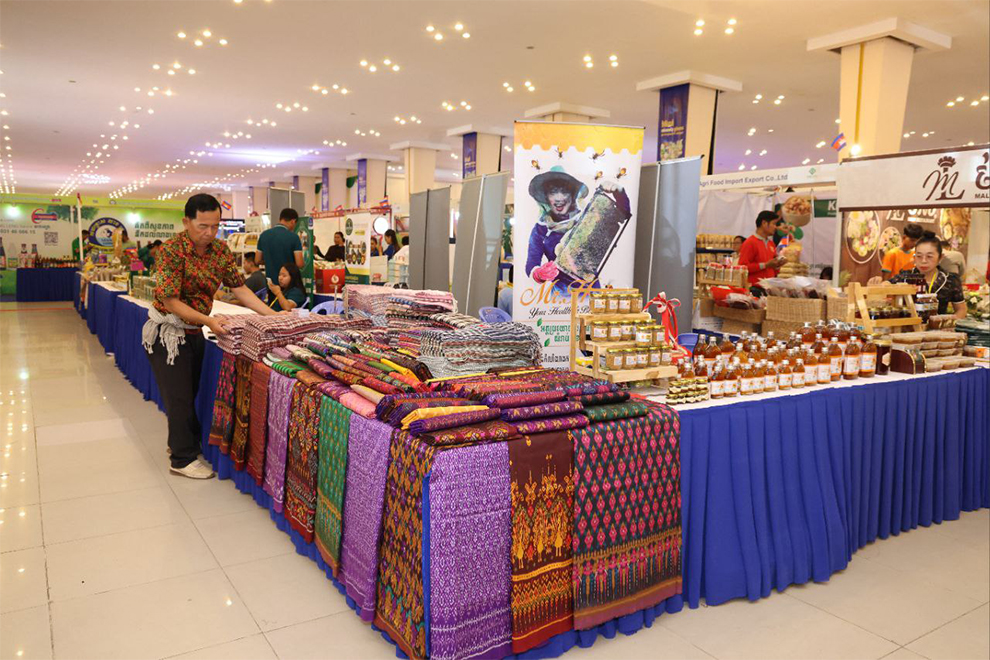
“The trend of consuming locally made products is steadily rising. For example, during the 2025 Khmer Products Exhibition, organized by FASMEC from September 11–13 in Phnom Penh, more than 100,000 Cambodians attended to support locally produced goods. Many even requested that FASMEC hold more exhibitions,” he said.
As FASMEC president, Taingpor stressed that alongside rising support for local goods, manufacturers must also improve product quality.
“Improving and expanding the quality of local products is essential. FASMEC frequently carries out education, awareness campaigns and workshops across the country to support local producers in terms of knowledge, technology, market access and financial support,” he explained.
To boost local manufacturing capacity, the Cambodian government recently approved FASMEC’s organisation of the second Khmer Products Exhibition of 2025, scheduled for November 5–7, at the Koh Pich Convention and Exhibition Center in Phnom Penh.
Lim Heng, vice-president of the Cambodia Chamber of Commerce (CCC), acknowledged that while the Cambodia–Thailand land border remains closed, some Thai products have entered Cambodia via Laos. He noted however, that the increase is smaller than expected, largely due to increased support for domestic products.
“This small increase is because most Cambodians are boycotting Thai products. This reflects a spirit of nationalism,” he said.
Nonetheless, he expressed hope that Cambodia and Thailand would restore good diplomatic, peacebuilding and trade relations.
He also urged authorities and the public to be more vigilant about imported goods that may use incorrect barcodes.