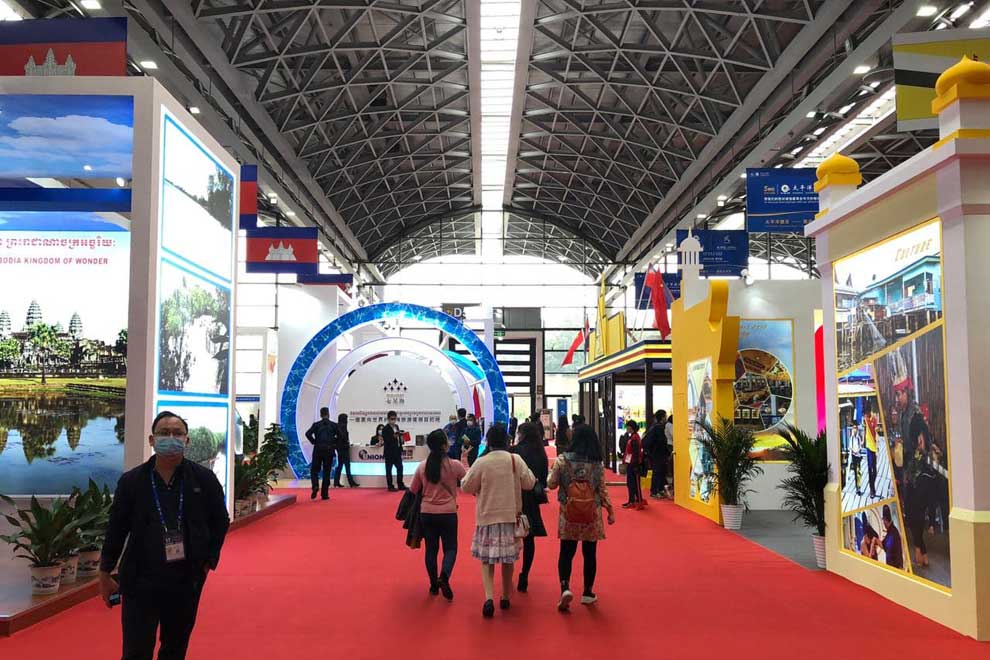
The commerce ministry has invited businessmen, entrepreneurs, investors and service providers doing business in Cambodia to participate in the 20th China-ASEAN Expo (CAEXPO), which is scheduled to be held at the Nanning International Convention and Exhibition Center in Nanning city of southern China’s Guangxi region on September 16-20.
The ministry affirmed in a March 30 statement that it will collaborate with the 20th CAEXPO organising committee and lead a delegation to the trade fair.
The statement highlighted the value of the event for trade and investment between China and the 10-nation Southeast Asian bloc that includes Cambodia, mentioning that it comes amid the former’s post-Covid-19 socio-economic reopening and in step with the bilateral Comprehensive Strategic Partnership (CSP) – established in 2021.
A CSP is a broad, detailed, dynamic, long-term, result-oriented agreement between signatories that affirms a high degree of maturity in relations as well as mutual trust and commitment.
On April 2, commerce ministry spokesman Penn Sovicheat said that Cambodian businesspeople, entrepreneurs, investors and producers wishing to network or reconnect with Chinese and ASEAN counterparts post-Covid as well as reinvigorate the Kingdom’s international trade and investment ties are welcome to attend the 20th CAEXPO.
The organising committee has extended an invitation to ASEAN countries to lead teams of exhibitors and other delegates to meet potential business partners and take part in major concurrent events such as the China-ASEAN Business and Investment Summit (CABIS), he added.
The trade fair will strengthen private sector linkages, and is shaping up to be one that “neither our traders nor businesspeople should overlook”, he opined.
Cambodia has “good” political and economic relations with China, and bilateral trade is ‘especially’ high, Sovicheat stated.
Keo Mom, CEO of Ly Ly Food Industry Co Ltd, one of the Kingdom’s largest food processing enterprises, also sees the 20th CAEXPO as a prime opportunity for Cambodian entrepreneurs to expand their market potential in China as well as other ASEAN countries.
“Expos always create opportunities for investors from all over the world to expand their partnerships and promote their products and services. The private sector is always happy to work with the government and encourage private-private partnerships in line with state policies to boost economic growth,” she said.
Trade flows
The ministry earlier reported that value of Cambodian trade with the nine other ASEAN countries hit $16.053 billion in 2022 – up 1.4 per cent from $15.838 million in 2021 – accounting for a 30.62 per cent share of the Kingdom’s $52.425 billion in total foreign trade for the year, down from a 32.99 per cent share in 2021.
Aside from Cambodia, the other nine ASEAN countries are: Brunei, Indonesia, Laos, Malaysia, Myanmar, the Philippines, Singapore, Thailand and Vietnam.
Cambodian exports to the nine countries rose by 13 per cent from $2.914 billion in 2021 to $3.297 billion last year, making up 14.7 per cent of the $22.483 billion in total exports. On the other hand, Cambodian imports from these markets slid by 1.3 per cent from $12.924 billion in 2021 to $12.756 billion last year, comprising 42.60 per cent of the $29.942 billion in total imports.
The Kingdom’s collective trade deficit with the other nine ASEAN countries narrowed by 5.5 per cent from $10.01 billion in 2021 to $9.46 billion in 2022.
Vietnam and Thailand alone represented 67.28 per cent of 2022 Cambodian trade with the nine other ASEAN countries, at $6.136 billion and $4.664 billion, respectively, rising by 19.64 per cent and 14.22 per cent on a yearly basis, according to the ministry.
For comparison, Customs (GDCE) figures show that trade between Cambodia and its top five ASEAN trading partners – Vietnam, Thailand, Singapore, Indonesia and Malaysia – was to the tune of $15.692 billion in 2022, up 0.77 per cent on-year.
Although trade between the Kingdom and mainland China had grown by 4.39 per cent on a yearly basis to $11.686 billion in 2022, it shrank by 15.09 per cent on-year to $1.705 billion in January-February 2023, GDCE figures show, reflecting a slowdown in the global economy and weak demand.
Official figures show that China’s dollar-denominated international trade reached $895.72 billion in the January-February period, down 8.3 per cent on-year, with imports and exports at $389.42 billion and $506.3 billion, respectively, down 10.2 per cent and 6.8 per cent.