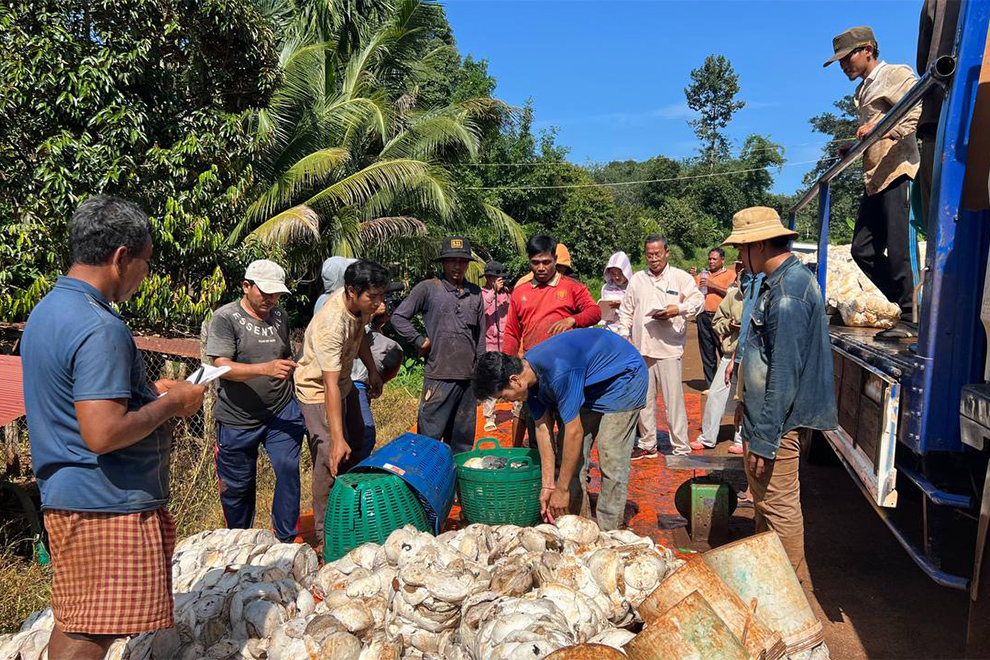
Cambodia exported over 220,000 tonnes of rubber during the first nine months of 2025, a more than ten per cent decline from the same period last year. Industry insiders note that the drop is due to increasing demand for rubber from domestic tyre manufacturers.
According to the General Directorate of Rubber under the Ministry of Agriculture, Forestry and Fisheries, from January to September, the Kingdom exported 220,240 tonnes of rubber, a decrease of 28,295 tonnes, or 11.38%, from the same period last year.
The average price of rubber during the first nine months of 2025 was $1,771 per tonne, up $185 from 2024. Total revenue from rubber exports was $390.04 million, slightly down from the $394.17 million reported last year.
In addition to rubber latex, Cambodia also exported 14,326 cubic metres of rubber wood, earning around $3.25 million.
Khun Kakada, deputy director-general of the rubber directorate, noted that the rubber production chain — management, maintenance, harvesting, processing and business operations — ran smoothly so far this year. At the same time, international rubber prices have increased.
At least six tyre manufacturers operate in Cambodia, in the special economic zones (SEZs) of Svay Rieng, Preah Sihanouk and Kratie provinces. Most of them are Chinese owned.
Ken Oudomonysinat, CEO of Sailun Tire Cambodia, told The Post on October 16 that the growth of these factories has driven increased domestic rubber demand.
“Our company’s demand for local rubber may double to over 100,000 tonnes this year, up from around 50,000 tons in 2024,” he said.
According to Oudomonysinat, last year, the company sold around 60,000 tires, but in just the first eight months of 2025, Sailun has already sold 100,000 tires.
He noted that Cambodian rubber is among the best in the region.
The rubber directorate reported that at the end of 2024, Cambodia had a total rubber plantation area of 425,443 hectares, an increase from 407,172 hectares in 2023. Of that, 330,259 hectares (or 77.63%) were tapped for latex, while 95,184 hectares (or 22.37%) were still in the maintenance stage.