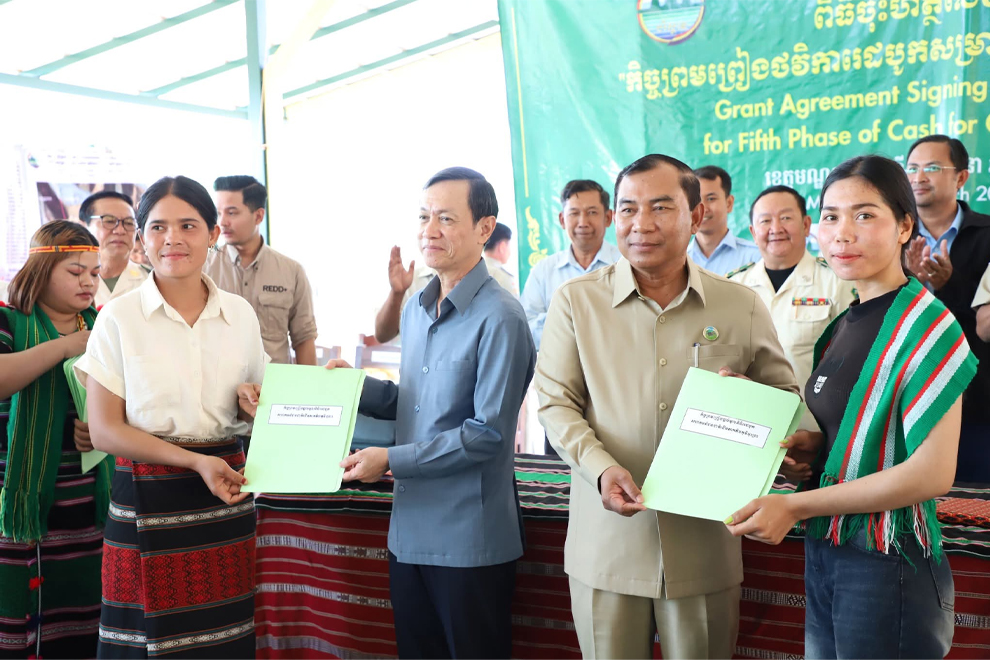
The Ministry of Environment, WCS Cambodia and representatives of indigenous communities have signed REDD+ benefit-sharing agreements for the fifth phase of the Keo Seima REDD+ project. The agreement is valued at approximately $1 million, which will be shared by 20 target villages of indigenous and local communities. The funding aims to sustain natural resource management and further promote community development. Including the previous four phases, the communities have received a total of about U$3 million.
The signing ceremony was held at the headquarters of the Keo Seima Wildlife Sanctuary in Mondulkiri province on March 14.
Chuop Paris, environment ministry secretary of state, praised the efforts of communities and WCS Cambodia, for their cooperation in protecting forest lands.
He described the Keo Seima REDD+ project as “a successful model” for reducing greenhouse gas emissions caused by deforestation and forest degradation. The project not only benefits the global environment but also provides direct economic benefits to communities, according to the Mondulkiri Provincial Department of Environment.
“This fund is a reward for the sacrifices made by communities in protecting and preserving natural resources,” said Paris.
Ngin Sovimean, deputy governor of Mondulkiri province, emphasised the importance of transparency and accountability in the use of funds.
He urged community committees to pay close attention to developing clear village development plans, focusing on key priorities such as small-scale infrastructure, improvements to clean water systems and strengthening the education sector.
The deputy governor stressed that the fund is an important catalyst for improving the livelihoods of indigenous communities and reducing their dependence on forest entry, wildlife hunting or illegal logging.
The Keo Seima REDD+ Project began in 2010. It covers 166,983 hectares of forest land within the more than 300,000 hectares of the Keo Seima Wildlife Sanctuary in Mondulkiri and Kratie provinces. It was the first project in Cambodia to receive funding through the sale of carbon credits on the international market. These funds are used to support natural resource conservation in the sanctuary and community development, with the environment ministry as project owner and WCS Cambodia as the implementing partner.
By 2025, the 20 indigenous communities had directly received some $2 million from the project.
Funding from Phase 5 will support community priorities such as in education sector – school meals, learning materials and improved learning environments – clean water & sanitation systems, health services, livelihood initiatives and community savings groups, small-scale infrastructure – roads, bridges, schools, and community meeting halls and forest protection and cultural heritage preservation.