Kampong Thom businessman Chav Soursdey has transformed his small-scale family fish processing operation onto a formal enterprise which is now ready for CQS certification. His sales volume and income have each jumped 85 per cent, and he has employed more staff, lifting the community members around him.
Each of these achievements is the result of not only his own hard work and entrepreneurial spirit, but technical support from the CAPFISH-Capture project and the Investment Support Facility (ISF).
The ubiquitous “Chav Soursdey” enterprise is located in Phsar Krang commune’s Chi Meas village, in Kampong Thom’s Stoung district.
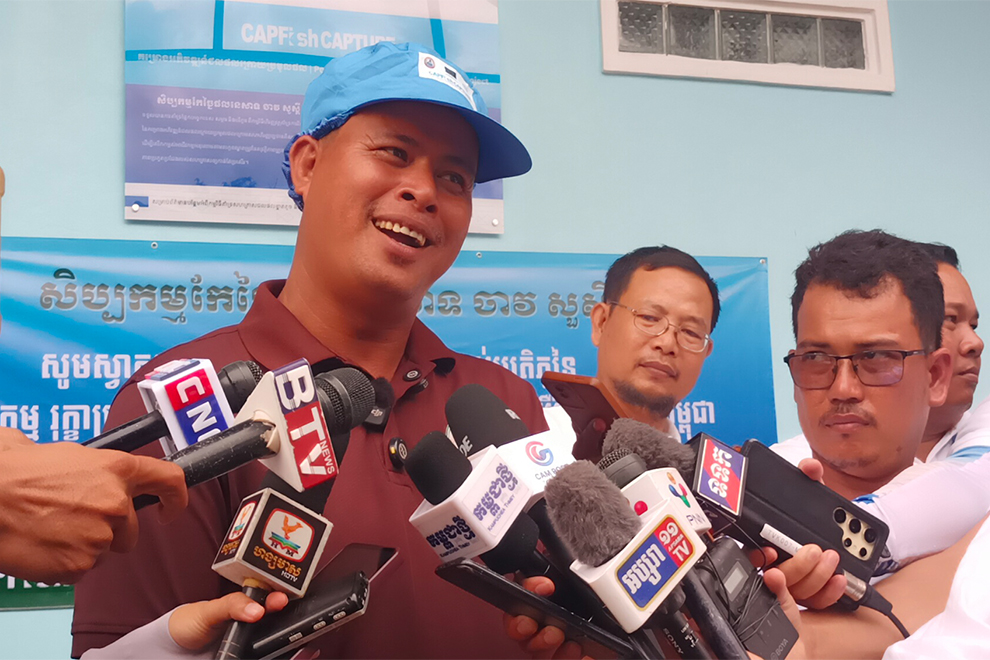
Soursdey is now sharing his expertise and experience, providing training to Cambodian youth in the art of producing fish-based products. On September 9, around 90 delegates – including about 40 journalists – joined him at his facilities, as part of the CAPFISH-Capture project’s third promotional roadshow.
The business owner explained that when he worked at family scale, from 2021 to 2024, he could only process between 2–3 tonnes of prahok (fermented fish paste) per year. But since receiving support from CAPFISH-Capture and ISF earlier this year, his production is on track to hit 20–30 tonnes annually.
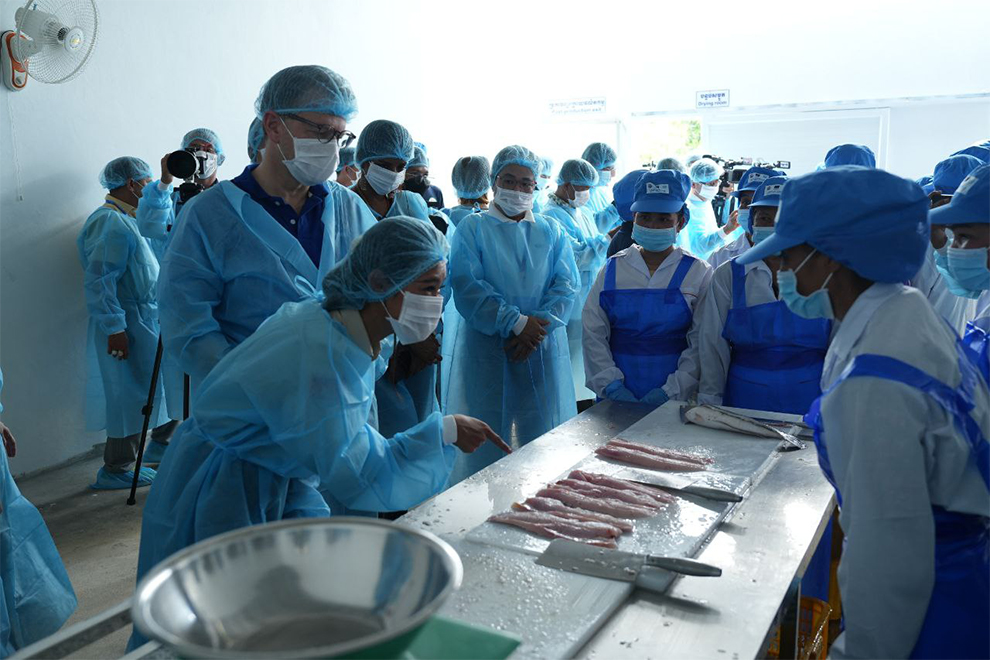

“Before, I used to pack everything by hand and could only make a small amount of prahok. But now we use machines, so we can process additional products such as proma fish powder and rice-fish powder in larger quantities. In the future, I plan to produce prahok fish soup powder as well,” he said.
He estimated that once his facilities are fully upgraded by the end of September, he could process up to 40 tonnes per annum, using both wild-caught fish and fish purchased from local farms. His enterprise currently earns between $3,000–$4,000 per month.
Through the project, he received 13 types of machines, covering every stage of processing from raw material to finished product.
“In 2025, with CAPFISH-Capture’s support, my production has increased fourfold. It’s wonderful, because now I have automatic packaging machines, mixers, dryers and sealing machines. Before, my drying barrels could only hold 5kg, but now I can process 50–100kg at a time. That means I can handle up to one tonne a day,” he noted.
The enterprise’s main products include prahok and trey broma powder, and fish paste. The products are made from giant snakehead fish, boeseman croaker and other small fish, targeting low- to medium-income markets locally. They are distributed through a network of 30 provincial distributors. The enterprise is also preparing production registration to supply supermarkets and Cambodian consumers abroad.
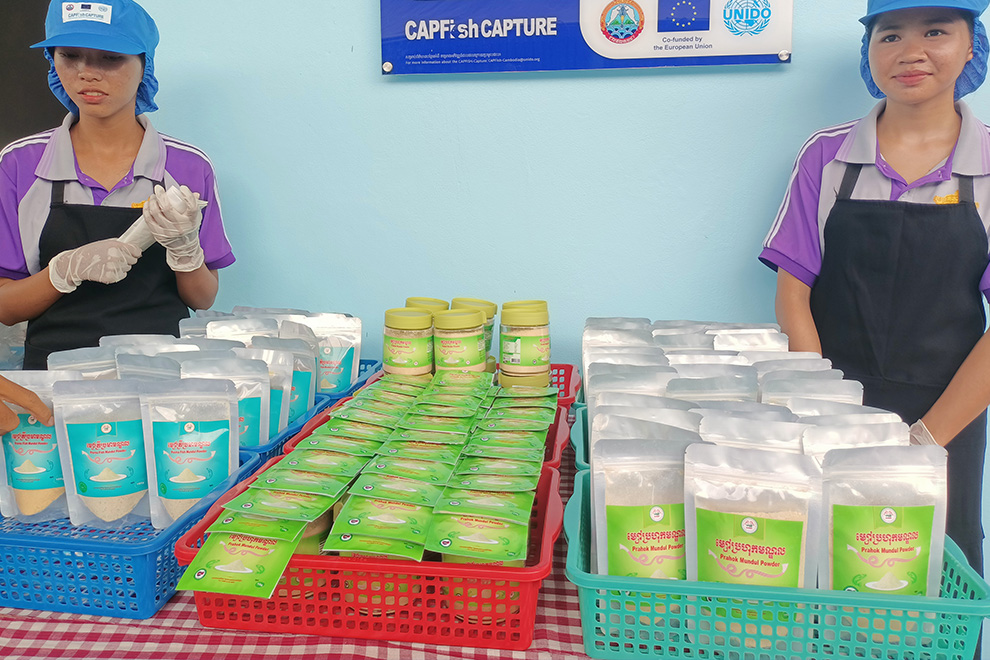
The products are crafted with local flavours, using the finest ingredients and with guaranteed hygiene and quality. Prahok powder is made by fermenting fish, usually giant snakehead fish, with salt and rice bran or roasted rice powder in jars for several months. The resulting paste has a strong, pungent flavour and aroma, with a salty and umami-rich taste.
Through ISF, the business received a support package worth $24,800, which helped leverage a total co-investment of $60,610 from the Sousdey enterprise. This included a $31,000 guaranteed loan and $29,610 equity investment from the business itself.
This funding allowed improvements such as stainless steel tables, upgraded electricity systems and cold storage facilities, all meeting food safety requirements. The enterprise is now preparing to receive full CQS certification.
By adopting technology and automation, the enterprise has improved efficiency, expanded domestic market share and achieved competitive pricing.
These achievements were made possible thanks to collaboration across the fisheries value chain, including collectors and the Fisheries Administration, who ensure that fish products are processed to the highest quality and meet food safety standards.
In addition to providing equipment under the ISF, CAPFISH-Capture has also provided technical assistance through business planning, food safety basics and training for the enterprise’s management, staff and business partners.
The project’s interventions have not only boosted income, reduced poverty, and created jobs, but also played a key role in improving food safety, protecting public health and contributing to local economic development.
Soursdey has also signed an MoU with the Department of Technical and Vocational Education of the Ministry of Education, Youth and Sports, to provide internship opportunities for students.
These one-month internships teach hygiene, food safety, processing techniques, theory and hands-on machine operation.
At present, 19 young Cambodians are interning at Chav Soursdey.
One, 16-year-old Kampong Thom native Seng Navin, said she had noticed that fish processing is not very widespread in Cambodia, and she wants to learn these skills so she can open her own business in the future.
The study tour was organised in cooperation with the Ministry of Agriculture, Forestry and Fisheries, the EU and UNIDO, through the CAPFISH-Capture post-harvest fisheries development project, funded by the EU and implemented by the Fisheries Administration and UNIDO.
Im Rachna, undersecretary of state and spokesperson for the agriculture ministry, observed that thanks to the support of the project, the Soursdey enterprise has not only grown in processing capacity but also innovation.
“We tasted the prahok powder ourselves. Its flavour is no different from traditional prahok. It is exciting and admirable that he has found an innovative way to transform traditional prahok, with its strong smell, into a modern food product,” she said.
This result has encouraged the ministry to continue supporting such initiatives.
While training youth is a valuable part of what Soursey does, helping the next generation to gain knowledge and recognise potential career paths in the agricultural sector, he does not plan to stop there.
He has ambitions to expand further, especially to export markets. With his current success, nobody should be surprised if they one day see the brand name Chav Soursdey sitting proudly on supermarket shelfs and in chef’s pantries around the world.