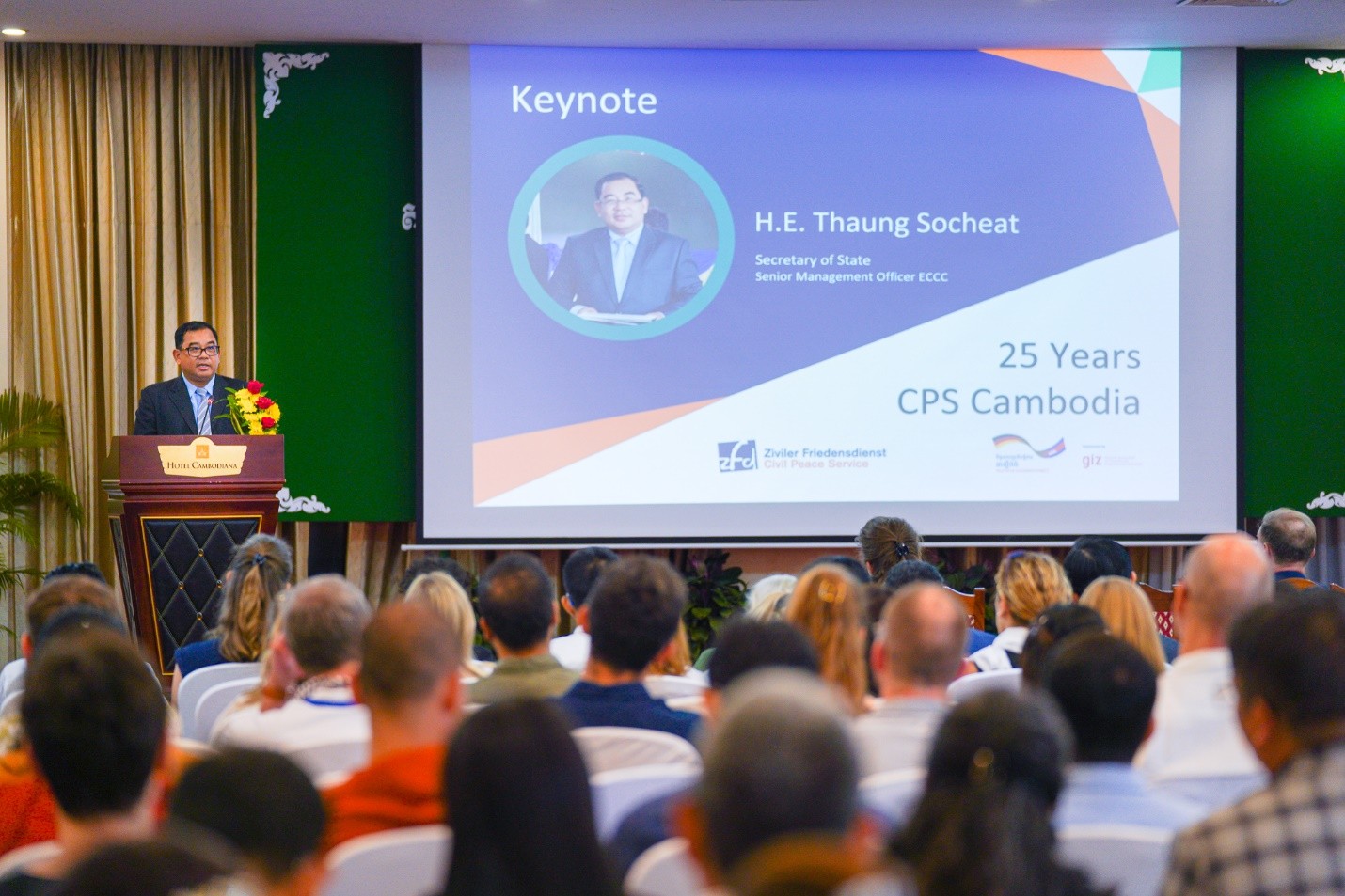
A senior official has lauded the contributions made by the German-funded Civil Peace Service (CPS) as the programme marks its 25th year, and final year in Cambodia. He reflected on the Kingdom’s journey from conflict to reconciliation through the Extraordinary Chambers in the Courts of Cambodia (ECCC) and nonjudicial process.
The event, held on February 5 in Phnom Penh, highlighted the enduring legacy of the ECCC, a hybrid tribunal established to prosecute Khmer Rouge atrocities. However, the celebration was bittersweet, marking the final year of CPS operations in the country after a quarter-century of pivotal contributions to peacebuilding.
Thaung Socheat, secretary of state and senior management officer of the ECCC Office of Administration, elaborated on the court process, beginning with the Win-Win Policy, championed by then-Prime Minister Hun Sen in the late 1990s. The strategy ended decades of civil war following the Khmer Rouge’s fall in 1979.
“The military conflicts and civil war only came to an end through the relentless efforts of Hun Sen,” said Socheat, in his opening remarks.
The policy enabled millions of Cambodians to return home and reintegrated tens of thousands of former Khmer Rouge soldiers into society, providing exoneration, property rights and livelihoods.
“More importantly, the Win-Win Policy was a cornerstone of this effort — it provided exoneration to former combatants, secured property ownership rights, and guaranteed career opportunities or livelihoods for reintegrated soldiers,” Socheat added.
The ECCC emerged in 2003 as a unique model of transitional justice, in partnership with the UN. Unlike purely international tribunals like the ICTY or ICTR, the ECCC emphasised Cambodian sovereignty through active government involvement, victim participation as civil parties and a hybrid structure blending national and international elements, he explained.
He added that the ECCC prosecuted Khmer Rouge crimes, rendered justice to victims, prevented atrocities and promoted stability, leading to numerous achievements, including institutionalised peace education, recognising victims, and memorialising the past reaching 70 per cent of Cambodia’s post-regime youth through outreach programmes.
Socheat said the ECCC stands apart for its focus on education, recognition and memorialisation to ensure a lasting impact. He described the CPS, funded by Germany’s BMZ and implemented by GIZ, as instrumental in the court’s inception.
“From the very beginning, BMZ, GIZ and CPS were instrumental in supporting civil society organisations, ensuring meaningful outcomes for victims and survivors, and providing technical expertise to support the functioning of the courts,” he noted.
He added that the programme facilitated community dialogues, mental health initiatives and survivor participation, aligning with the ECCC’s goals of healing and ending of impunity.
He praised the CPS for its vital role in supporting peace and reconciliation in Cambodia.
Looking ahead, Cambodia plans a Legacy Institution by 2028 to preserve the court’s 2.5 million trial pages for education and research purposes, plus a Victim Foundation, backed by Germany’s EVZ.
“The seeds of peace, justice and inclusion planted by the ECCC and the Civil Peace Service will continue to grow,” said Socheat.