A senior official from the Ministry of Environment has encouraged students from indigenous communities to pay greater attention to environmental issues — especially by joining in community clean-up activities, reducing plastic bag use keeping their surroundings green, protecting forests and replanting trees.
The encouragement came from ministry secretary of state Chuop Paris, representing environment minister Eang Sophalleth, during the launch of the “Promoting a Clean and Green Mindset in Local Communities” campaign on Saturday, October 25, at Keo Seima High School in Keo Seima district, Mondulkiri province.
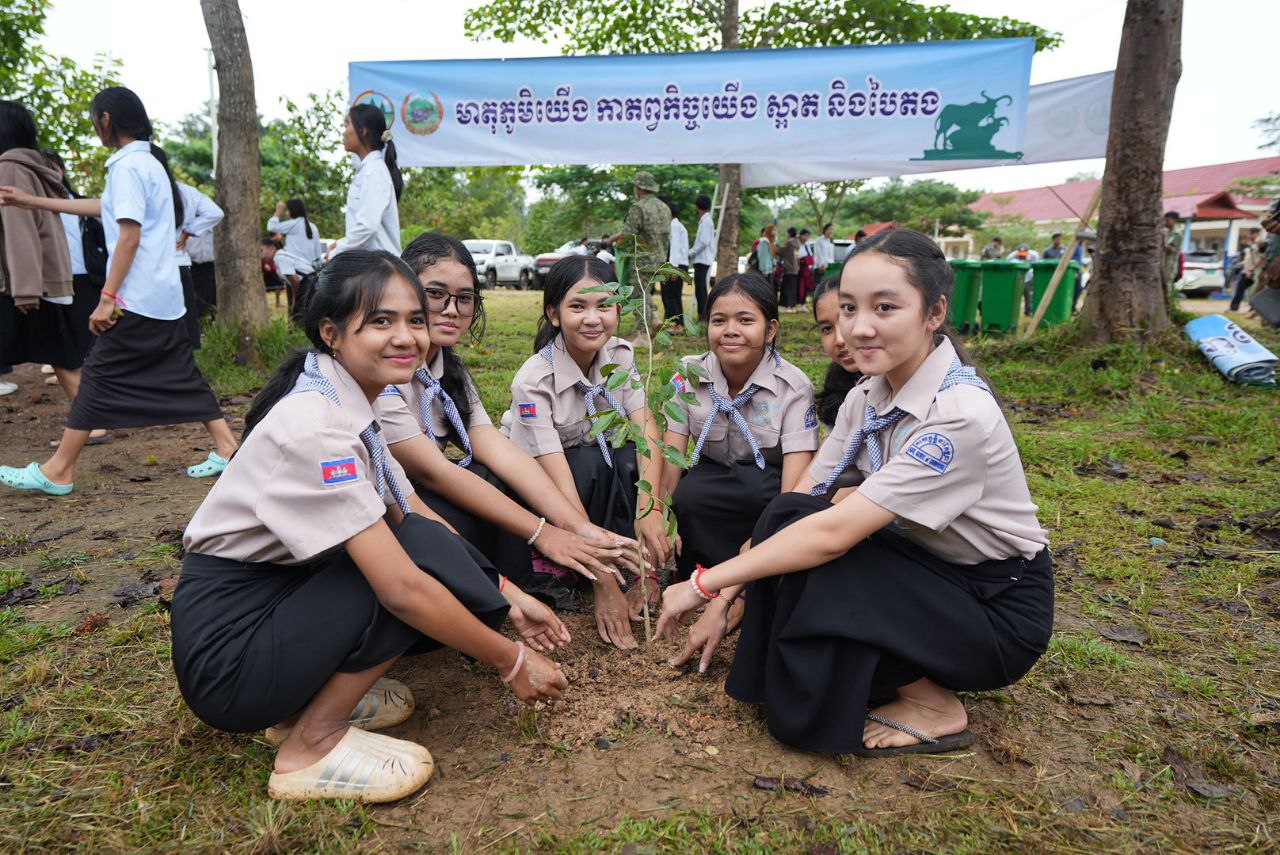
Addressing students holding banners that read “Think Together, Act Together, Clean Together”, Paris said:
“You, the younger generation — the bamboo shoots replacing the old — should think deeply about environmental issues. Taking care of the environment is not difficult; it comes down to three simple points.”
He explained that those three points are cleanliness, greenness and sustaining both cleanliness and greenness, forever.
“It shouldn’t be clean only today but dirty again tomorrow; or green today but bare tomorrow,” he said.
“Cleanliness means maintaining hygiene and avoiding plastic bags, because plastic is very harmful. It doesn’t decompose easily — it breaks down into microplastics, which eventually enter our bodies through the fish and meat we eat. It’s as if we are eating plastic ourselves. That’s why we must reduce and avoid excessive plastic use,” he added.
He emphasised that when hygiene and beauty are maintained, tourists will be attracted, as they value communities which are clean, dignified and environmentally responsible.
Regarding “greenness”, he urged students to plant trees and care for existing ones. He pointed out that Kaev Seima district’s abundant forests bring tangible benefits through community development funds derived from forest protection.
He cited the Keo Seima REDD+ project — Cambodia’s first such initiative — owned by the environment ministry and implemented by the Wildlife Conservation Society (WCS). The project sells carbon credits from forest conservation on international markets, generating income for community development and forest protection.
Student Rah Solita, a Grade 10 student at the school, observed that plastic bag use remains widespread in her community. However, she expressed hope that this awareness campaign would help raise understanding about the environmental impacts of plastic and encourage people to reduce their use.
“We’ve learned in school that plastic doesn’t decompose easily — it takes a very long time to break down. So we shouldn’t use too much plastic. We can replace it with alternatives… Without plastic, the environment will be cleaner,” she said.
During the event, participants planted trees in the school compound and picked up litter in nearby public areas.
Paris also appealed to local authorities and armed forces to help protect forests and preserve the region’s natural greenery for the future.
Ngin Sovimean, deputy governor of Mondulkiri province, explained that the provincial administration has been actively working to keep the province clean and green through various campaigns, including regular public clean-ups.
He said that Mondulkiri province has a population of 92,213, which produces about 11,000 tonnes of organic and plastic waste annually. Of this, Sen Monorom town, with roughly 15,800 residents, generates around 9,000 tonnes per annum.
The provincial administration has contracted two private waste collection companies that operate daily, collecting trash from homes, markets, national roads and other public areas.
“We want our town to stay clean and free of garbage. But that also requires public participation — people must properly package and separate their waste to make collection easier and prevent trash from scattering, which spoils the beauty of the area,” he said.
Sovimean urged all departments, authorities and citizens to maintain regular hygiene and environmental care in their communities. He called on local authorities to continue educating the public on waste management, including proper waste separation, disposal and solid-liquid waste handling.