The Japan Aerospace Exploration Agency (JAXA) has strengthened cooperation with the Ministry of Environment. It is using satellite technology to support the fight against global climate change and contribute to natural resource management, with the ultimate goal of helping Cambodia become carbon neutral by 2050.
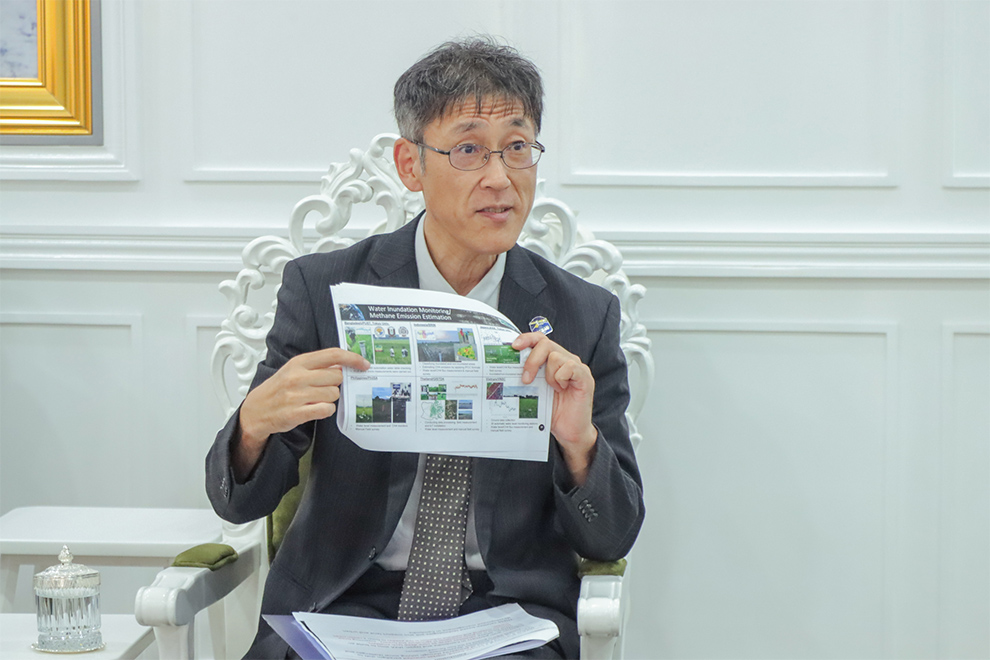
This comprehensive cooperation was highlighted during a July 23 working meeting between Minister of Environment Eang Sophalleth and Osamu Ochiai, director of the Earth Observation Research Center at JAXA, held at the ministry’s headquarters in Phnom Penh.
According to the ministry, Osamu highlighted advanced capabilities in collecting environmental data via satellite. This includes a Biomass Map, which helps Cambodia understand the amount of biomass and carbon absorbed by its forests, and a Mangrove Map, enabling the tracking of mangrove area changes since 1990.
In addition, a Land Cover/Use Map with 10-metre resolution can classify up to 15 land types, such as urban areas, rice fields, forests or grasslands.
JAXA also supports methane emission monitoring in rice fields by tracking water levels — an important step in reducing methane emissions, a potent greenhouse gas.
Sophalleth expressed his appreciation for JAXA’s support and affirmed the ministry’s endorsement of the use of Japanese satellite technology to collect environmental data, as a reference for cross-verification with Cambodia’s existing systems.
He encouraged JAXA to serve as a carbon credit verification agency in the ASEAN region, by helping to help verify Cambodia’s data and conduct assessments of forest loss and carbon sequestration every six months or less. This would support accurate projections for reforestation efforts and help Cambodia meet its 2050 carbon neutrality target.
The minister suggested that JAXA identify one island in Cambodia and help turn it into the first carbon-neutral island in ASEAN. JAXA could evaluate its carbon sequestration capacity and estimate the number of trees that needed to be planted. This initiative could help establish a carbon credit market in Cambodia and broaden cooperation into key sectors such as energy, industry and waste management.
The ministry added that this Cambodia-Japan partnership will become a key driving force in fulfilling the vision of Prime Minister Hun Manet to make Cambodia carbon neutral by 2050. It also reflects Cambodia’s commitment to reducing greenhouse gas emissions and fighting climate change on a global scale.
During the meeting, the JAXA delegation presented updates on their technical progress. This included use of satellite imagery for forest biomass mapping, future directions and an action plan for continued technical cooperation.
Currently, the agency is working with the ministry on a three-year cooperation project (2024–2026) to produce forest biomass maps using satellite imagery.
On the same day, Sophalleth also met with Nobutaka Maekawa, executive vice-president of the Japan External Trade Organization (JETRO), along with 32 Japanese business delegates.
The minister welcomed the interest shown by the Japanese government-backed and private sector companies in closely partnering with the ministry on carbon credit projects.