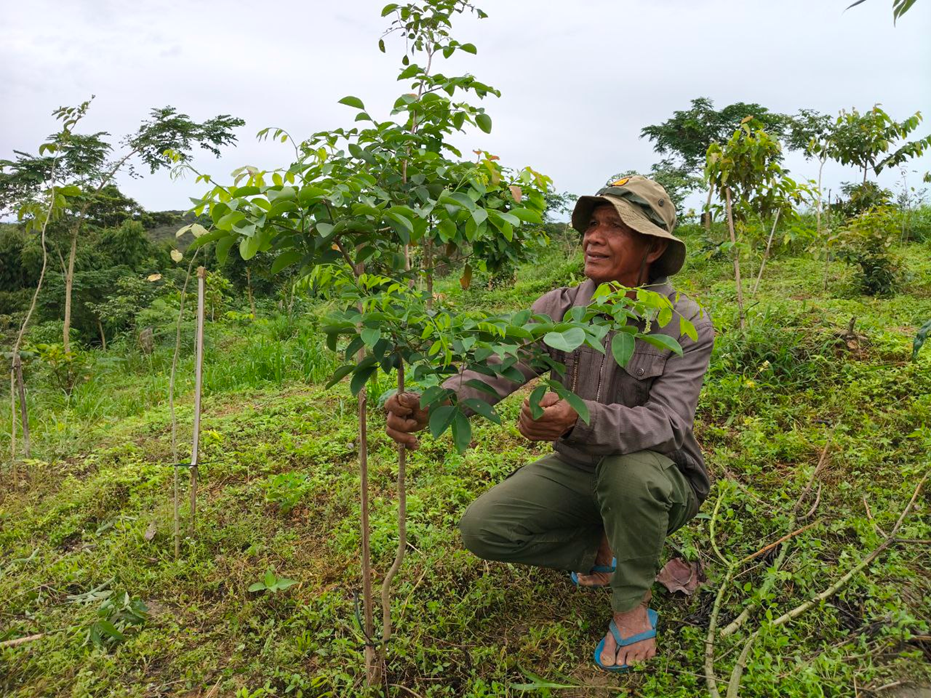
More than 150,000 tree saplings have been planted in Keo Seima Wildlife Sanctuary and in public areas across Mondulkiri province, including land reclaimed from illegal encroachment.
The sapling nurseries and replanting were carried out under the forest restoration program in Keo Seima Wildlife Sanctuary through the Keo Seima REDD+ Project, with financial and technical support from WCS Cambodia, in cooperation with the Ministry of Environment and the Mondulkiri Provincial Department of Environment.
WCS Cambodia reported that from May 2022 to July 2025, approximately 156,000 saplings of 17 different species were prepared for planting in degraded forest areas within the sanctuary and for distribution to government institutions and local residents for planting in public spaces.
About 100,000 saplings were planted over a total area of more than 155 hectares within the sanctuary. Around 1,100 community members participated in the planting activities. The project worked with 20 families from the Banong Indigenous community to establish community-level nurseries and raise an additional 20,000 saplings, contributing to forest restoration in community areas of the sanctuary.
Tan Setha, WCS head of the forest restoration project, noted that some forest land belonging to Banong Indigenous communities had been illegally encroached upon and claimed by offenders, even in cases where formal land titles had been issued.
WCS Cambodia assisted the communities in reclaiming the land, in cooperation with relevant authorities, in order to restore the forests. This included 1.5 hectares of Indigenous community forest land in O’Rona village, Sre Khtum commune, Keo Seima district.
“The offenders occupied the land and planted cassava there for about two to three years. This land is a burial forest with formal land titles, and the community reclaimed it through legal proceedings because it had already been officially registered and could not be converted into private ownership. That is why we succeeded in getting the land back to restore the forest,” said Setha.
Yeng Chantha, a member of the O’Rona village Community Forestry Committee, said that the burial forest land had been encroached upon by community members around 2016. After it was reclaimed, nearly 3,000 trees were replanted on the site.
“We planted a mix of species, including luxury timber and native trees such as Kranhoung, Beng, Thnong and kakoh. Much of the forest had already been lost, so we replanted it for conservation so that future generations can know it. According to tradition, burial forests must have trees and forest cover,” she explained.
Setha noted that after replanting, the organisation has plans for ongoing protection, maintenance and regular monitoring.
He added that when forests are healthy or successfully restored, they can become tourist attractions, especially for visitors who are interested in indigenous traditions.
Under the 2025–2026 plan, WCS is cooperating with the environment ministry to construct a new nursery at the sanctuary’s headquarters, with the capacity to raise approximately 225,000 saplings per year.
The Keo Seima REDD+ Project began in 2010 and is implemented over 166,983 hectares of forest within the more than 300,000 hectares of Keo Seima Wildlife Sanctuary in Mondulkiri and Kratie provinces. It is the
first project in Cambodia to receive funding through the sale of carbon credits on the international market.
The funds are used to support natural resource conservation in Keo Seima Wildlife Sanctuary and promote local community development, with the environment ministry as the project owner and WCS Cambodia as the implementing organisation.