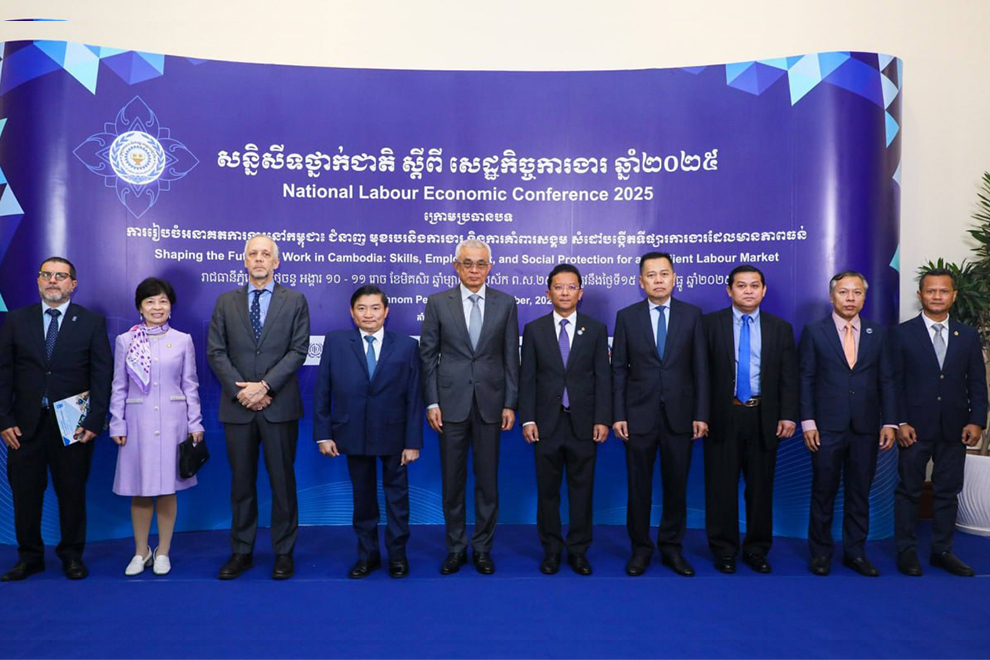
The Ministry of Labour and Vocational Training, in cooperation with its partners, has held the Second Labour Economics Conference 2025, a two-day event, aimed at promoting inclusive and sustainable labour market solutions. The conference seeks to foster evidence-based dialogue, identify policy options and strategies, and accelerate skills development.
The conference, which began on Monday, 15 December, is themed “Shaping the Future of Work: Skills, Employment and Social Protection for a Resilient Labour Market in Cambodia”, under the chairmanship of Deputy Prime Minister Aun Pornmoniroth, Minister of Economy and Finance.
Labour minister Heng Sour explained that the forum provides an important opportunity to promote cooperation and knowledge exchange, aligning Cambodia’s labour vision with socio-economic transformation.
The minister noted that the main objective of the conference is to advance inclusive and sustainable labour market solutions by promoting evidence-based dialogue, identifying policy and strategic options to accelerate skills development for new economic trends, strengthening social security systems and enhancing multi-stakeholder partnerships to foster cooperation.
“The ministry is implementing strategic measures to modernise the labour market, including Technical and Vocational Education and Training (TVET) and Recognition of Prior Learning (RPL) reforms, encouraging TVET to focus on skills for the Fourth Industrial Revolution (Industry 4.0), he said.
He explained that the measures include circular economy skills, such as repair and remanufacturing, migration management and legal reforms, social security and informal employment, through the Global Accelerator on Decent Jobs and Social Protection for Just Transitions (2024–2028), improvements to worker transport vehicles and technical inspections and a commitment to eliminate gender-based violence and harassment in the workplace, in order to enhance productivity and job quality.
Speaking at the opening ceremony, Pornmoniroth noted that the conference plays a vital role in improving national policy formulation and policy coherence, while strengthening synergy in implementation within what he described as “the dynamics of a single-actor system in the labour market”.
He also praised the efforts of the labour ministry and their partners, for jointly advancing objectives in line with the Pentagonal Strategy – Phase 1, which places “people” as the first key priority.
He advised focusing on creating synergy and integrating foresight into key national pillars, including jobs and employment, technical and vocational education and training (TVET) and labour migration.
“Cambodia must continue efforts to transform its employment structure toward greater reliance on medium- and high-skilled workers to enhance competitiveness and diversify the economy — an essential factor in building labour market resilience, particularly in preparation for graduation from Least Developed Country (LDC) status in 2029,” he said.
The conference was attended by approximately 350 participants, including representatives from relevant ministries and institutions, embassies and the ASEAN Secretariat, national and international organisations and development partners, employers’ and workers’ representatives, as well as professors and researchers.
The labour ministry first organised the conference in 2024 under the theme “Economic and Employment Recovery and the Path Toward Graduation from Least Developed Country Status”. The outcomes of that conference were synthesised and published as three policy briefs, covering the National Policy on Jobs and Employment, the National Policy on Technical and Vocational Education and Training and the National Policy on Labour Migration.