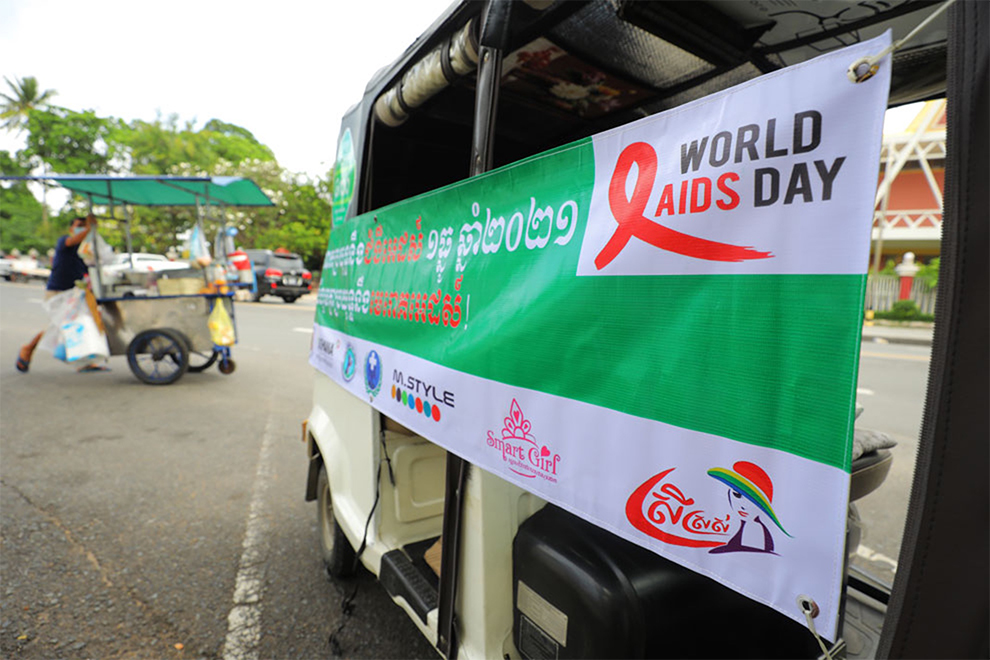
Prime Minister Hun Manet has called for a stronger nationwide push to identify and support the estimated 4,000 people living with HIV who still do not know their status, warning that failure to reach them could slow Cambodia’s progress toward achieving the global 95-95-95 targets and ending AIDS as a public health threat.
In a message marking World AIDS Day on Monday, the prime minister said that despite the country’s progress, “we must all work harder” to ensure early testing, rapid treatment and continued care for those who have not yet entered the health system.
The 4,000 people with unknown HIV status remain one of the largest remaining gaps in the country’s response.
“Overcoming disruptions in the AIDS response requires action that is more effective and more focused,” Manet said, as part of the “Overcoming disruption, transforming the AIDS response” campaign.
He stressed that efforts must be intensified among key populations and young people, who remain at higher risk of infection.
He urged ministries, local authorities and community groups to ensure that those who come forward for testing can access treatment on the same day, “without discrimination”.
Cambodia has made significant progress in recent years. As of 2024, the government estimates around 76,000 people are living with HIV.
Of them, 71,716 know their status and are receiving antiretroviral therapy through a public health system that has achieved 100 per cent coverage — the highest in the Asia-Pacific region.
New infections fell from 1,500 in 2023 to 1,200 in 2024, while annual deaths declined from 1,100 to 1,000.
Manet described these achievements as demonstrating the strength of Cambodia’s national response, supported by the National Policy for Ending AIDS and the Sustainability of HIV Programme for 2023-2028.
The policy adopts a “One System of Actors” approach, integrating ministries, local governments, health facilities and development partners into a unified framework aimed at ending AIDS by 2030.
He warned, however, that real progress depends on reaching those who have not yet been diagnosed and reducing the number of people who drop out of treatment.
He also urged renewed focus on eliminating mother-to-child transmission, an area where national strategies have shown strong results.
The prime minister emphasised that Cambodia’s efforts must continue in close collaboration with communities, civil society and key population groups, including men who have sex with men, transgender people, sex workers, drug users and young people.
Prevention tools such as condoms, PrEP, PEP and accessible testing services must be expanded, he said.
Manet also highlighted the need to remove stigma and discrimination, calling them persistent barriers that continue to deter people from seeking care.
He urged authorities at all levels — from ministries to communes — to take a leading role in promoting safe-sex awareness and strengthening support systems for vulnerable groups.
The prime minister explained that achieving the 95-95-95 targets requires a fully inclusive approach: ensuring that 95 per cent of people living with HIV know their status, 95 per cent of those diagnosed are on treatment, and 95 per cent of those on treatment achieve viral suppression.
As part of the social protection effort, he noted that 53,821 people living with HIV — 75 per cent of active patients — have received health equity cards since 2022, along with 15,454 key populations in early 2025.
While acknowledging the country’s progress, Manet said sustained international support remains essential, particularly as donor funding continues to decline.
He urged global partners to help close the remaining financial and technical gaps to protect the gains achieved so far.
“Our achievements are the result of collective effort,” he said, expressing gratitude to health workers, authorities, civil society, development partners and communities.
“We must continue to work together to reach every person and to end AIDS as a public health problem in Cambodia,” he added.