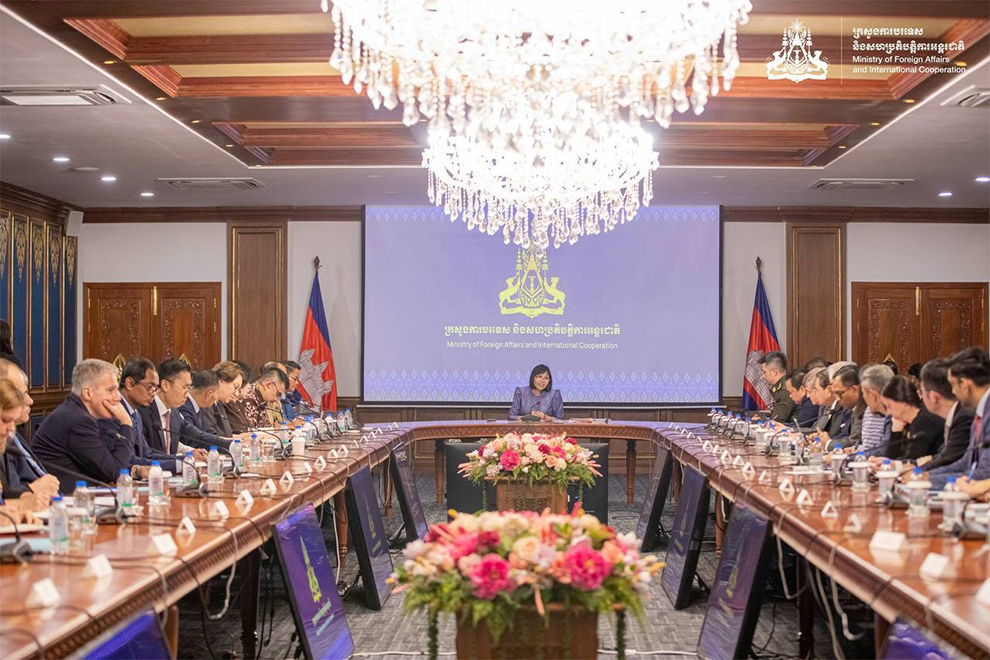
On November 25, Cambodian officials briefed diplomats on the findings of a preliminary investigation into the November 12 shooting of Cambodian villagers by Thai armed forces in Banteay Meanchey province, concluding that the incident was “unprovoked” and occurred entirely inside Cambodian territory.
At the meeting, chaired by permanent secretary of state for foreign affairs Eat Sophea, officials detailed how one Cambodian civilian was killed and three others were injured when Thai soldiers opened fire on Prey Chan village, O Bei Chorn commune, O Chrov district.
The incident took place in broad daylight, and investigators found no evidence that Cambodian armed forces discharged any weapons before or after the Thai unit opened fire.
“There were no shots fired by the Cambodian armed forces, either before or after Thai forces opened fire into the village,” according to the Ministry of Foreign Affairs and International Cooperation.
“The findings are from an on-site investigation at Prey Chan Village, conducted by the Cambodian National Police on the morning of November 13, with the participation of the ASEAN Observation Team (AOT),” it added.
Sophea told diplomats that Cambodia “remains fully committed” to the 28 July ceasefire and the Kuala Lumpur Joint Declaration, adopted on 26 October.
She said Phnom Penh has acted in good faith to maintain calm along the border despite the seriousness of the November incidents.
Sophea also rejected Thai claims that Cambodia planted new landmines — an allegation Bangkok cited when it announced the suspension of its obligations under the Kuala Lumpur agreement.
She insisted that a November 10 landmine explosion that injured Thai soldiers occurred inside Cambodian territory, in a contaminated zone officially mapped by the Franco-Siamese Mixed Commission.
That map — recognised and relied upon by the International Court of Justice (ICJ) in its 1962 judgment and reaffirmed in 2013 — places the blast site well on the Cambodian side of the border.
“Cambodia deeply regrets Thailand’s decision to suspend the implementation of the Joint Declaration,” Sophea said, noting that the explosion was due to Thai troops entering a known hazardous area rather than any new activity by Cambodian forces.